Mupakati Tambudzai, Tanyanyiwa Vincent I
United Nations Development Programme, Strengthening National Capacity for Climate Change Programme, Ministry of Environment, Water and Climate, Zimbabwe.
Department of Geography and Environmental Studies, Zimbabwe Open University, Zimbabwe.
Jamba. 2017 Apr 25;9(1):348. doi: 10.4102/jamba.v9i1.348. eCollection 2017.
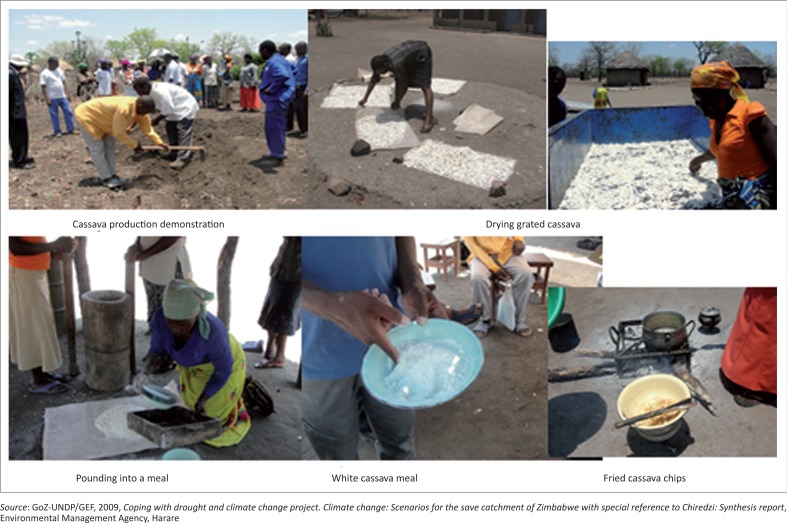
This study sought to pilot a range of long-term adaptation measures in the agriculture sector because of climate change shocks. Past droughts in Zimbabwe have had devastating environmental and socio-economic impacts in rural areas where livelihoods mainly depend on agriculture. Over the past few years, many parts of Zimbabwe have been experiencing extreme events. The study sought to address the following objectives to describe smallholder farmers' knowledge of climate change variability and change in Chilonga Ward and to explore the potential of cassava production as a climate change adaptation strategy in Chiredzi. An assessment of the impact of cassava production on rural livelihoods as a climate change adaptation strategy was also done. Focus group discussions, in-depth interviews, desk research and observation were the tools used to collect data. The results show that cassava has an extensive root system that can penetrate poor soils which may not support crops like maize. Zimbabwe has to increase cassava production as its tubers can be value added to produce a range of products that include livestock feed and porridge.
由于气候变化冲击,本研究旨在试点一系列农业部门的长期适应措施。津巴布韦过去的干旱对农村地区造成了毁灭性的环境和社会经济影响,这些地区的生计主要依赖农业。在过去几年里,津巴布韦许多地区一直在经历极端事件。该研究旨在实现以下目标:描述奇隆加村小农户对气候变化变异性和变化的了解,并探索木薯生产作为奇雷兹气候变化适应战略的潜力。还对木薯生产作为气候变化适应战略对农村生计的影响进行了评估。焦点小组讨论、深入访谈、案头研究和观察是用于收集数据的工具。结果表明,木薯有广泛的根系,可以穿透贫瘠的土壤,而这种土壤可能无法支撑玉米等作物。津巴布韦必须增加木薯产量,因为其块茎可以增值生产一系列产品,包括牲畜饲料和粥。