Ekeleme Friday, Dixon Alfred, Atser Godwin, Hauser Stefan, Chikoye David, Korie Sam, Olojede Adeyemi, Agada Mary, Olorunmaiye Patience M
International Institute of Tropical Agriculture, PMB 5320, Ibadan, Oyo State, Nigeria.
National Root Crops Research Institute, PMB 7006, Umuahia, Abia State, Nigeria.
Crop Prot. 2021 Dec;150:105810. doi: 10.1016/j.cropro.2021.105810.
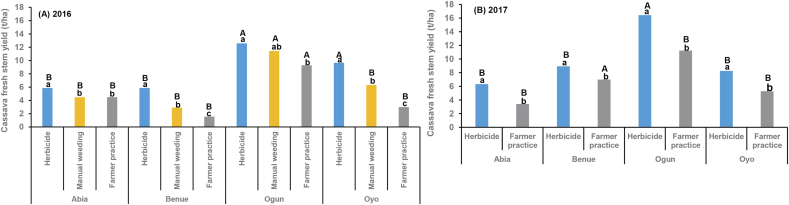
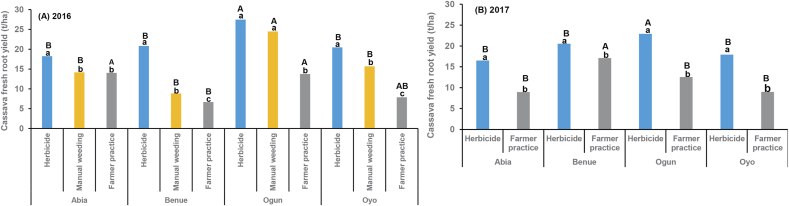
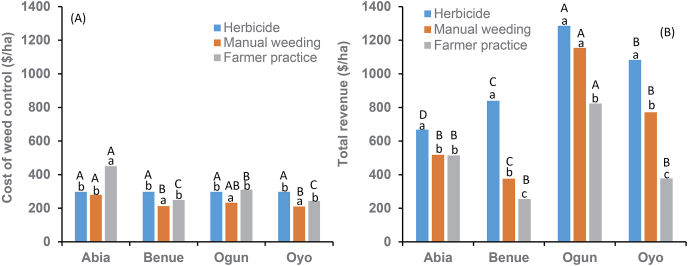
Weed competition is the major biological stress affecting cassava production in smallholder farms in West and Central Africa, where yields are low compared with those in Asia and Latin America. Options for improved weed management are crucial in increasing productivity. Selected pre- and post-emergence herbicides, integrated with appropriate tillage and plant spacing, were tested in 96 sites in four locations in Nigeria, 24 in 2016 and 72 in 2017. Trials were split plots with six pre-emergence herbicides and no post-emergence treatment as main plots. Subplot treatments were four post-emergence herbicides, weeding with a motorized rotary weeder, short- and long-handled hoes, and no post-emergence weed control, i.e., regardless of pre-emergence treatments. Indaziflam-based treatments, irrespective of post-emergence treatment, and flumioxazin + pyroxasulfone applied pre-emergence followed by one weeding with a long-handled hoe provided >80% control of major broadleaf and grass weeds. Compared with herbicide use, farmer control practices (53%) were not efficient in controlling weeds. The highest root yield was produced where (1) s-metolachlor was combined with atrazine, and one weeding with a long-handled hoe or clethodim with lactofen, and (2) indaziflam + isoxaflutole was combined with glyphosate. An increase in root yield from 3.41 to 14.2 t ha- and from 3.0 to 11.99 t ha- was obtained where herbicides were used compared with farmers' practice and manual hoe weeding. Our results showed that integrating good agronomic practices with safe and effective use of appropriate herbicides can result in root yield >20 t ha i.e., twice the national average root yield of 8-12 t ha, with >50% net profit. The use of appropriate herbicides can reduce the amount of manual labor required and improve livelihoods, specifically for women and children. Smallholder cassava farmers would require continuous training on the safe use and handling of herbicides to improve efficiency and prevent adverse effects on humans and the environment.
杂草竞争是影响西非和中非小农户木薯生产的主要生物胁迫因素,与亚洲和拉丁美洲相比,这些地区的产量较低。改进杂草管理的方法对于提高生产力至关重要。在尼日利亚四个地点的96个试验点对选定的芽前和芽后除草剂,并结合适当的耕作和种植间距进行了测试,2016年有24个试验点,2017年有72个试验点。试验采用裂区设计,六个芽前除草剂处理且无芽后处理作为主区。副区处理为四种芽后除草剂、使用机动旋耕除草机除草、使用长短柄锄头除草以及不进行芽后杂草控制,即无论芽前处理如何。基于茚嗪氟草胺的处理,无论芽后处理如何,以及芽前施用氟嘧磺隆+唑吡嘧磺隆随后用长柄锄头除草一次,可对主要阔叶杂草和禾本科杂草实现>80%的防除效果。与使用除草剂相比,农民的除草措施(53%)在控制杂草方面效率不高。最高根产量出现在以下情况:(1)异丙甲草胺与莠去津混用,并使用长柄锄头或烯草酮与乳氟禾草灵进行一次除草,以及(2)茚嗪氟草胺+异恶唑草酮与草甘膦混用。与农民的除草方法和手工锄头除草相比,使用除草剂使根产量分别从3.41吨/公顷提高到14.2吨/公顷以及从3.0吨/公顷提高到11.99吨/公顷。我们的结果表明,将良好的农艺措施与安全有效地使用适当除草剂相结合,可使根产量>20吨/公顷,即全国平均根产量8 - 12吨/公顷的两倍,净利润>50%。使用适当的除草剂可以减少所需的体力劳动量并改善生计,特别是对妇女和儿童而言。小农户木薯种植者需要接受关于除草剂安全使用和处理的持续培训,以提高效率并防止对人类和环境产生不利影响。