Suo Ya, Zhang Zhiwei, Fu Huaying, Zhang Yue, Yuan Meng, Wang Yuanyuan, Goudis Christos A, Tse Gary, Liu Tong, Li Guangping
1 Tianjin Key Laboratory of Ionic-Molecular Function of Cardiovascular Disease, Department of Cardiology, Tianjin Institute of Cardiology, Second Hospital of Tianjin Medical University, People's Republic of China.
2 Department of Cardiology, General Hospital of Serres, Greece.
J Renin Angiotensin Aldosterone Syst. 2018 Apr-Jun;19(2):1470320318782623. doi: 10.1177/1470320318782623.
We examined whether the use of a renin-angiotensin-aldosterone system (RAS) inhibitor plays a role in protecting against left atrial appendage thrombus (LAAT) in patients with hypertension complicated by atrial fibrillation (AF).
Two observational studies were conducted on patients with diagnoses of hypertension and AF, who were categorized into RAS inhibitor user or nonuser groups. Demographic characteristics, clinical characteristics, echocardiographic parameters and hemostatic markers were examined and the occurrence of LAAT during follow-up were recorded.
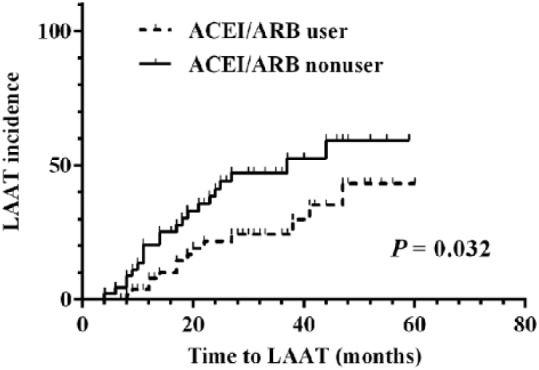
In the first study ( n = 131), LA peak systolic strain and LAA emptying flow velocity (LAA eV) were significantly increased in patients on RAS inhibitors compared with the nonuser group ( p < 0.05). Lower D-dimer and fibrinogen levels were observed in patients on RAS inhibitors ( p < 0.05). In the second study ( n = 99), 25.9% ( n = 11) of patients on RAS inhibitors developed LAAT, compared with 46.7% ( n = 21) in the nonuser group ( p < 0.05). After controlling for risk factors related to LAAT, use of RAS inhibitors remained associated with a significantly lower risk of developing LAAT (HR, 0.406; 95% CI, 0.191-0.862; p = 0.019).
RAS inhibitors use was associated with a significant reduction in the risk of LAAT in patients with hypertension and AF.
我们研究了肾素-血管紧张素-醛固酮系统(RAS)抑制剂的使用在预防高血压合并心房颤动(AF)患者左心耳血栓(LAAT)方面是否发挥作用。
对诊断为高血压和AF的患者进行了两项观察性研究,这些患者被分为RAS抑制剂使用者组和非使用者组。检查了人口统计学特征、临床特征、超声心动图参数和止血标志物,并记录了随访期间LAAT的发生情况。
在第一项研究(n = 131)中,与非使用者组相比,使用RAS抑制剂的患者左心房峰值收缩应变和左心耳排空流速(LAA eV)显著增加(p < 0.05)。在使用RAS抑制剂的患者中观察到较低的D-二聚体和纤维蛋白原水平(p < 0.05)。在第二项研究(n = 99)中,使用RAS抑制剂的患者中有25.9%(n = 11)发生了LAAT,而非使用者组为46.7%(n = 21)(p < 0.05)。在控制了与LAAT相关的危险因素后,使用RAS抑制剂仍与发生LAAT的风险显著降低相关(HR,0.406;95%CI,0.191 - 0.862;p = 0.019)。
使用RAS抑制剂与高血压合并AF患者LAAT风险的显著降低相关。