Population Studies Center, University of Pennsylvania, Philadelphia, Pennsylvania, United States of America.
French Institute for Demographic Studies (INED), Paris, France.
PLoS One. 2018 Jun 29;13(6):e0199669. doi: 10.1371/journal.pone.0199669. eCollection 2018.
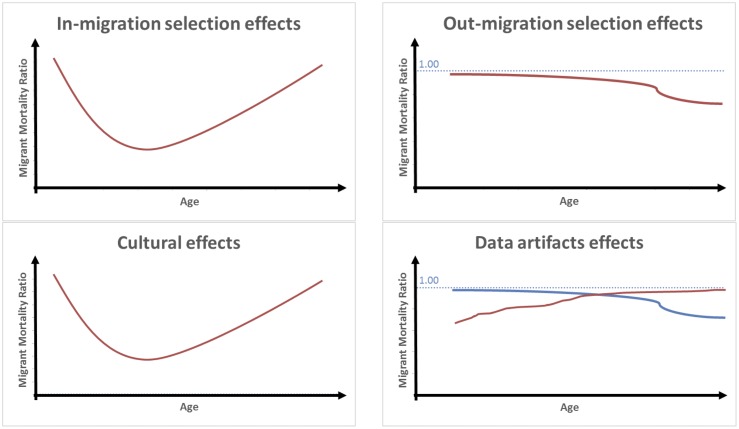
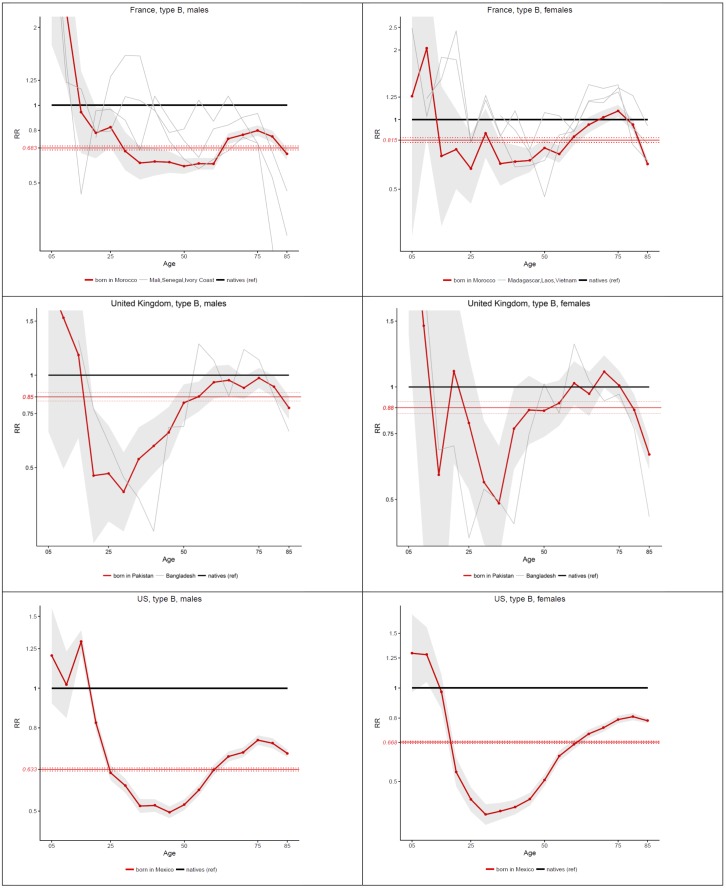
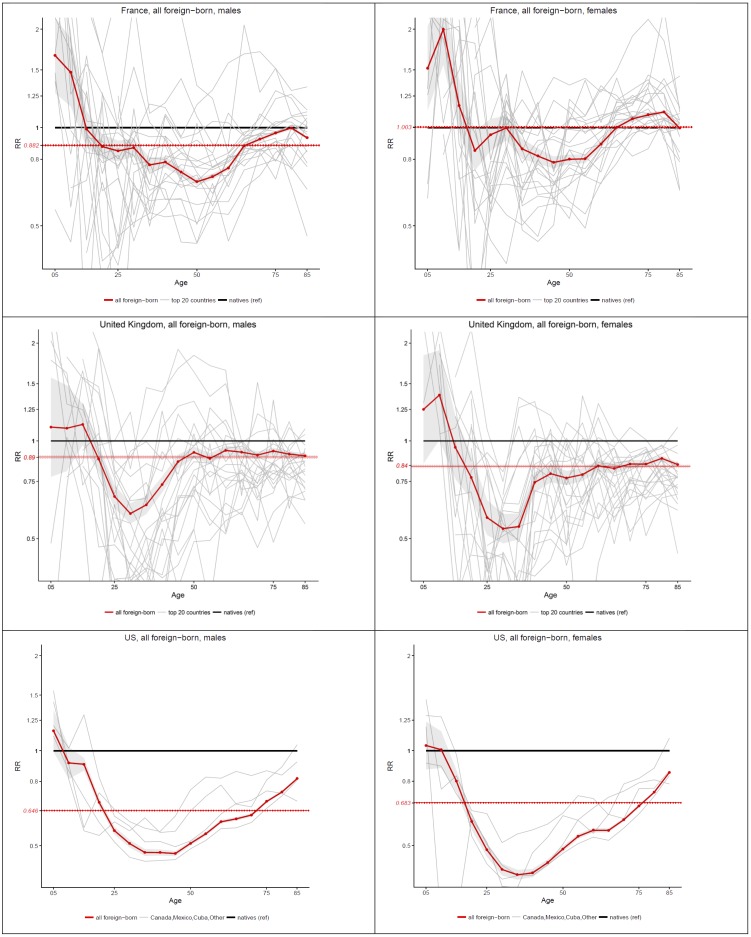
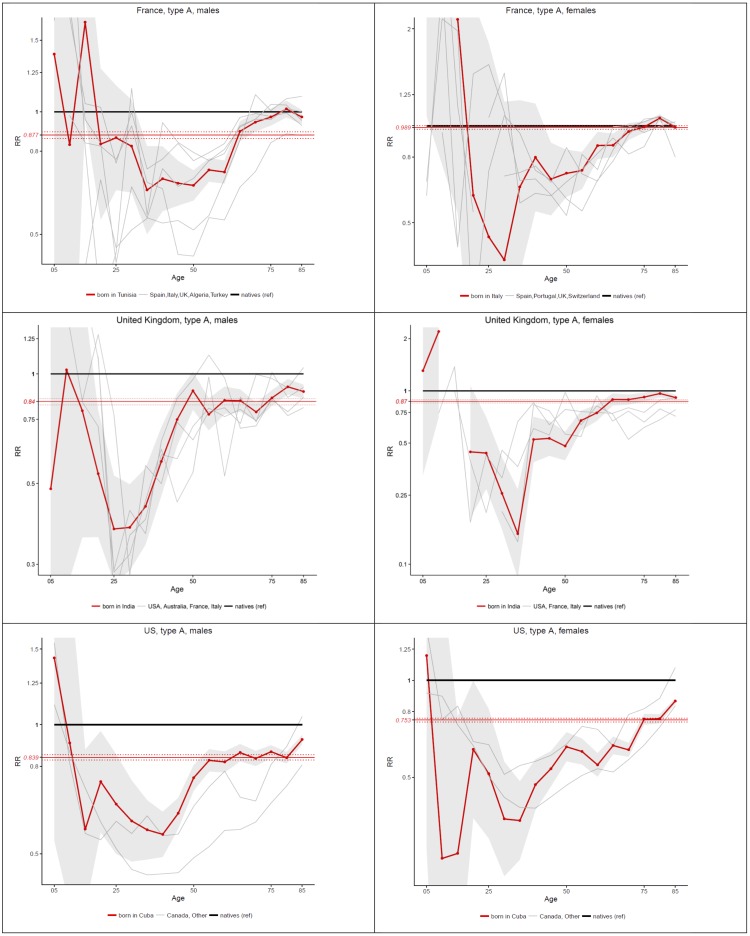
This paper investigates age variations in foreign-born vs. native-born mortality ratios in an international comparative perspective, with the purpose of gaining insight into the mechanisms underlying the so-called migrant mortality advantage. We examine the four main explanations that have been proposed in the literature for the migrant mortality advantage (i.e., in-migration selection effects, out-migration selection effects, cultural effects, and data artifacts), and formulate expectations as to whether they should generate an increase, a decrease, or no change in relative mortality over the life course. Using data from France, the US and the UK for periods around 2010, we then examine typical age patterns of foreign-born vs. native-born mortality ratios in light of this theoretical framework. We find that these mortality ratios vary greatly by age, with important similarities across migrant groups and host countries. The most systematic age pattern we find is a U-shape pattern: at the aggregate level, migrants often experience excess mortality at young ages, then exhibit a large advantage at adult ages (with the largest advantage around age 45), and finally experience mortality convergence with natives at older ages. The explanation most consistent with this pattern is the "in-migration selection effects" explanation. By contrast, the "out-migration selection effects" explanation is poorly supported by the observed patterns. Our age disaggregation also shows that migrants at mid-adult ages experience mortality advantages that are often far greater than typically documented in this literature. Overall, these results reinforce the notion that migrants are a highly-selected population exhibiting mortality patterns that poorly reflect their living conditions in host countries.
本文从国际比较的角度研究了出生在国外的人与出生在本国的人之间的死亡率差异随年龄的变化,旨在深入了解所谓的移民死亡率优势的背后机制。我们考察了文献中提出的移民死亡率优势的四个主要解释(即入境移民选择效应、出境移民选择效应、文化效应和数据假象),并就它们是否应该在整个生命历程中导致相对死亡率增加、减少或不变提出了预期。然后,我们利用法国、美国和英国在 2010 年前后的数据,根据这一理论框架检验了出生在国外的人与出生在本国的人之间的典型死亡率年龄模式。我们发现,这些死亡率比率随年龄变化很大,移民群体和东道国之间存在重要的相似之处。我们发现的最系统的年龄模式是 U 型模式:在总体水平上,移民在年轻时通常经历超额死亡率,然后在成年时表现出很大的优势(最大优势在 45 岁左右),最后在老年时与本地人死亡率趋同。与这种模式最一致的解释是“入境移民选择效应”解释。相比之下,观察到的模式对“出境移民选择效应”解释的支持度较差。我们的年龄细分还表明,中年移民经历的死亡率优势往往远远大于该文献中通常记录的优势。总的来说,这些结果强化了这样一种观点,即移民是一个高度选择的群体,其死亡率模式与他们在东道国的生活条件很差地反映。