Center of Research on Psychology in Somatic Diseases (CoRPS), Department of Medical and Clinical Psychology, Tilburg University, Tilburg, The Netherlands.
Department of Obstetrics and Gynecology, Gynecologic Cancer Center South, Elisabeth-TweeSteden Hospital, Tilburg, The Netherlands.
Support Care Cancer. 2019 Feb;27(2):423-431. doi: 10.1007/s00520-018-4327-6. Epub 2018 Jun 29.
It is unknown whether positive psychological changes (e.g., in life perspective, self-perception, and social relationships) after being diagnosed with ovarian cancer can reduce anxiety and depression in patients and their partners. The first aim of the present study was to assess differences in anxiety and depression between patients diagnosed with an ovarian tumor and their partners. The second aim was to explore the mutual associations of patients' and partners' posttraumatic growth and their anxiety and depressive symptoms.
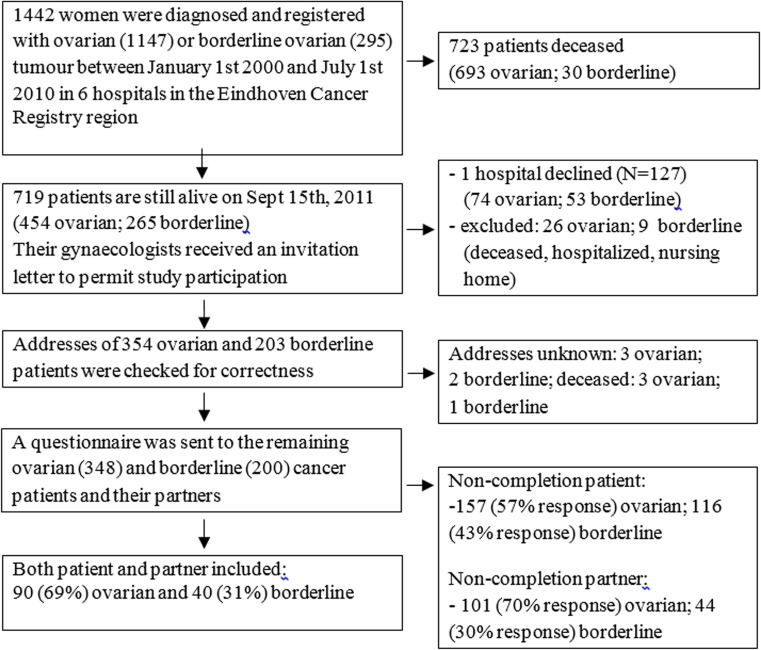
Participants included 130 Dutch couples of which one partner was diagnosed with a borderline ovarian tumor or ovarian cancer between 2000 and 2010, as registered by the Netherlands Cancer Registry. In September 2011, a questionnaire was sent including the Hospital Anxiety and Depression Scale (anxiety and depression) and Cancer Survivors (Partners) Unmet Needs measure (positive psychological changes).
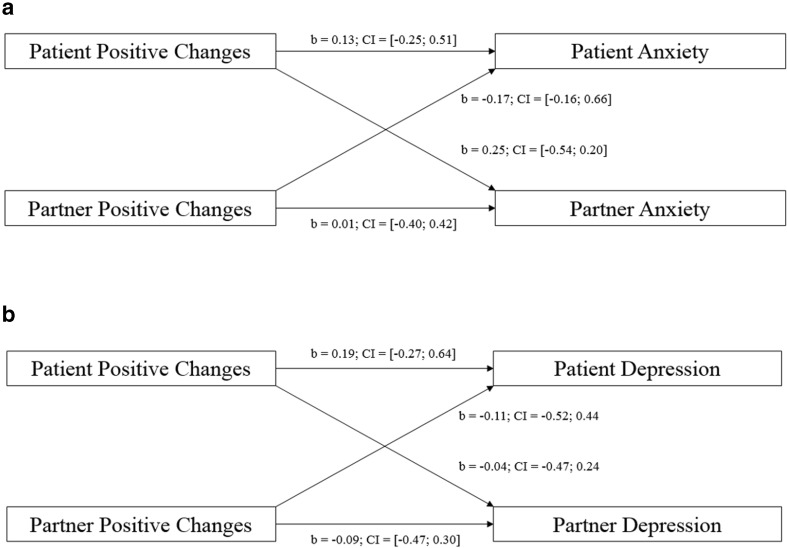
A one-way multivariate analysis of variance showed that patients reported higher anxiety than partners, without differences in depression. Contrasting to our expectations, an actor-partner interdependence model revealed no mutual dyadic associations between positive psychological changes and anxiety or depressive symptoms.
Based on these findings, positive psychological change seems to be an independent construct unrelated to anxiety or depression in couples diagnosed with ovarian tumors. Still, as ovarian tumor patients and partners suffer from high anxiety and depression, further research investigating how these feelings can be reduced in couples dealing with an ovarian tumor is necessary.
目前尚不清楚卵巢癌患者确诊后积极的心理变化(如生活观、自我认知和社会关系的变化)是否可以减轻患者及其伴侣的焦虑和抑郁。本研究的主要目的之一是评估卵巢肿瘤患者及其伴侣之间的焦虑和抑郁差异。第二个目的是探讨患者和伴侣创伤后成长之间的相互关联及其焦虑和抑郁症状。
研究对象包括 130 对荷兰夫妇,其中一方在 2000 年至 2010 年间被诊断出患有交界性卵巢肿瘤或卵巢癌,这些病例均被荷兰癌症登记处记录在案。2011 年 9 月,向参与者发送了一份问卷,其中包括医院焦虑和抑郁量表(焦虑和抑郁)以及癌症幸存者(伴侣)未满足需求量表(积极的心理变化)。
单变量方差分析显示,患者的焦虑程度高于伴侣,但抑郁程度无差异。与我们的预期相反,主体间相互依存模型显示,积极的心理变化与焦虑或抑郁症状之间没有相互的二元关联。
根据这些发现,积极的心理变化似乎是一个独立的结构,与卵巢肿瘤患者及其伴侣的焦虑或抑郁无关。尽管如此,由于卵巢肿瘤患者及其伴侣都存在较高的焦虑和抑郁,因此仍有必要进一步研究如何减轻这些夫妇在应对卵巢肿瘤时的这些感受。