Department of Clinical Psychology, Van der Boechorststraat 1, Vrije Universiteit Amsterdam, Amsterdam Public Health (APH), Amsterdam, The Netherlands.
Cancer Center Amsterdam (CCA), Amsterdam Public Health (APH), Amsterdam, The Netherlands.
Support Care Cancer. 2019 Feb;27(2):443-450. doi: 10.1007/s00520-018-4325-8. Epub 2018 Jun 29.
Positive mental health involves theoretical constructs like psychological well-being, personal meaning, and posttraumatic growth. This study aims to provide empirical insight into possible overlap between these constructs in cancer survivors.
Within the context of a randomized controlled trial, 170 cancer survivors completed the patient-reported outcome measures (PROMs) Ryff's Scales of Psychological Well-Being (SPWB), Personal Meaning Profile (PMP), and Posttraumatic Growth Inventory (PTGI). Exploratory factor analysis (EFA) on the subscales of these PROMs, as well as structural equation modeling (SEM), was used to explore overlap in these three constructs.
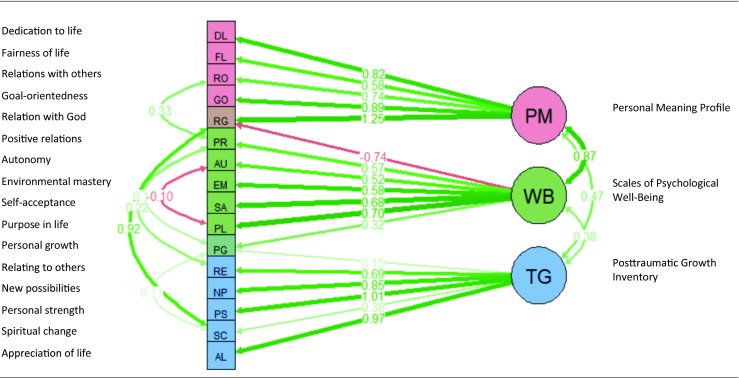
The EFA resulted in a three-factor solution with an insufficient model fit. SEM led to a model with a high estimated correlation (0.87) between SPWB and PMP and lower estimated correlations with PTGI (respectively 0.38 and 0.47). Furthermore, the estimated correlation between the subscales relation with God (PMP) and spiritual change (PTGI) was high (0.92). This model had adequate fit indices (χ(93) = 144, p = .001, RMSEA = 0.059, CFI = 0.965, TLI = 0.955, SRMR = 0.061).
The constructs psychological well-being and personal meaning overlap to a large extent in cancer survivors. Posttraumatic growth can be seen as a separate construct, as well as religiosity. These findings facilitate researchers to select the appropriate PROM(s) when testing the effect of a psychosocial intervention on positive mental health in cancer survivors.
An increasing number of psychosocial intervention trials for cancer survivors use positive mental health outcomes. These constructs are often multifaceted and overlapping. Knowledge of this overlap is important in designing trials, in order to avoid the pitfalls of multiple testing and finding artificially strengthened associations.
NTR3571.
积极的心理健康涉及到心理幸福感、个人意义和创伤后成长等理论概念。本研究旨在为癌症幸存者中这些结构的可能重叠提供实证见解。
在一项随机对照试验的背景下,170 名癌症幸存者完成了患者报告的结果测量(PROM)Ryff 的心理幸福感量表(SPWB)、个人意义量表(PMP)和创伤后成长量表(PTGI)。这些 PROM 的子量表进行探索性因素分析(EFA),以及结构方程模型(SEM),用于探讨这三个结构的重叠。
EFA 得出了一个三因素解决方案,模型拟合度不足。SEM 导致 SPWB 和 PMP 之间的估计相关性很高(0.87),而与 PTGI 的估计相关性较低(分别为 0.38 和 0.47)。此外,与上帝(PMP)和精神变化(PTGI)相关的子量表关系的估计相关性很高(0.92)。该模型具有适当的拟合指数(χ²(93)=144,p=0.001,RMSEA=0.059,CFI=0.965,TLI=0.955,SRMR=0.061)。
在癌症幸存者中,心理幸福感和个人意义这两个结构在很大程度上重叠。创伤后成长可以被视为一个单独的结构,以及宗教信仰。这些发现有助于研究人员在测试心理社会干预对癌症幸存者积极心理健康的影响时,选择适当的 PROM。
越来越多的癌症幸存者使用积极心理健康结果的心理社会干预试验。这些结构通常是多方面和重叠的。了解这种重叠对于设计试验非常重要,以避免多次测试的陷阱,并发现人为强化的关联。
NTR3571。