Gede Noémi, Reményi Kiss Diána, Kiss István
Institute for Translational Medicine, Medical School, and Doctoral School of Health Sciences, Faculty of Health Sciences, University of Pécs, Szigeti út 12, Pécs, 7624, Hungary.
Doctoral School of Health Sciences, University of Pécs, Pécs, Hungary.
BMC Fam Pract. 2018 Jun 30;19(1):106. doi: 10.1186/s12875-018-0799-1.
This study aims to survey the level of awareness of colorectal cancer and screening and to identify sources of information among the population under investigation.
A cross-sectional study was conducted among 1150 adults between the ages of 40 and 70 using quota sampling. Data were collected through self-made questionnaires to be completed by respondents.
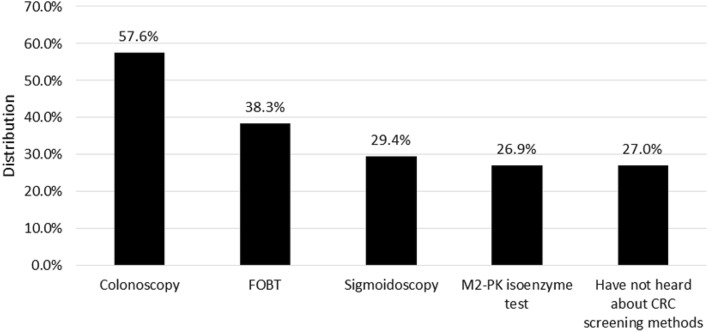
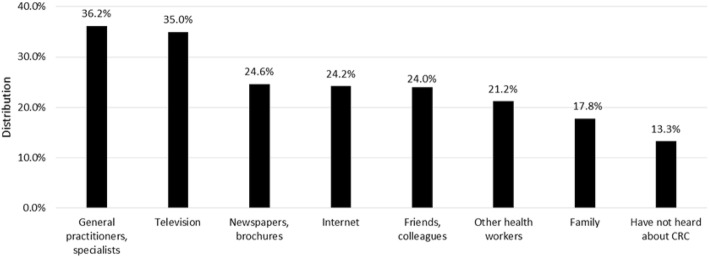
32.7% of the participants correctly identified the recommended beginning of colorectal cancer screening, these participants were more likely to see their physician more frequently in the past years than those answering to the qusetion incorrectly (p = 0.008). 22.4% of the respondents were in possession of appropriate information on the frequency of colorectal cancer screening and had a relatively high level of educational attainment (p < 0.001). Very few respondents were well-informed about the risk factors and symptoms of colorectal cancer. Those who were well-informed were likely to live in a county town (p < 0.001) and to have a relatively high level of educational attainment (p < 0.001). They were most likely to have accessed their information on the internet. 27.0% of respondents had not heard of CRC screening methods before. They were likely to be male and relatively young and to have a relatively low level of educational attainment. Furthermore, they saw their doctor relatively seldom. The respondents who had heard about screening methods were most likely to have gathered their information from health workers.
The majority of respondents did not have sufficient information about colorectal cancer and screening. This is particularly true of less educated, younger male participants who do not live in a county town and of respondents who see their physician relatively seldom. Sources of information should be used more effectively, thus yielding an increased level of awareness.
本研究旨在调查结直肠癌及筛查的知晓水平,并确定被调查人群的信息来源。
采用配额抽样法,对1150名40至70岁的成年人进行横断面研究。通过自制问卷收集数据,由受访者填写。
32.7%的参与者正确识别了结直肠癌筛查的推荐起始年龄,与回答错误的参与者相比,这些参与者在过去几年更频繁地看医生(p = 0.008)。22.4%的受访者掌握了结直肠癌筛查频率的适当信息,且教育程度相对较高(p < 0.001)。很少有受访者对结直肠癌的危险因素和症状有充分了解。了解充分的受访者可能居住在县城(p < 0.001)且教育程度相对较高(p < 0.001)。他们最有可能通过互联网获取信息。27.0%的受访者此前从未听说过结直肠癌筛查方法。他们可能是男性且相对年轻,教育程度较低。此外,他们看医生相对较少。听说过筛查方法的受访者最有可能从医护人员那里获取信息。
大多数受访者对结直肠癌及筛查的信息不足。对于居住不在县城、教育程度较低、相对年轻的男性参与者以及看医生相对较少的受访者而言尤其如此。应更有效地利用信息来源,从而提高知晓水平。