Institut National de la Santé et de la Recherche Médicale, U1213, Lyon, F-69008, France; Université de Lyon, Lyon, F-69008, France; Université Lyon1, Villeurbanne, F-69622, France.
Institut National de la Santé et de la Recherche Médicale, U1213, Lyon, F-69008, France; Université de Lyon, Lyon, F-69008, France; Université Lyon1, Villeurbanne, F-69622, France.
Mol Metab. 2018 Oct;16:203-212. doi: 10.1016/j.molmet.2018.06.010. Epub 2018 Jun 18.
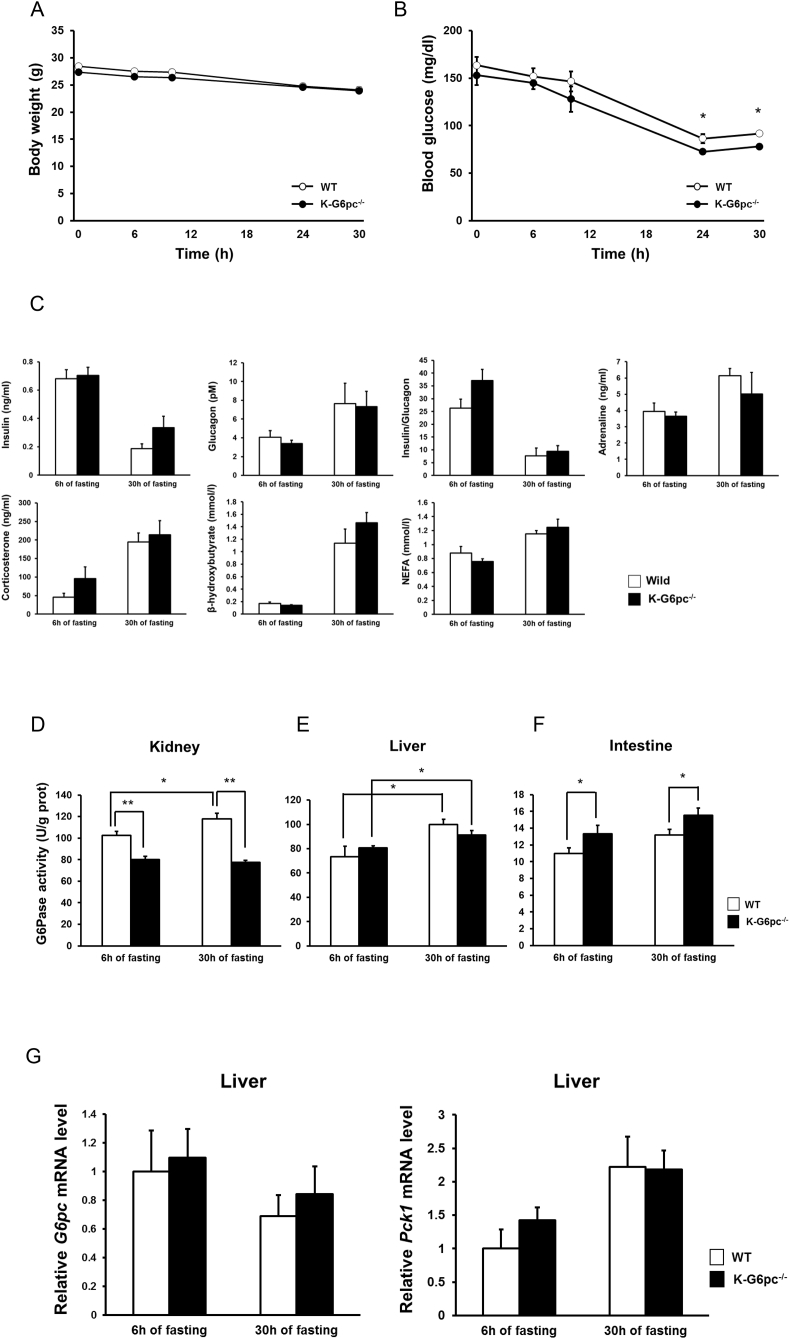
The respective contributions to endogenous glucose production (EGP) of the liver, kidney and intestine vary during fasting. We previously reported that the deficiency in either hepatic or intestinal gluconeogenesis modulates the repartition of EGP via glucagon secretion (humoral factor) and gut-brain-liver axis (neural factor), respectively. Considering renal gluconeogenesis reportedly accounted for approximately 50% of EGP during fasting, we examined whether a reduction in renal gluconeogenesis could promote alterations in the repartition of EGP in this situation.
We studied mice whose glucose-6-phosphatase (G6Pase) catalytic subunit (G6PC) is specifically knocked down in the kidneys (K-G6pc mice) during fasting. We also examined the additional effects of intestinal G6pc deletion, renal denervation and vitamin D administration on the altered glucose metabolism in K-G6pc mice.
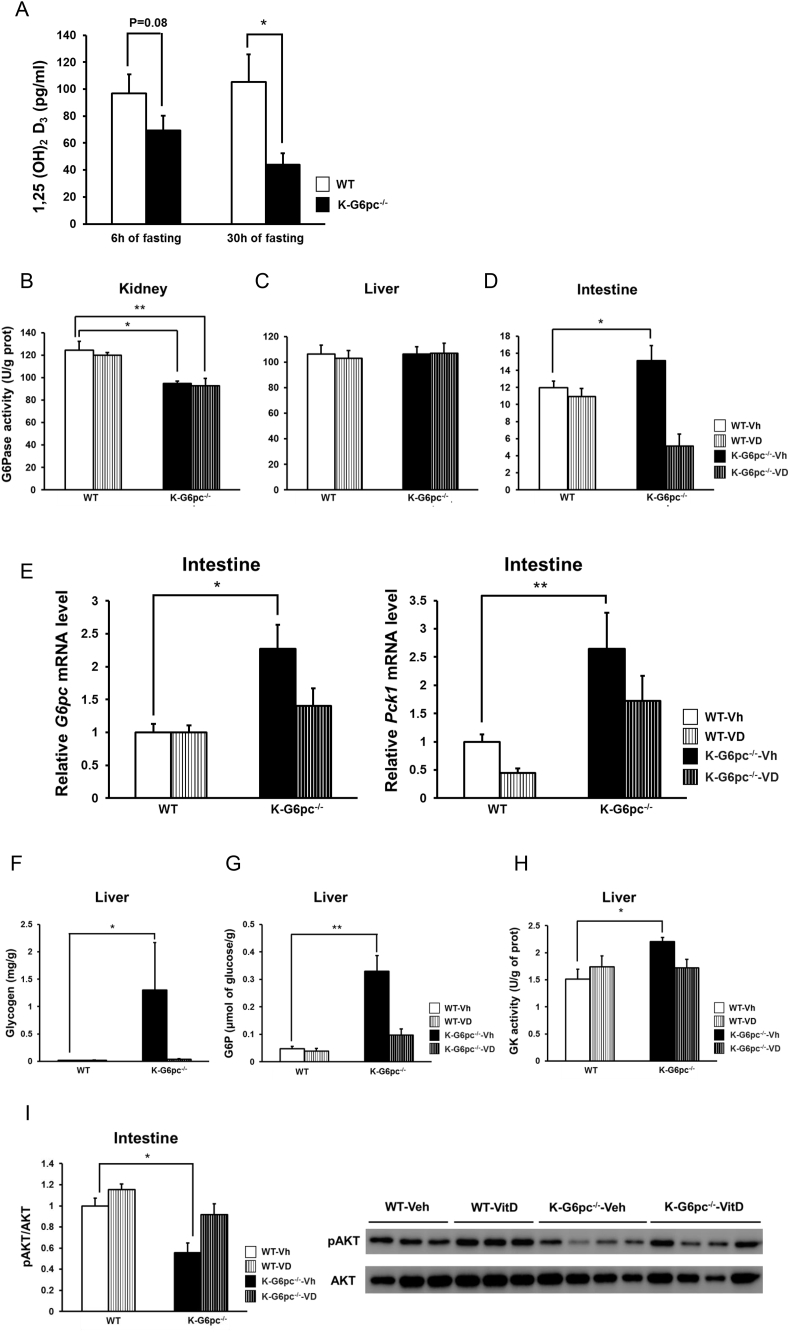
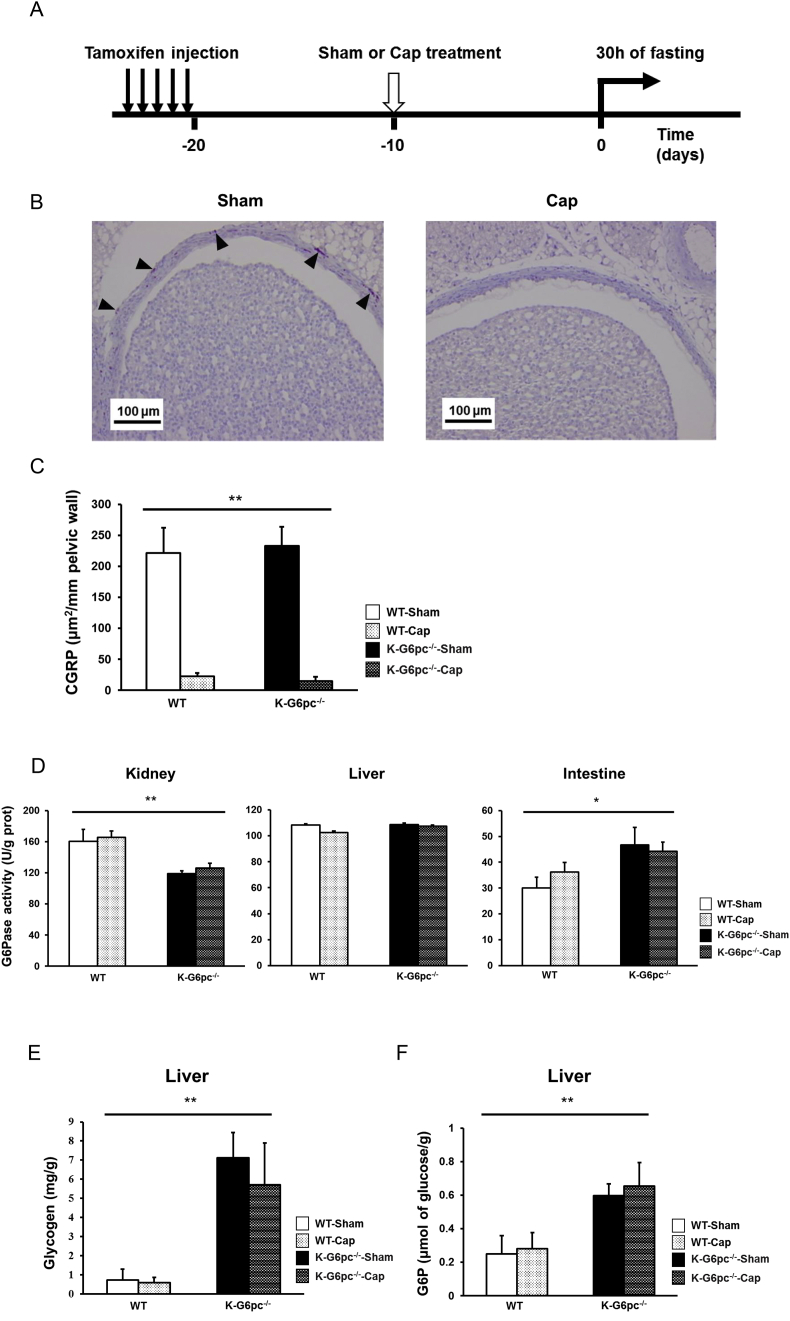
Compared with WT mice, K-G6pc mice exhibited (1) lower glycemia, (2) enhanced intestinal but not hepatic G6Pase activity, (3) enhanced hepatic glucokinase (GK encoded by Gck) activity, (4) increased hepatic glucose-6-phosphate and (5) hepatic glycogen spared from exhaustion during fasting. Increased hepatic Gck expression in the post-absorptive state could be dependent on the enhancement of insulin signal (AKT phosphorylation) in K-G6pc mice. In contrast, the increase in hepatic GK activity was not observed in mice with both kidney- and intestine-knockout (KI-G6pc mice). Hepatic Gck gene expression and hepatic AKT phosphorylation were reduced in KI-G6pc mice. Renal denervation by capsaicin did not induce any effect on glucose metabolism in K-G6pc mice. Plasma level of 1,25 (OH) D, an active form of vitamin D, was decreased in K-G6pc mice. Interestingly, the administration of 1,25 (OH) D prevented the enhancement of intestinal gluconeogenesis and hepatic GK activity and blocked the accumulation of hepatic glycogen otherwise observed in K-G6pc mice during fasting.
A diminution in renal gluconeogenesis that is accompanied by a decrease in blood vitamin D promotes a novel repartition of EGP among glucose producing organs during fasting, featured by increased intestinal gluconeogenesis that leads to sparing glycogen stores in the liver. Our data suggest a possible involvement of a crosstalk between the kidneys and intestine (via the vitamin D system) and the intestine and liver (via a neural gut-brain axis), which might take place in the situations of deficient renal glucose production, such as chronic kidney disease.
在禁食期间,肝脏、肾脏和肠道对内源性葡萄糖生成(EGP)的贡献各不相同。我们之前的研究报告表明,肝或肠糖异生的缺陷分别通过胰高血糖素分泌(体液因子)和肠-脑-肝轴(神经因子)来调节 EGP 的分配。考虑到肾脏糖异生在禁食期间约占 EGP 的 50%,我们研究了减少肾脏糖异生是否会促进这种情况下 EGP 分配的改变。
我们研究了在禁食期间肾脏中葡萄糖-6-磷酸酶(G6Pase)催化亚基(G6PC)特异性敲除的小鼠(K-G6pc 小鼠)。我们还研究了肠道 G6pc 缺失、肾脏去神经和维生素 D 给药对 K-G6pc 小鼠葡萄糖代谢改变的额外影响。
与 WT 小鼠相比,K-G6pc 小鼠表现出(1)血糖降低,(2)肠道但不是肝脏 G6Pase 活性增强,(3)肝脏葡萄糖激酶(由 Gck 编码)活性增强,(4)肝脏葡萄糖-6-磷酸增加,(5)肝脏糖原在禁食期间免于耗尽。在吸收后状态下,肝脏 Gck 表达的增加可能依赖于 K-G6pc 小鼠胰岛素信号的增强(AKT 磷酸化)。相反,在同时具有肾脏和肠道敲除的小鼠(KI-G6pc 小鼠)中未观察到肝 GK 活性的增加。KI-G6pc 小鼠的肝 Gck 基因表达和 AKT 磷酸化减少。用辣椒素进行肾脏去神经不会对 K-G6pc 小鼠的葡萄糖代谢产生任何影响。K-G6pc 小鼠的血浆 1,25(OH)D 水平,即维生素 D 的活性形式降低。有趣的是,1,25(OH)D 的给药阻止了肠道糖异生和肝 GK 活性的增强,并阻止了 K-G6pc 小鼠在禁食期间肝脏糖原积累。
伴随血液维生素 D 减少的肾脏糖异生减少促进了禁食期间葡萄糖产生器官之间 EGP 的新分配,其特征是肠道糖异生增加,导致肝脏糖原储存得以保留。我们的数据表明,肾脏和肠道(通过维生素 D 系统)以及肠道和肝脏(通过肠-脑-肝轴)之间可能存在一种相互作用,这种相互作用可能发生在肾脏葡萄糖产生不足的情况下,如慢性肾病。