Wade Francesca E, Mok Kam-Ming, Fong Daniel Tik-Pui
National Centre for Sport and Exercise Medicine- East Midlands, School of Sport, Exercise and Health Sciences, Loughborough University, Loughborough, Leicestershire, The United Kingdom.
Department of Orthopaedics and Traumatology, Prince of Wales Hospital, Faculty of Medicine, The Chinese University of Hong Kong, Hong Kong, China.
Asia Pac J Sports Med Arthrosc Rehabil Technol. 2018 Mar 9;12:12-16. doi: 10.1016/j.asmart.2018.02.001. eCollection 2018 Apr.
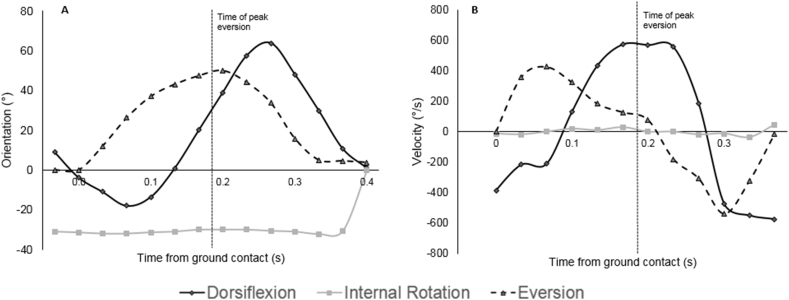
Ankle sprains are one of the most prevalent athletic injuries. Prior work has investigated lateral ankle sprains, but research on generally more severe medial sprains is lacking. This case report performs a kinematic analysis using novel motion analysis methods on a non-contact medial ankle sprain. Peak eversion (50°) occurred 0.2 seconds following ground contact, maximum velocity of 426°/s, while peak dorsiflexion (64°) occurred with a greater maximum velocity (573°/s). The combination of dorsiflexion at ground contact and rapid eversion is associated with a non-contact eversion sprain. This study provides a quantitative analysis of the eversion ankle sprain injury mechanism.
踝关节扭伤是最常见的运动损伤之一。此前的研究主要关注外侧踝关节扭伤,但对于通常更为严重的内侧扭伤的研究却很缺乏。本病例报告采用新颖的运动分析方法,对一例非接触性内侧踝关节扭伤进行了运动学分析。在接触地面后0.2秒出现最大外翻角度(50°),最大速度为426°/秒,而最大背屈角度(64°)出现时的最大速度更高(573°/秒)。接触地面时的背屈和快速外翻相结合与非接触性外翻扭伤相关。本研究提供了对外翻型踝关节扭伤损伤机制的定量分析。