H Muljono David, Wijayadi Teguh, Sjahril Rizalinda
Eijkman Institute for Molecular Biology, Jakarta, Indonesia; Universitas Hasanuddin, Makassar, Indonesia; and Sydney Medical School University of Sydney, New South Wales, Australia.
Universitas Hasanuddin, Makassar, Indonesia; Tarumanegara University, Jakarta Indonesia.
Euroasian J Hepatogastroenterol. 2018 Jan-Jun;8(1):88-92. doi: 10.5005/jp-journals-10018-1269. Epub 2018 May 1.
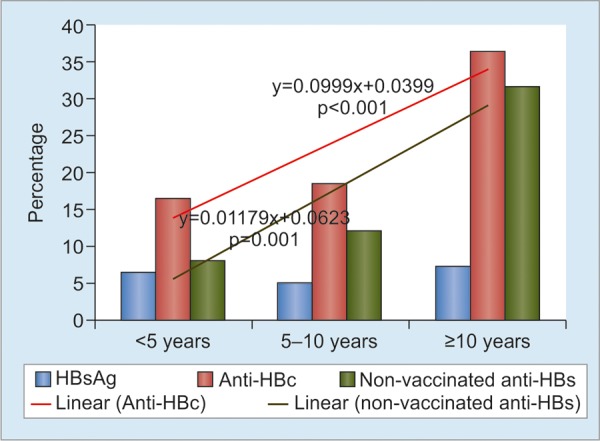
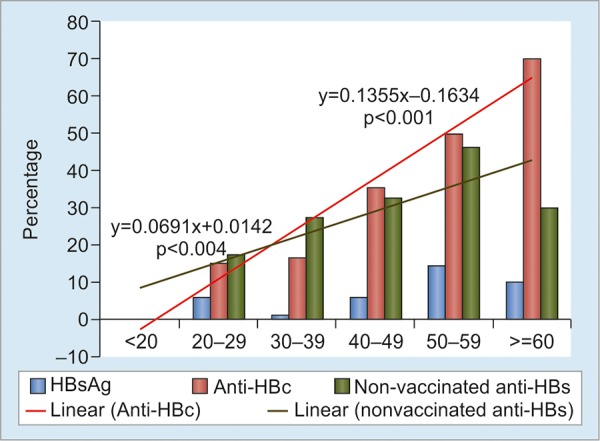
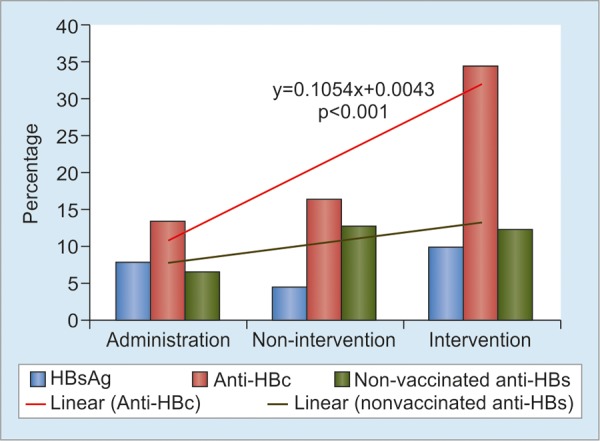
Hepatitis B virus (HBV) infection is a global health problem with an estimated 257 million chronically infected people. Indonesia is a moderately hepatitis B-endemic country with 7.1% prevalence of hepatitis surface antigen (HBsAg). This infection is considered as an important occupational hazard among health care workers (HCWs), who may become further transmitters of this infection. The extent of hepatitis B among HCWs and specific control strategy are not available in Indonesia. A study was done on 644 HCWs, who were categorized into administration, nonintervention, and intervention groups. The prevalence of HBsAg, antibody to HBV core antigen (anti-HBc), and antibody to HBsAg (anti-HBs) was 4.7, 18.5, and 36.7% respectively, while 57.3% were negative for all seromarkers, indicating susceptibility to this infection. Increasing trend with age was observed in the exposure to infection (anti-HBc) (p <0.001) and the marker of resolved infection (HBsAg-, anti-HBc+, anti-HBs+) (p = 0.004), suggesting accumulated exposure to HBV infection by increasing age. Rising trend of exposure rate was also observed across the administration, nonintervention, and intervention groups (p < 0.001). By length of service period, significant escalation of exposure (p = 0.010) and resolved infection (p < 0.001) were also observed, suggesting increasing occupational risk to HBV infection. There is an urgent need to safeguard the HCWs with hepatitis B vaccination and provide continuing education at various health care setups. The establishment of a national policy and a roadmap for effective and efficient intervention is required for the prevention, diagnosis, postexposure management, and treatment of HBV infection in this special population. Muljono DH, Wijayadi T, Sjahril R. Hepatitis B Virus Infection among Health Care Workers in Indonesia. Euroasian J Hepato-Gastroenterol 2018;8(1):88-92.
乙型肝炎病毒(HBV)感染是一个全球性的健康问题,估计有2.57亿人慢性感染。印度尼西亚是乙型肝炎中度流行国家,乙肝表面抗原(HBsAg)流行率为7.1%。这种感染被认为是医护人员(HCWs)面临的一项重要职业危害,医护人员可能会成为这种感染的进一步传播者。在印度尼西亚,医护人员中乙肝感染的程度以及具体的控制策略尚不清楚。对644名医护人员进行了一项研究,这些人员被分为行政组、非干预组和干预组。HBsAg、乙肝核心抗体(抗-HBc)和乙肝表面抗体(抗-HBs)的流行率分别为4.7%、18.5%和36.7%,而57.3%的人所有血清标志物均为阴性,表明对这种感染易感。在感染暴露(抗-HBc)(p<0.001)和已解决感染的标志物(HBsAg-、抗-HBc+、抗-HBs+)(p = 0.004)方面观察到随年龄增长的上升趋势,这表明随着年龄增长,累积接触HBV感染的情况增加。在行政组、非干预组和干预组中也观察到暴露率的上升趋势(p<0.001)。按服务年限来看,还观察到暴露(p = 0.010)和已解决感染(p<0.001)显著增加,这表明医护人员感染HBV的职业风险在增加。迫切需要通过乙肝疫苗接种保护医护人员,并在各种医疗机构提供继续教育。需要制定一项国家政策和路线图,以便对这一特殊人群的HBV感染进行有效且高效的预防、诊断、暴露后管理和治疗。Muljono DH、Wijayadi T、Sjahril R。印度尼西亚医护人员中的乙型肝炎病毒感染。《欧亚肝脏胃肠病学杂志》2018年;8(1):88 - 92。