Ford Jaclyn H, Kensinger Elizabeth A
Department of Psychology, Boston College, Chestnut Hill, Massachusetts, USA.
Neuroreport. 2018 Sep 5;29(13):1129-1134. doi: 10.1097/WNR.0000000000001084.
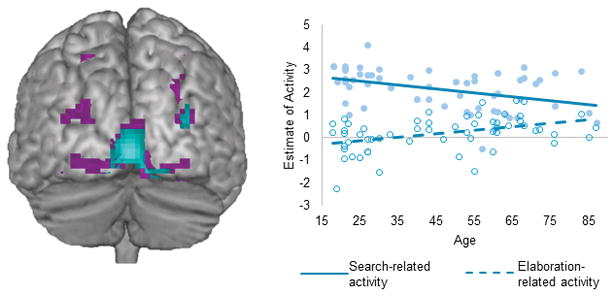
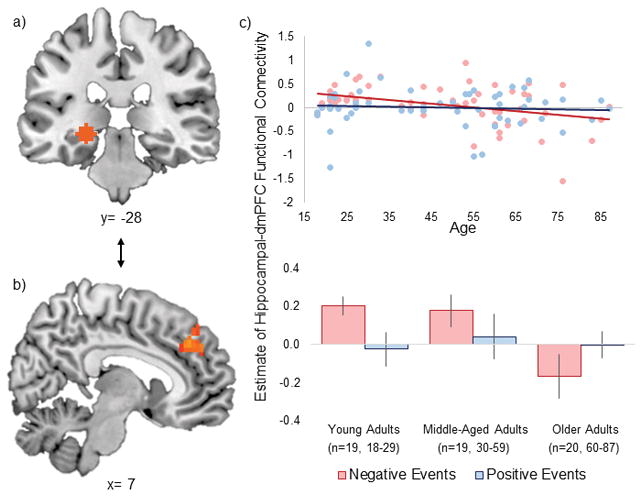
Previous research has revealed an age-related shift in how individuals recall events from their personal past, with older adults reporting events that are more positive than young adults. We recently showed that age-by-valence interactions may be partially driven by a prefrontally mediated control mechanism recruited by older adults during retrieval of negative laboratory events to reduce phenomenological richness. Specifically, age was associated with greater increases in prefrontal recruitment during retrieval of negative relative to positive events, with this recruitment linked to decreases in hippocampal activity and subjective vividness ratings. In the current study, we examined whether older adults may rely on a similar mechanism during retrieval of a complex, highly emotional real-world event. Participants (n=58, age: 18-87 years) were presented with images related to the 2013 Boston Marathon Bombings and were asked to retrieve a memory associated with each image. Images cued participants with either negative (associated with fear, destruction, and sadness) or positive (images of hope, resilience, support) features. This study replicated previous episodic memory tasks: age was associated with more negative hippocampal connectivity with dorsomedial prefrontal regions during retrieval of memories triggered by negative relative to positive cues. Such findings suggest that older adults may be recruiting a similar regulatory mechanism during retrieval of both negative laboratory stimuli and highly negative events from their past. These findings are discussed in relation to previous work showing that young and older adults interact differently with the negative details related to a highly negative event.
先前的研究揭示了个体回忆个人过去事件的方式存在与年龄相关的转变,老年人回忆的事件比年轻人回忆的事件更积极。我们最近表明,年龄与效价的相互作用可能部分是由老年人在检索负面实验室事件时所采用的前额叶介导的控制机制驱动的,以减少现象学上的丰富性。具体而言,与积极事件相比,在检索负面事件时,年龄与前额叶活动的更大增加相关,这种活动与海马体活动和主观生动性评分的降低有关。在当前的研究中,我们考察了老年人在检索复杂、高度情绪化的现实世界事件时是否可能依赖类似的机制。参与者(n = 58,年龄:18 - 87岁)观看了与2013年波士顿马拉松爆炸案相关的图像,并被要求回忆与每张图像相关的记忆。图像向参与者提示了负面(与恐惧、破坏和悲伤相关)或正面(希望、恢复力、支持的图像)特征。这项研究重复了先前的情景记忆任务:与正面线索触发的记忆检索相比,在负面线索触发的记忆检索过程中,年龄与海马体与背内侧前额叶区域的更多负性连接有关。这些发现表明,老年人在检索负面实验室刺激和过去的高度负面事件时可能采用了类似的调节机制。我们将结合先前的研究成果对这些发现进行讨论,先前的研究表明年轻人和老年人与高度负面事件相关的负面细节的互动方式有所不同。