Asiki Gershim, Mohamed Shukri F, Wambui David, Wainana Caroline, Muthuri Stella, Ramsay Michelle, Kyobutungi Catherine
a Health and Systems for Health Unit , African Population and Health Research Center , Nairobi , Kenya.
b Department of Women's and Children's Health , Karolinska Intitutet , Stockholm , Sweden.
Glob Health Action. 2018;11(sup2):1470738. doi: 10.1080/16549716.2018.1470738.
Body mass index (BMI) is rising globally with a faster increase in urban areas in low- and middle-income countries. It is critical to identify modifiable risk factors for BMI to prevent the occurrence of associated health consequences.
To investigate socio-demographic, behavioural and biological factors associated with BMI in Nairobi slums.
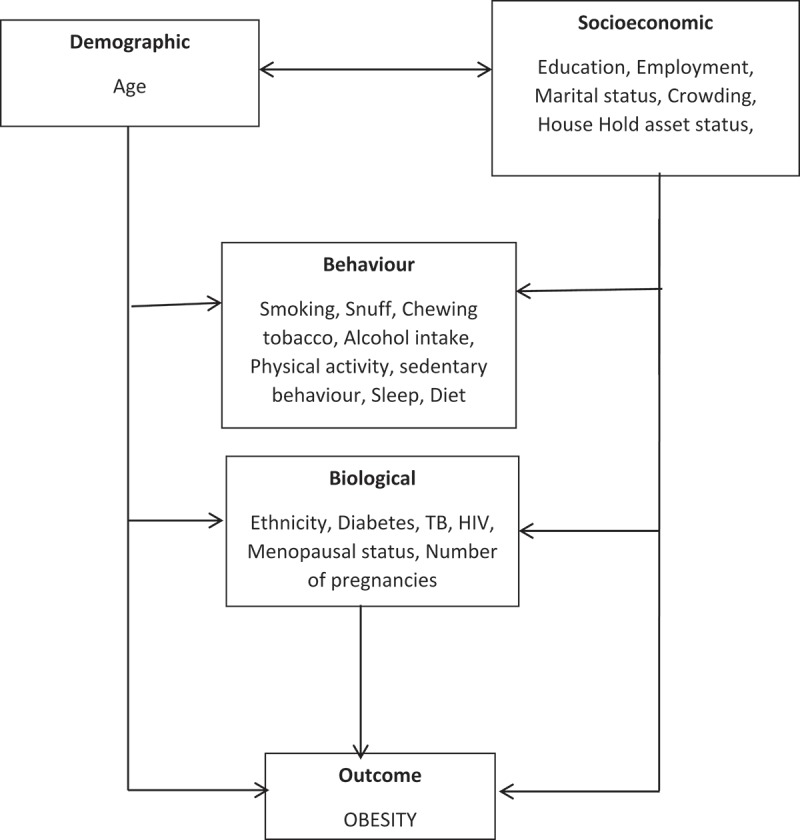
In 2014-2015, a cross sectional study of men and women aged 40-60 years in Nairobi slums (Korogocho and Viwandani) was conducted. Data were collected on socio-demographic, behavioural and biological characteristics. Mean BMI, overweight and obesity were computed. Hierarchical multiple linear regression analysis was conducted separately for men and women to explore factors associated with BMI.
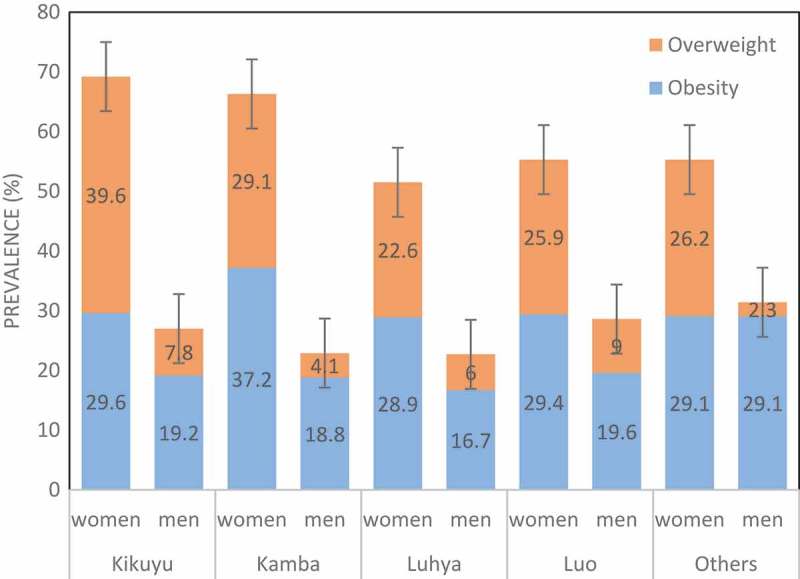
In total, 1942 study participants (54.4%, women) with a mean age (SD) of 48.3 (5.3) years and 48.8(5.6) years for women and men respectively were recruited. Mean BMI was higher among women than men (27.6 versus 22.8; p < 0.001). More women were overweight (30.9% versus 19.6%; p < 0.001) and obese (32.1% versus 5.1%; p < 0.001) than men. Among men, BMI was independently associated with wealth index, bread consumption and self-reported diabetes and was negatively associated with current tobacco smoking, HIV and TB infections. Among women, BMI was independently associated with wealth, current non-problematic drinking, and sedentary time, but was lower among other ethnicities compared to Kikuyu, among current smokers, women with longer sleep, and those with HIV infection and tuberculosis. Wealth index contributed the most variance in BMI among women and men (10.4%, 7.5%, respectively), but behavioural factors (7.4%) among men and biological factors (6.5%) among women accounted for most of the additional BMI variance.
Adults aged 40-60 years in the urban slums of Nairobi have a high BMI associated with wealth. Bread consumption by men and sedentary life among women are the main risky behaviours that need urgent targeted interventions.
全球范围内,身体质量指数(BMI)呈上升趋势,在低收入和中等收入国家的城市地区增长更快。识别BMI的可改变风险因素对于预防相关健康后果的发生至关重要。
调查内罗毕贫民窟中与BMI相关的社会人口学、行为和生物学因素。
2014年至2015年,在内罗毕贫民窟(科罗戈乔和维万达尼)对40至60岁的男性和女性进行了一项横断面研究。收集了社会人口学、行为和生物学特征的数据。计算了平均BMI、超重和肥胖情况。分别对男性和女性进行分层多元线性回归分析,以探讨与BMI相关的因素。
共招募了1942名研究参与者(54.4%为女性),女性和男性的平均年龄(标准差)分别为48.3(5.3)岁和48.8(5.6)岁。女性的平均BMI高于男性(27.6对22.8;p<0.001)。超重的女性比男性更多(30.9%对19.6%;p<0.001),肥胖的女性也比男性更多(32.1%对5.1%;p<0.001)。在男性中,BMI与财富指数、面包消费和自我报告的糖尿病独立相关,与当前吸烟、艾滋病毒和结核病感染呈负相关。在女性中,BMI与财富、当前无问题饮酒和久坐时间独立相关,但与基库尤族相比,其他种族的BMI较低,在当前吸烟者中、睡眠较长的女性以及感染艾滋病毒和结核病的女性中也是如此。财富指数在女性和男性的BMI差异中贡献最大(分别为10.4%和7.5%),但男性的行为因素(7.4%)和女性的生物学因素(6.5%)占了额外BMI差异的大部分。
内罗毕城市贫民窟中40至60岁的成年人BMI较高,且与财富相关。男性食用面包和女性久坐的生活方式是需要紧急针对性干预的主要危险行为。