Grantham Institute for Climate Change, Imperial College, London, SW7 2AZ, UK.
Potsdam Institute for Climate Impact Research, Potsdam, 14473, Germany.
Nat Commun. 2018 Jul 2;9(1):2556. doi: 10.1038/s41467-018-04881-7.
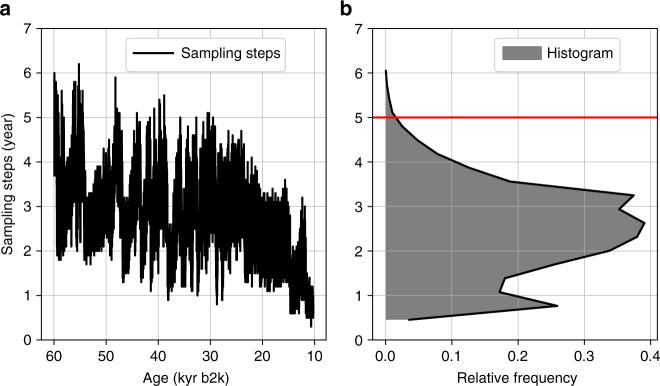
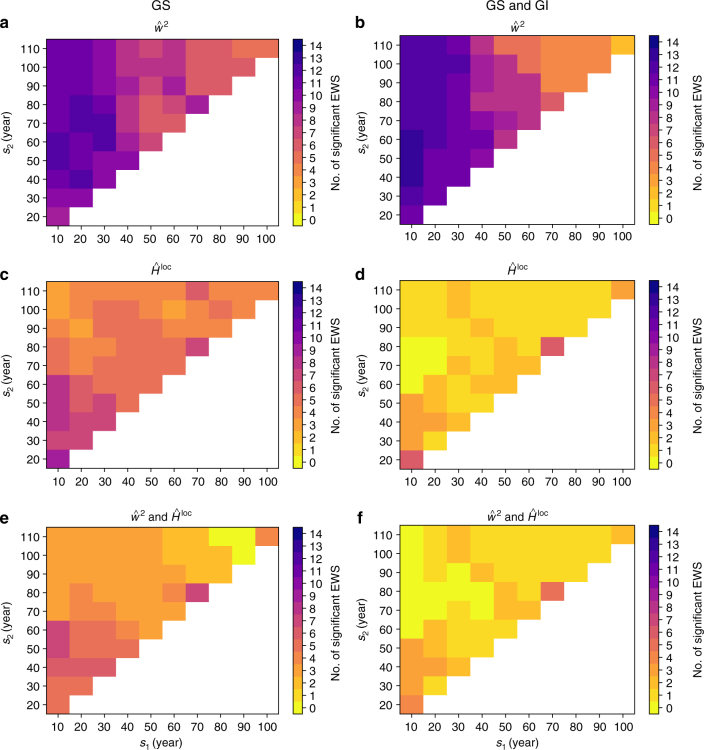
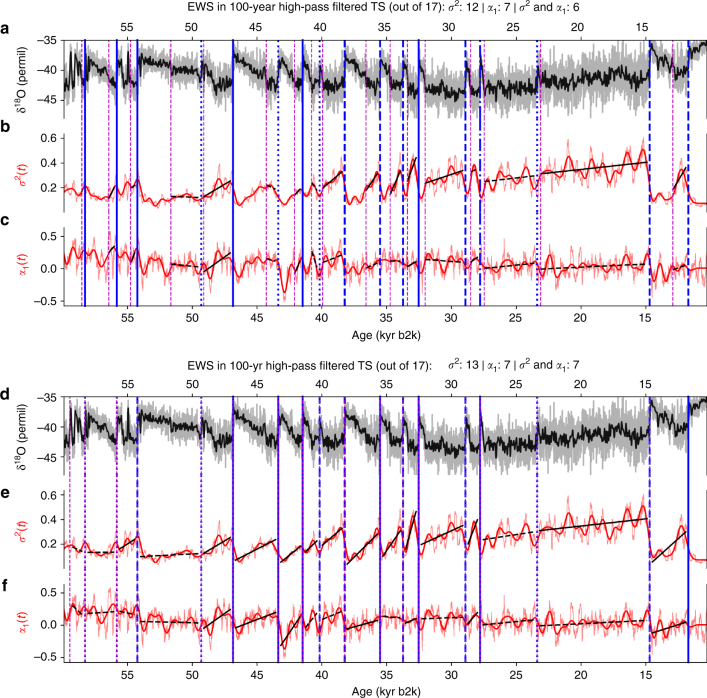
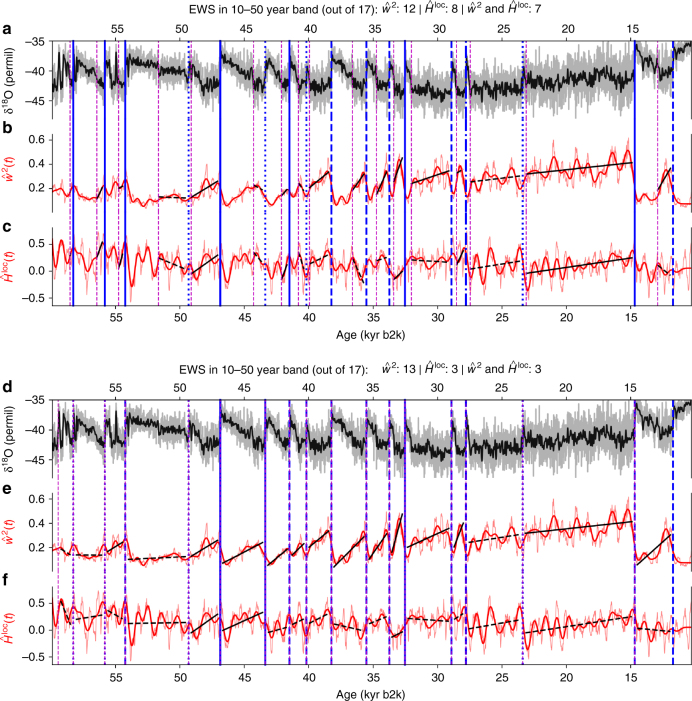
The Dansgaard-Oeschger (DO) events, as observed in oxygen isotope ratios from the North Greenland Ice Core Project (NGRIP) record, are an outstanding example of past abrupt climate transitions. Their physical cause remains debated, and previous research indicated that they are not preceded by classical early-warning signals (EWS). Subsequent research hypothesized that the DO events are caused by bifurcations of physical mechanisms operating at decadal timescales, and proposed to search for EWS in the high-frequency fluctuation levels. Here, a time series with 5-year resolution is obtained from the raw NGRIP record, and significant numbers of EWS in terms of variance and autocorrelation increases are revealed in the decadal-scale variability. Wavelet analysis indicates that the EWS are most pronounced in the 10-50-year periodicity band, confirming the above hypothesis. The DO events are hence neither directly noise-induced nor purely externally forced, which provides valuable constraints regarding potential physical causes.
Dansgaard-Oeschger(DO)事件,如北格陵兰冰芯项目(NGRIP)记录中的氧同位素比值所观察到的那样,是过去气候急剧转变的一个突出例子。其物理原因仍存在争议,先前的研究表明,它们之前没有经典的早期预警信号(EWS)。随后的研究假设 DO 事件是由作用于数十年时间尺度的物理机制的分岔引起的,并提出在高频波动水平中寻找 EWS。在这里,从原始 NGRIP 记录中获得了分辨率为 5 年的时间序列,并且在数十年尺度的可变性中揭示了大量在方差和自相关增加方面的 EWS。小波分析表明,EWS 在 10-50 年的周期性波段中最为明显,证实了上述假设。因此,DO 事件既不是直接由噪声引起的,也不是纯粹由外部强迫引起的,这为潜在的物理原因提供了有价值的约束。