Miranda Claudio D, Godoy Felix A, Lee Matthew R
Laboratorio de Patobiología Acuática, Departamento de Acuicultura, Universidad Católica del Norte, Coquimbo, Chile.
Centro AquaPacífico, Coquimbo, Chile.
Front Microbiol. 2018 Jun 18;9:1284. doi: 10.3389/fmicb.2018.01284. eCollection 2018.
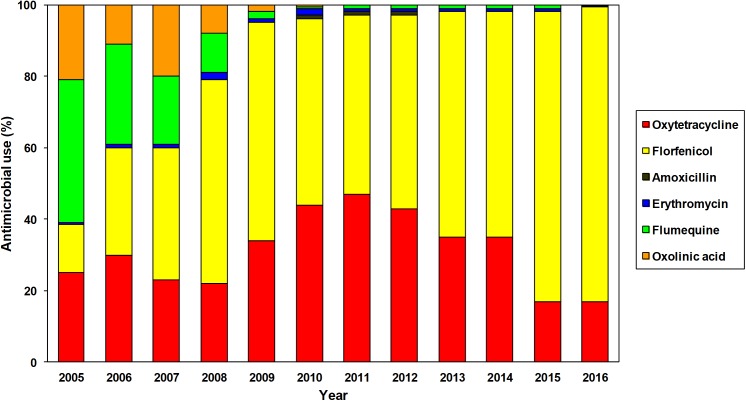
The Chilean salmon industry has undergone a rapid development making the country the world's second largest producer of farmed salmon, but this growth has been accompanied by an intensive use of antibiotics. This overuse has become so significant that Chilean salmon aquaculture currently has one of the highest rates of antibiotic consumption per ton of harvested fish in the world. This review has focused on discussing use of antibiotics and current status of scientific knowledge regarding to incidence of antimicrobial resistance and associated genes in the Chilean salmonid farms. Over recent years there has been a consistent increase in the amount of antimicrobials used by Chilean salmonid farms, from 143.2 tons in 2010 to 382.5 tons in 2016. During 2016, Chilean companies utilized approximately 0.53 kg of antibiotics per ton of harvested salmon, 363.4 tons (95%) were used in marine farms, and 19.1 tons (5%) in freshwater farms dedicated to smolt production. Florfenicol and oxytetracycline were by far the most frequently used antibiotics during 2016 (82.5 and 16.8%, respectively), mainly being used to treat , currently considered the main bacterial threat to this industry. However, the increasing development of this industry in Chile, as well as the intensive use of antimicrobials, has not been accompanied by the necessary scientific research needed to understand the impact of the intensive use of antibiotics in this industry. Over the last two decades several studies assessing antimicrobial resistance and the resistome in the freshwater and marine environment impacted by salmon farming have been conducted, but information on the ecological and environmental consequences of antibiotic use in fish farming is still scarce. In addition, studies reporting the antimicrobial susceptibility of bacterial pathogens, mainly , have been developed, but a high number of these studies were aimed at setting their epidemiological cut-off values. In conclusion, further studies are urgently required, mainly focused on understanding the evolution and epidemiology of resistance genes in Chilean salmonid farming, and to investigate the feasibility of a link between these genes among bacteria from salmonid farms and human and fish pathogens.
智利三文鱼产业发展迅速,使该国成为世界第二大养殖三文鱼生产国,但这种增长伴随着抗生素的大量使用。这种过度使用已变得十分严重,以至于智利三文鱼养殖业目前是世界上每吨收获鱼抗生素消费量最高的行业之一。本综述着重讨论了智利鲑鱼养殖场抗生素的使用情况以及关于抗菌药物耐药性和相关基因发生率的科学知识现状。近年来,智利鲑鱼养殖场使用的抗菌药物数量持续增加,从2010年的143.2吨增至2016年的382.5吨。2016年期间,智利公司每吨收获的三文鱼使用约0.53千克抗生素,其中363.4吨(95%)用于海洋养殖场,19.1吨(5%)用于专门培育鲑鱼苗的淡水养殖场。氟苯尼考和土霉素是2016年使用最为频繁的抗生素(分别占82.5%和16.8%),主要用于治疗目前被认为是该行业主要细菌威胁的疾病。然而,智利该产业的不断发展以及抗菌药物的大量使用,并未伴随着了解抗生素大量使用对该行业影响所需的必要科学研究。在过去二十年里,已经开展了多项评估受三文鱼养殖影响的淡水和海洋环境中抗菌药物耐药性和抗性组的研究,但关于养鱼业中抗生素使用的生态和环境后果的信息仍然匮乏。此外,已经开展了一些报告细菌病原体(主要是某种细菌)抗菌药敏性的研究,但其中大量研究旨在确定其流行病学临界值。总之,迫切需要进一步开展研究,主要集中在了解智利鲑鱼养殖中耐药基因的演变和流行病学,并调查鲑鱼养殖场细菌中的这些基因与人类和鱼类病原体之间联系的可行性。