Marinov Miroslav, Teofanova Denitsa, Gadjev Dimitar, Radoslavov Georgi, Hristov Peter
Institute of Biodiversity and Ecosystem Research, Bulgarian Academy of Sciences, Sofia, Bulgaria.
Department of Biochemistry, Faculty of Biology, Sofia University "St. Kliment Ohridski", Sofia, Bulgaria.
PeerJ. 2018 Jun 27;6:e5060. doi: 10.7717/peerj.5060. eCollection 2018.
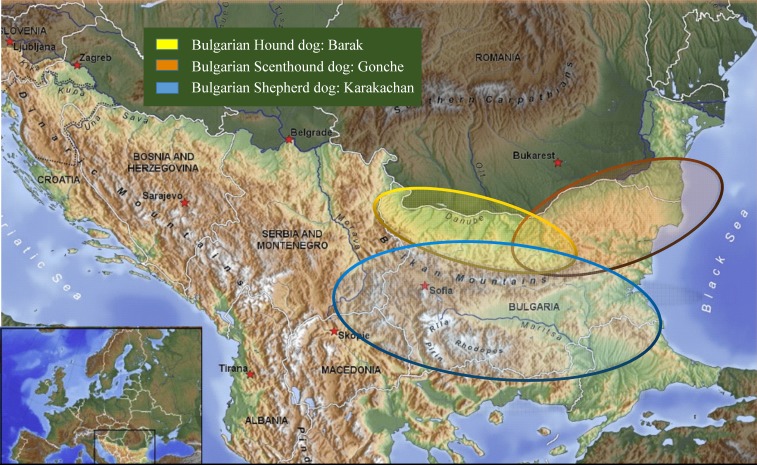
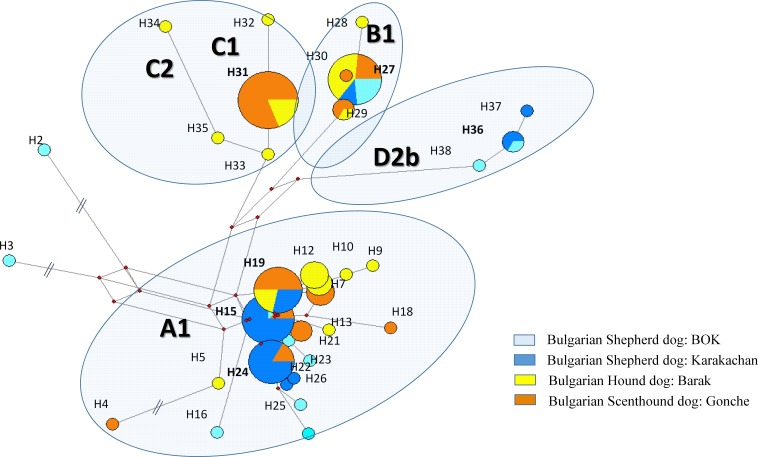
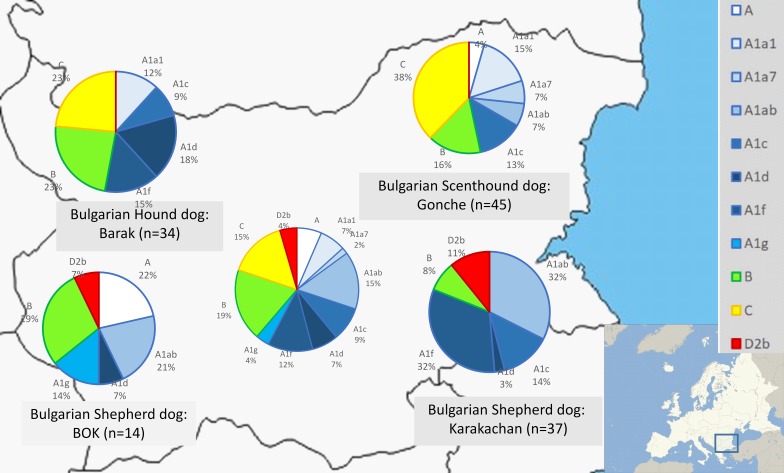
The dog has been the first domesticated animal to have a central role in human society from ancient times to present day. Although there have been numerous investigations of dog phylogeny and origin, genetic data of dogs in the region of the Balkan Peninsula (South-Eastern Europe) are still scarce. Therefore, the aim of the present study was to perform phylogenetic analysis of three native Bulgarian dog breeds. A total of 130 samples were analyzed at HVR1 (hypervariable region, D-loop region). The samples were taken from two hunting dog breeds (Bulgarian Hound Dog: Barak, = 34; Bulgarian Scenthound Dog: Gonche, = 45) as well as from a Bulgarian Shepherd Dog ( = 51). The first two breeds are reared in a flat region of the country (the Northern part of Bulgaria, the Danubian Plain), while the last breed is a typical representative of the mountainous part of the country. The results have shown the presence of almost all main clades-A, B, C and D-in the three dog breeds taken together, except clades E and F, as expected. With regard to haplogroups distribution, there are clear differences among investigated breeds. While hunting breeds exhibit a prevalence of clade C, the mountainous Shepherd dog shows presence of the D2 haplogroup but absence of the C clade. In conclusion, the present study has been the first to investigate the mitochondrial DNA diversity of native dog breeds in Bulgaria. The results have revealed a clear difference of haplogroups dissemination in native hunting and shepherd dogs, which suggests a dual independent phylogenetic origin, without hybridization events between these dogs.
从古至今,狗一直是在人类社会中扮演核心角色的第一种被驯化的动物。尽管对狗的系统发育和起源已经进行了大量研究,但巴尔干半岛(东南欧)地区狗的遗传数据仍然匮乏。因此,本研究的目的是对三个保加利亚本土犬种进行系统发育分析。在高变区1(HVR1,D环区域)对总共130个样本进行了分析。样本取自两个猎犬品种(保加利亚猎犬:巴拉克,n = 34;保加利亚寻血猎犬:贡切,n = 45)以及一个保加利亚牧羊犬(n = 51)。前两个品种饲养在该国的平原地区(保加利亚北部,多瑙河平原),而最后一个品种是该国山区的典型代表。结果表明,这三个犬种共同存在几乎所有主要分支——A、B、C和D,正如预期的那样,除了E和F分支。关于单倍群分布,在所研究的品种之间存在明显差异。虽然猎犬品种中C分支占优势,但山区的牧羊犬显示存在D2单倍群但不存在C分支。总之,本研究首次调查了保加利亚本土犬种的线粒体DNA多样性。结果揭示了本土猎犬和牧羊犬中单倍群传播的明显差异,这表明它们有双重独立的系统发育起源,这些狗之间没有杂交事件。