Université Paris-Saclay, Univ. Paris-Sud, UVSQ, CESP, INSERM, Villejuif, France.
Service de Biostatistique et d'Epidémiologie, Gustave-Roussy, Villejuif, France.
BMC Med Res Methodol. 2018 Jul 3;18(1):67. doi: 10.1186/s12874-018-0527-5.
Recently, the intervention calculus when the DAG is absent (IDA) method was developed to estimate lower bounds of causal effects from observational high-dimensional data. Originally it was introduced to assess the effect of baseline biomarkers which do not vary over time. However, in many clinical settings, measurements of biomarkers are repeated at fixed time points during treatment and, therefore, this method needs to be extended. The purpose of this paper is to extend the first step of the IDA, the Peter Clarks (PC)-algorithm, to a time-dependent exposure in the context of a binary outcome.
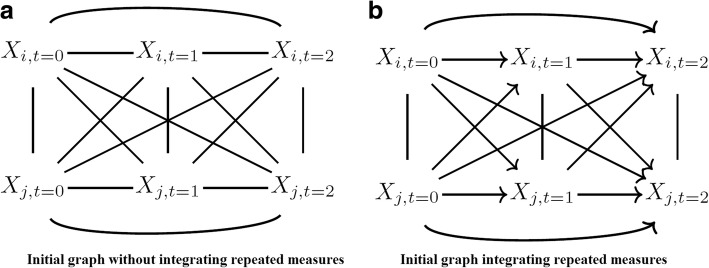
We generalised the so-called "PC-algorithm" to take into account the chronological order of repeated measurements of the exposure and proposed to apply the IDA with our new version, the chronologically ordered PC-algorithm (COPC-algorithm). The extension includes Firth's correction. A simulation study has been performed before applying the method for estimating causal effects of time-dependent immunological biomarkers on toxicity, death and progression in patients with metastatic melanoma.
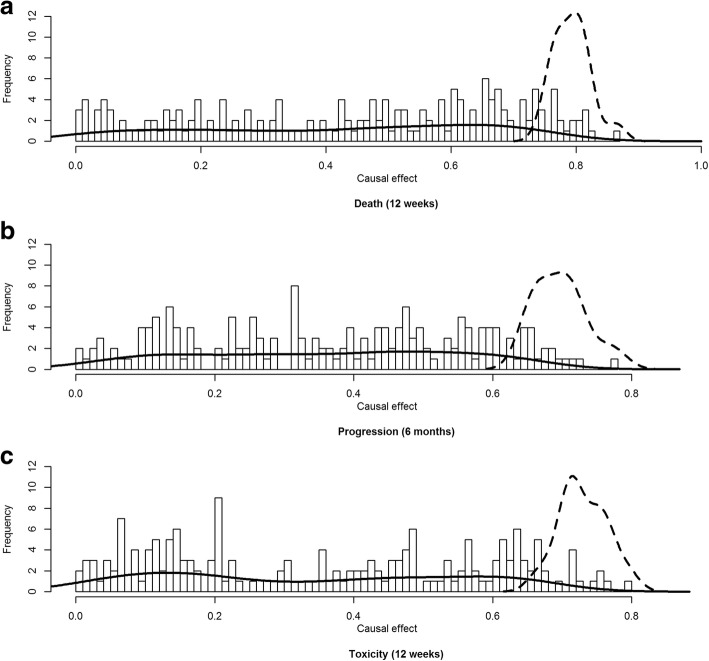
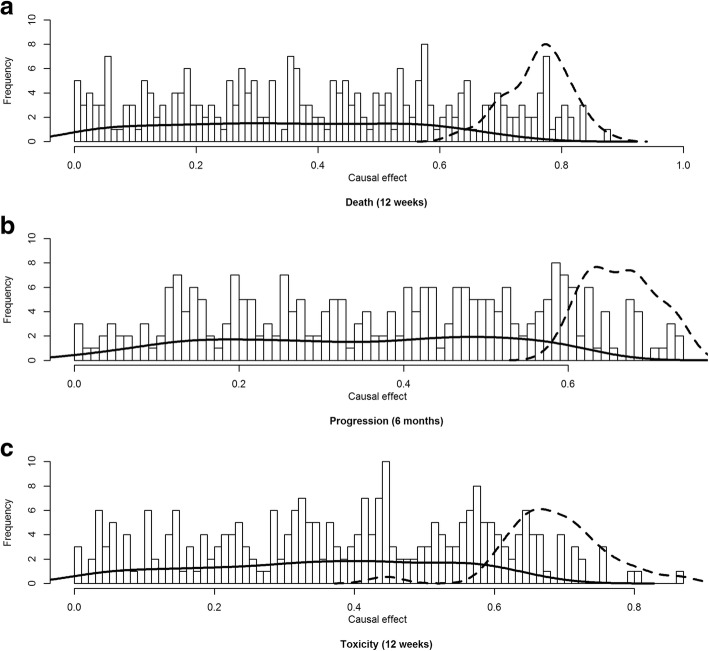
The simulation study showed that the completed partially directed acyclic graphs (CPDAGs) obtained using COPC-algorithm were structurally closer to the true CPDAG than CPDAGs obtained using PC-algorithm. Also, causal effects were more accurate when they were estimated based on CPDAGs obtained using COPC-algorithm. Moreover, CPDAGs obtained by COPC-algorithm allowed removing non-chronological arrows with a variable measured at a time t pointing to a variable measured at a time t´ where t´ < t. Bidirected edges were less present in CPDAGs obtained with the COPC-algorithm, supporting the fact that there was less variability in causal effects estimated from these CPDAGs. In the example, a threshold of the per-comparison error rate of 0.5% led to the selection of an interpretable set of biomarkers.
The COPC-algorithm provided CPDAGs that keep the chronological structure present in the data and thus allowed to estimate lower bounds of the causal effect of time-dependent immunological biomarkers on early toxicity, premature death and progression.
最近,当 DAG 缺失时(IDA)方法被开发出来,用于从观察性高维数据中估计因果效应的下限。最初,它被引入来评估不随时间变化的基线生物标志物的效应。然而,在许多临床情况下,生物标志物的测量在治疗期间重复固定的时间点,因此,该方法需要扩展。本文的目的是扩展 IDA 的第一步,即 Peter Clarks(PC)算法,以适应二分类结果中随时间变化的暴露。
我们将所谓的“PC 算法”推广到暴露的时间依赖性,并提出应用 IDA 及其新版本,即时间有序 PC 算法(COPC 算法)。扩展包括 Firth 校正。在将该方法应用于估计转移性黑色素瘤患者的时间依赖性免疫生物标志物对毒性、死亡和进展的因果效应之前,进行了模拟研究。
模拟研究表明,使用 COPC 算法获得的完整部分有向无环图(CPDAG)在结构上比使用 PC 算法获得的 CPDAG 更接近真实的 CPDAG。此外,基于使用 COPC 算法获得的 CPDAG 估计的因果效应更准确。此外,COPC 算法获得的 CPDAG 允许删除具有在时间 t 测量的变量指向在时间 t´ 测量的变量的非时间顺序箭头,其中 t´<t。COPC 算法获得的 CPDAG 中双向边较少,这支持了从这些 CPDAG 中估计的因果效应变化较小的事实。在该示例中,比较错误率的阈值为 0.5%,导致选择了一组可解释的生物标志物。
COPC 算法提供了保留数据中时间结构的 CPDAG,从而允许估计时间依赖性免疫生物标志物对早期毒性、过早死亡和进展的因果效应下限。