Department of Neonatology, Liuzhou Maternity and Child Health Care Hospital, Liuzhou, 545001, China.
Department of Laboratory, Liuzhou Maternity and Child Healthcare Hospital, Liuzhou, 545001, China.
BMC Infect Dis. 2018 Jul 3;18(1):291. doi: 10.1186/s12879-018-3216-4.
The epidemiology of maternal and infant Group B streptococcus (GBS) colonization is poorly understood in China. The aim of this study is to explore the prevalence and risk factors associated with maternal and infant GBS colonization in Western China.
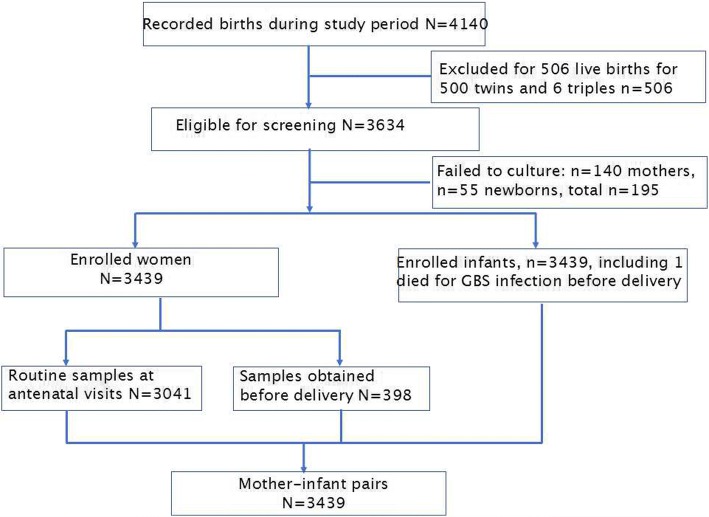
From January 2017 to June 2017, a prospective study was conducted to estimate the maternal and infant GBS colonization rate by maternal rectovaginal and infant nasopharynx, ear canal and umbilical swab culture. Patient demographics, clinical characteristics and outcomes were collected. Chi-square and logistic regression analyses were used to examine the risk factors associated with GBS colonization of mothers and infants.
The GBS colonization rate in mothers and infants was 6.1 and 0.7%, respectively. The vertical transmission rate was 7.6%. The early onset GBS infection rate was 0.58 per 1000 live births and mortality was 0.29 per 1000 live births. Age younger than 40 years (p = 0.040) and minority ethnic status (p = 0.049) were associated with higher GBS colonization rate in pregnant women. Positive GBS status in the mother prior to delivery (p < 0.001) as well as longer duration of membrane rupture (≥12 h) (p < 0.001) and longer labor (≥4 h) (p < 0.001) were all significant risk factors for GBS colonization in infants. Compared to infants without GBS colonization, infants colonized with GBS were more likely to have had a temperature of ≥38 °C (p < 0.001), developed early onset infection (EOD) (p < 0.001), and been prescribed antibiotics (p < 0.001). Furthermore, infants with GBS were more likely to have been admitted to neonatal intensive unit (NICU) (p < 0.001) with a longer hospital length of stay (LOS) (p < 0.001).
Maternal GBS colonization, longer duration of membrane rupture and labor were all major risk factors associated with GBS colonization in Chinese infants. Infant GBS colonization was associated with increased risk of EOD and NICU admission as well as longer LOS.
在中国,母婴群体 B 型链球菌(GBS)定植的流行病学情况了解甚少。本研究旨在探索中国西部地区母婴 GBS 定植的流行情况及相关危险因素。
本前瞻性研究于 2017 年 1 月至 6 月进行,通过采集母亲直肠-阴道和婴儿鼻咽、耳道和脐部拭子进行培养,估计母婴 GBS 定植率。收集患者的人口统计学、临床特征和结局数据。采用卡方检验和 logistic 回归分析来探讨与母婴 GBS 定植相关的危险因素。
母亲和婴儿的 GBS 定植率分别为 6.1%和 0.7%。垂直传播率为 7.6%。早发型 GBS 感染率为每 1000 例活产 0.58 例,死亡率为每 1000 例活产 0.29 例。年龄小于 40 岁(p=0.040)和少数民族(p=0.049)与孕妇 GBS 定植率较高有关。分娩前母亲 GBS 阳性(p<0.001)、胎膜破裂时间≥12 小时(p<0.001)和产程≥4 小时(p<0.001)均为婴儿 GBS 定植的显著危险因素。与未定植 GBS 的婴儿相比,定植 GBS 的婴儿更易出现体温≥38°C(p<0.001)、发生早发型感染(EOD)(p<0.001)和使用抗生素(p<0.001)。此外,GBS 定植的婴儿更有可能入住新生儿重症监护病房(NICU)(p<0.001),住院时间延长(p<0.001)。
母亲 GBS 定植、胎膜破裂时间和产程时间延长均为中国婴儿 GBS 定植的主要危险因素。婴儿 GBS 定植与 EOD 和 NICU 入院风险增加以及住院时间延长有关。