Department of Energy and Materials Engineering, Dongguk University-Seoul, Seoul, 04620, Republic of Korea.
Department of Food Science and Biotechnology, Graduate School, Kyungpook National University, Daegu, 41566, Republic of Korea.
BMC Complement Altern Med. 2018 Jul 3;18(1):200. doi: 10.1186/s12906-018-2253-2.
Cancer is one of the most frequently occurring diseases and is the second leading cause of death worldwide. In this study, anthraquinone derivatives (Compounds 1-5) were evaluated for their anti-cancer potential against various skin and breast cancer cell lines to assess whether these anthraquinone derivatives may serve as a lead for the augmentation of anti-cancer drug.
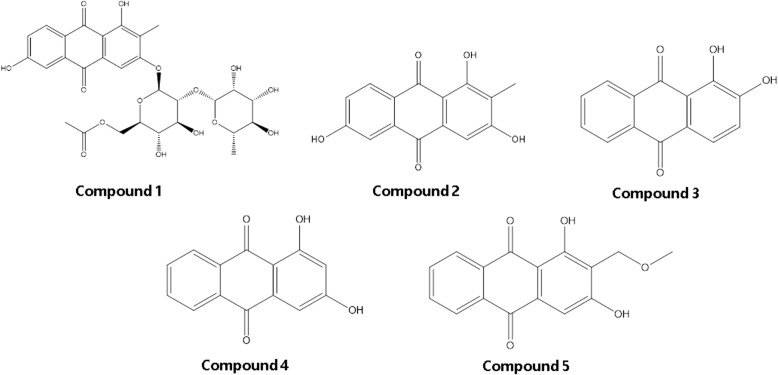
Anthraquinone derivatives, 2-methyl-1,3,6-trihydroxy-9,10-anthraquinone-3-O-(6'-O-acetyl)-α-rhamnosyl(1 → 2)-β-glucoside (Comp 1), 2-methyl-1,3,6-trihydroxy-9,10-anthraquinone (Comp 2), and alizarin (Comp 3) were isolated from the dichloromethane fraction of the roots of Rubia philippinensis., whereas ethyl acetate fraction yielded xanthopurpurin (Comp 4) and lucidin-ω-methyl ether (Comp 5). Structures of all the isolated compounds were determined by spectral data analysis. All isolated compounds (Comp 1-5) were assessed for cytotoxicity by the 3-(4,5-dimethylthiazol-2-yl)-2,5-diphenyltetrazolium bromide (MTT) assay against four different cancer cell lines, i.e. human melanoma (SK-MEL-5), murine melanoma (B16F10), and human breast adenocarcinoma (MCF7 and MDA-MB-231).
Significant activity of the compounds 4 and 5 was observed against the breast cancer cell line MDA-MB-231 with IC values of 14.65 ± 1.45 and 13.03 ± 0.33 μM, respectively. Encouragingly, IC values of 67.89 ± 1.02 and 79.01 ± 0.03 μM against normal kidney epithelial cells (MDCK) were also obtained for compounds 4 and 5, respectively, which indicated very low toxicity and favorable selectivity indices for compounds 4 and 5 in the range of 1.85 to 3.95 and 2.11 to 6.06 against skin cancer cell lines (SK-MEL-5, and B16F10), and breast cancer cell lines (MCF7 and MDA-MB-231), respectively.
Our results suggested that the compounds 4 (xanthopurpurin) and 5 (lucidin-ω-methyl ether) showed high selective toxicity towards breast cancer cells at lower concentrations without showing toxicity towards normal cells, thus could be of potential as new lead molecules in cancer treatment.
癌症是最常见的疾病之一,也是全球第二大致死原因。在这项研究中,评估了蒽醌衍生物(化合物 1-5)对各种皮肤和乳腺癌细胞系的抗癌潜力,以评估这些蒽醌衍生物是否可作为增强抗癌药物的先导化合物。
从菲律宾茜草根的二氯甲烷部分分离出蒽醌衍生物,2-甲基-1,3,6-三羟基-9,10-蒽醌-3-O-(6'-O-乙酰基)-α-鼠李糖苷(1→2)-β-葡萄糖苷(化合物 1)、2-甲基-1,3,6-三羟基-9,10-蒽醌(化合物 2)和茜素(化合物 3),而乙酸乙酯部分则得到黄嘌呤(化合物 4)和卢西定ω-甲醚(化合物 5)。所有分离化合物的结构均通过光谱数据分析确定。通过 3-(4,5-二甲基噻唑-2-基)-2,5-二苯基四唑溴盐(MTT)测定法评估所有分离化合物(化合物 1-5)对四种不同癌细胞系(即人黑色素瘤(SK-MEL-5)、鼠黑色素瘤(B16F10)和人乳腺癌腺癌(MCF7 和 MDA-MB-231)的细胞毒性。
化合物 4 和 5 对乳腺癌细胞系 MDA-MB-231 表现出显著的活性,IC 值分别为 14.65±1.45 和 13.03±0.33 μM。令人鼓舞的是,化合物 4 和 5 对正常肾脏上皮细胞(MDCK)的 IC 值分别为 67.89±1.02 和 79.01±0.03 μM,这表明化合物 4 和 5 的毒性非常低,对化合物 4 和 5 的选择性指数分别在 1.85 到 3.95 和 2.11 到 6.06 之间,对皮肤癌细胞系(SK-MEL-5 和 B16F10)和乳腺癌细胞系(MCF7 和 MDA-MB-231)。
我们的结果表明,化合物 4(黄嘌呤)和 5(卢西定ω-甲醚)在较低浓度下对乳腺癌细胞表现出高选择性毒性,而对正常细胞没有毒性,因此可能是癌症治疗的潜在新先导分子。