Department of Applied Microbiology and Biotechnology, School of Biotechnology, Yeungnam University, Gyeongsan, Gyeongbuk 38541, Korea.
Department of Food Science and Biotechnology, Graduate School, Kyungpook National University, Daegu 41566, Korea.
Sci Rep. 2017 Apr 5;7:46035. doi: 10.1038/srep46035.
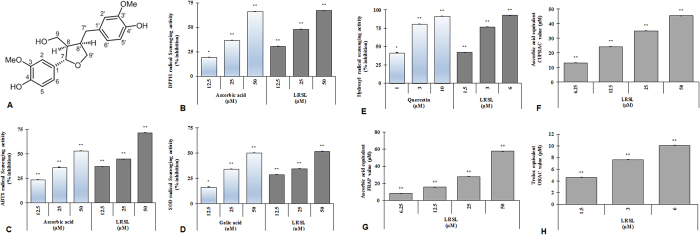
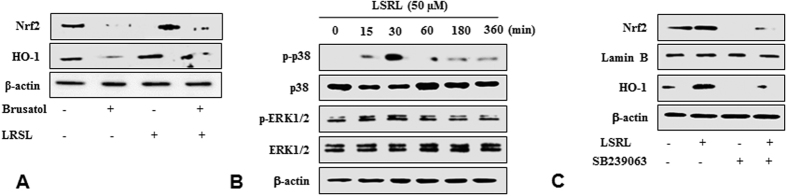
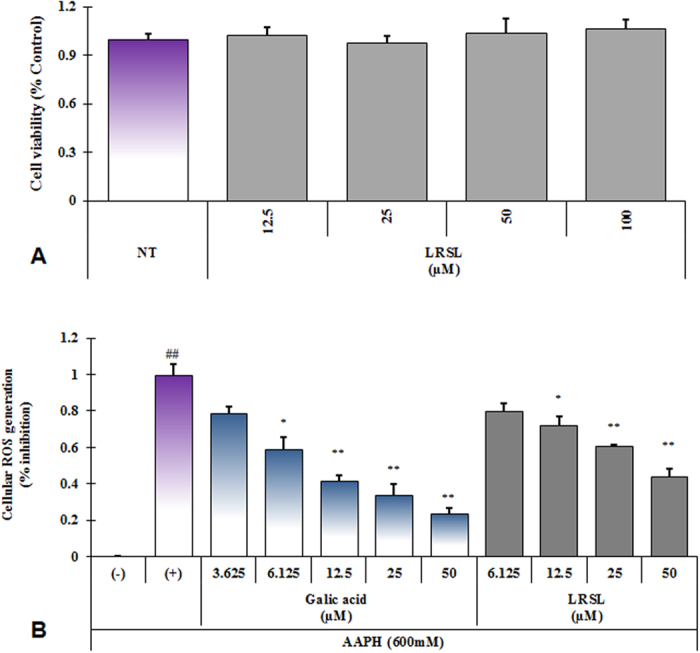
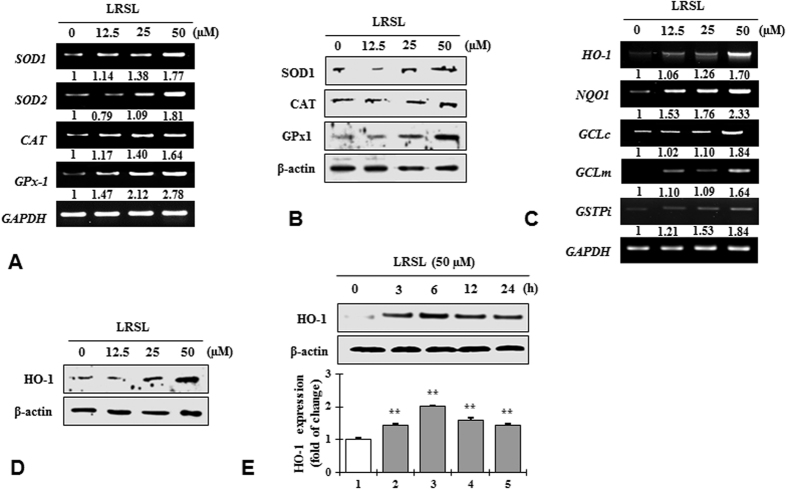
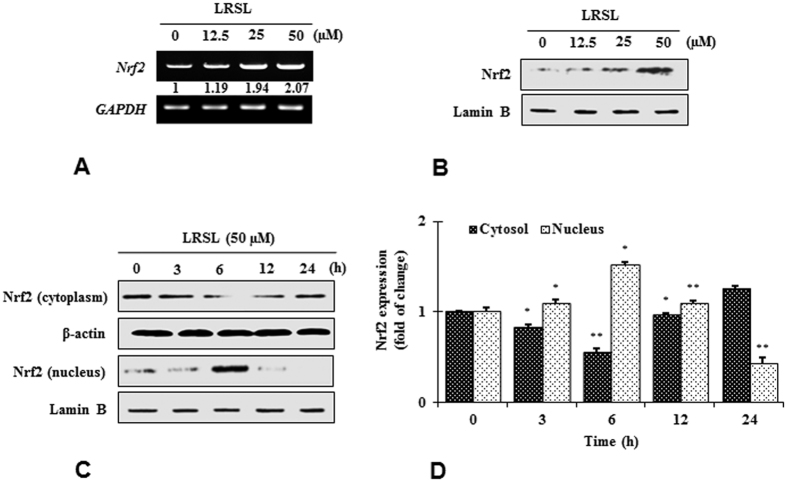
The aim of the present study was to examine the antioxidative activity of (+)-lariciresinol (LRSL), an optically active lignan isolated from Rubia philippinensis in several in vitro assays. LRSL was also subjected to evaluate its inhibitory effect against the generation of reactive oxygen species (ROS) in murine macrophage (RAW 264.7) cells. The results showed that LRSL possessed very strong radical scavenging activity and reducing power, as well as inhibited ROS generation in a dose-dependent manner without showing any cytotoxicity. The transcriptional and translational levels of superoxide dismutase (SOD), glutathione peroxidase (GPx) and catalase (CAT) were markedly higher in the sample treated group. LRSL treatment also increased the transcriptional and translational activities of NF-E2-related factor-2 (Nrf-2) with a corresponding increase in the transcriptional and translational activities of the heme oxygenase-1 (HO-1). LRSL activated p38 and treatments with SB239063 (a p38 inhibitor) suppressed the LRSL-induced activation of Nrf2, resulting in a decrease in HO-1 expression. Collectively, the data demonstrated that LRSL has potent antioxidative activity, decreasing ROS generation in RAW 264.7 cells and increasing the transcriptional and translational levels of antioxidant enzymes by activating Nrf2-mediated HO-1 induction via p38 signaling.
本研究旨在探讨从菲律宾藜芦中分离得到的手性木质素 (+)-松脂醇(LRSL)在几种体外测定中的抗氧化活性。还对 LRSL 进行了评价,以研究其对小鼠巨噬细胞(RAW 264.7)细胞中活性氧(ROS)生成的抑制作用。结果表明,LRSL 具有很强的自由基清除活性和还原能力,能呈剂量依赖性抑制 ROS 的生成,且无细胞毒性。与对照组相比,样品处理组中超氧化物歧化酶(SOD)、谷胱甘肽过氧化物酶(GPx)和过氧化氢酶(CAT)的转录和翻译水平显著升高。LRSL 处理还增加了 NF-E2 相关因子-2(Nrf-2)的转录和翻译活性,血红素加氧酶-1(HO-1)的转录和翻译活性也相应增加。LRSL 激活了 p38,并用 SB239063(一种 p38 抑制剂)处理抑制了 LRSL 诱导的 Nrf2 激活,导致 HO-1 表达降低。总之,数据表明 LRSL 具有很强的抗氧化活性,可通过 p38 信号通路激活 Nrf2 介导的 HO-1 诱导,减少 RAW 264.7 细胞中 ROS 的生成,并增加抗氧化酶的转录和翻译水平。