Department of Clinical Neuroscience, Karolinska Institute, Stockholm, Sweden
Department of Clinical Neuroscience, Karolinska Institute, Stockholm, Sweden.
J Neurol Neurosurg Psychiatry. 2021 Jul;92(7):717-722. doi: 10.1136/jnnp-2020-325676. Epub 2021 Mar 9.
We aimed to investigate the influence of environmental risk factors for multiple sclerosis (MS) in different genetic contexts, and study if interactions between environmental factors and human leucocyte antigen (HLA) genes differ in magnitude according to heterozygocity and homozygocity for .
Using population-based case-control studies (6985 cases, 6569 controls), subjects with different genotypes and smoking, EBNA-1 status and adolescent Body Mass status, were compared regarding MS risk, by calculating OR with 95% CI employing logistic regression. The interaction between different genotypes and each environmental factor was evaluated on the additive scale.
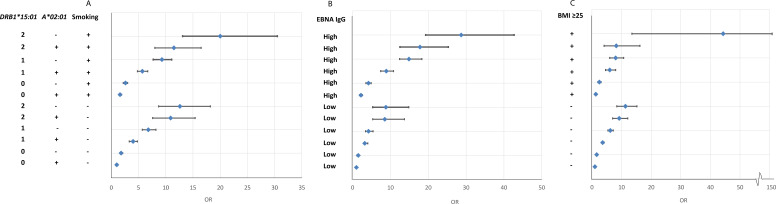
The effect of each allele on MS risk was additive on the log-odds scale for each additional allele. Interaction between and each assessed environmental factor was of similar magnitude regardless of the number of alleles, although ORs were affected. When any of the environmental factors were present in carriers without the protective allele, a three-way interaction occurred and rendered high ORs, especially among homozygotes (OR 20.0, 95% CI 13.1 to 30.5 among smokers, OR 21.9, 95% CI 15.0 to 31.8 among those with elevated EBNA-1 antibody levels, and OR 44.3, 95% CI 13.5 to 145 among those who reported adolescent overweight/obesity).
The strikingly increased MS risk among homozygotes exposed to any of the environmental factors is a further argument in favour of these factors acting on immune-related mechanisms. The data further reinforce the importance of preventive measures, in particular for those with a genetic susceptibility to MS.
我们旨在研究多发性硬化症(MS)的环境风险因素在不同遗传背景下的影响,并研究环境因素与人类白细胞抗原(HLA)基因之间的相互作用是否因杂合性和纯合性而在大小上有所不同。
使用基于人群的病例对照研究(6985 例病例,6569 例对照),比较具有不同基因型和吸烟、EBNA-1 状态和青少年体重状况的个体的 MS 风险,通过计算逻辑回归的 OR 和 95%CI。在加性尺度上评估不同基因型与每个环境因素之间的相互作用。
每个 等位基因对 MS 风险的影响在对数几率尺度上是加性的,每个额外的等位基因都会增加。与每个评估的环境因素之间的相互作用在大小上是相似的,无论 等位基因的数量如何,尽管 OR 会受到影响。当任何环境因素存在于没有保护性 等位基因的 携带者中时,会发生三向相互作用,导致高 OR,尤其是在 纯合子中(吸烟者中的 OR 为 20.0,95%CI 为 13.1 至 30.5;EBNA-1 抗体水平升高者中的 OR 为 21.9,95%CI 为 15.0 至 31.8;报告青少年超重/肥胖者中的 OR 为 44.3,95%CI 为 13.5 至 145)。
在暴露于任何环境因素的 纯合子中,MS 风险显著增加,这进一步证明了这些因素作用于免疫相关机制。这些数据进一步强调了预防措施的重要性,特别是对于那些具有 MS 遗传易感性的人。