Rimpelä Jenni M, Pörsti Ilkka H, Jula Antti, Lehtimäki Terho, Niiranen Teemu J, Oikarinen Lasse, Porthan Kimmo, Tikkakoski Antti, Virolainen Juha, Kontula Kimmo K, Hiltunen Timo P
Department of Medicine, University of Helsinki and Helsinki University Hospital, 00290, Helsinki, Finland.
Faculty of Medicine and Life Sciences, University of Tampere and Tampere University Hospital, Tampere, Finland.
BMC Med Genet. 2018 Jul 4;19(1):110. doi: 10.1186/s12881-018-0624-7.
Reduced nocturnal fall (non-dipping) of blood pressure (BP) is a predictor of cardiovascular target organ damage. No genome-wide association studies (GWAS) on BP dipping have been previously reported.
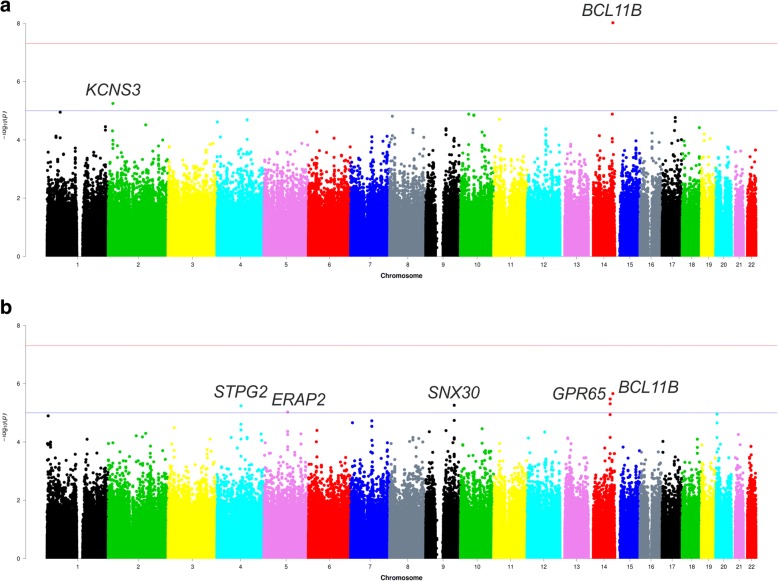
To study genetic variation affecting BP dipping, we conducted a GWAS in Genetics of Drug Responsiveness in Essential Hypertension (GENRES) cohort (n = 204) using the mean night-to-day BP ratio from up to four ambulatory BP recordings conducted on placebo. Associations with P < 1 × 10 were further tested in two independent cohorts: Haemodynamics in Primary and Secondary Hypertension (DYNAMIC) (n = 183) and Dietary, Lifestyle and Genetic determinants of Obesity and Metabolic Syndrome (DILGOM) (n = 180). We also tested the genome-wide significant single nucleotide polymorphism (SNP) for association with left ventricular hypertrophy in GENRES.
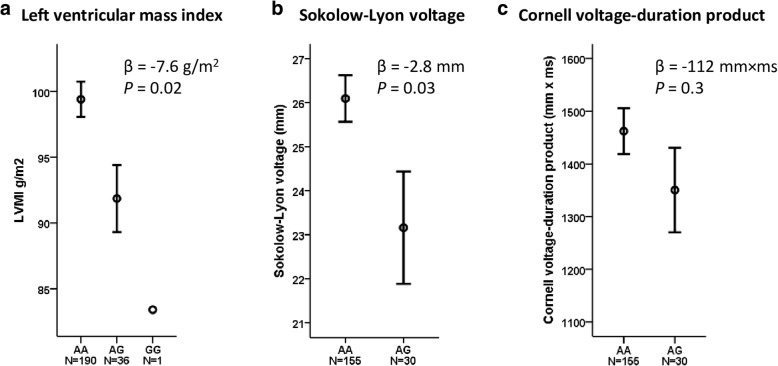
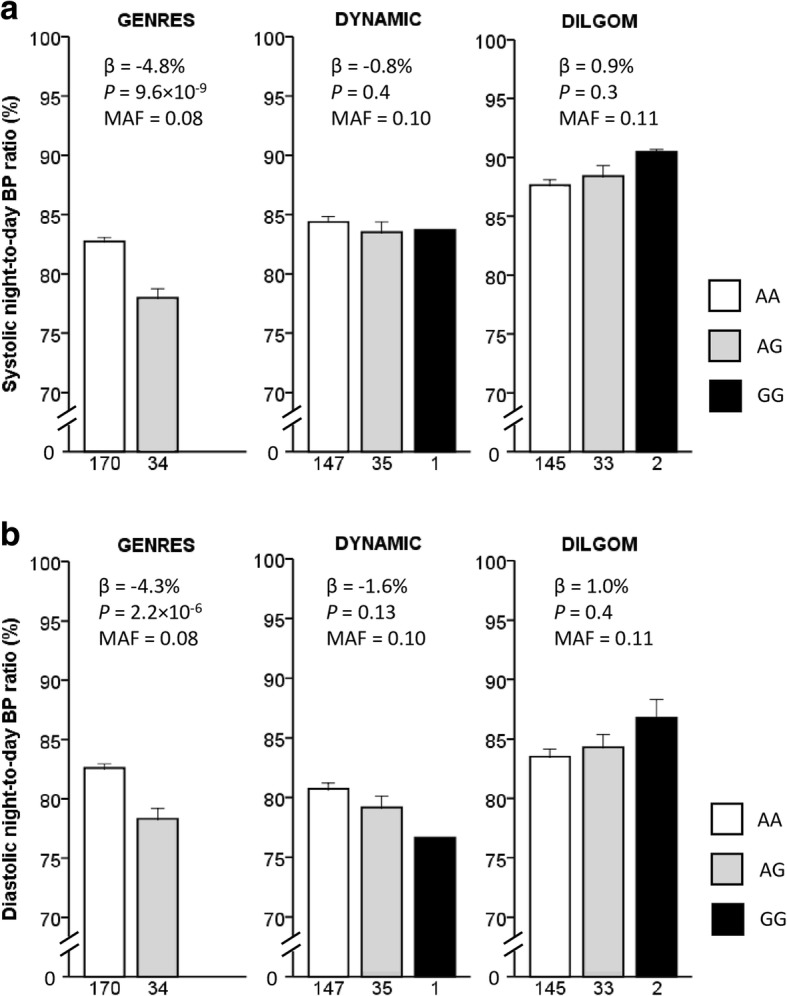
In GENRES GWAS, rs4905794 near BCL11B achieved genome-wide significance (β = - 4.8%, P = 9.6 × 10 for systolic and β = - 4.3%, P = 2.2 × 10 for diastolic night-to-day BP ratio). Seven additional SNPs in five loci had P values < 1 × 10. The association of rs4905794 did not significantly replicate, even though in DYNAMIC the effect was in the same direction (β = - 0.8%, P = 0.4 for systolic and β = - 1.6%, P = 0.13 for diastolic night-to-day BP ratio). In GENRES, the associations remained significant even during administration of four different antihypertensive drugs. In separate analysis in GENRES, rs4905794 was associated with echocardiographic left ventricular mass (β = - 7.6 g/m, P = 0.02).
rs4905794 near BCL11B showed evidence for association with nocturnal BP dipping. It also associated with left ventricular mass in GENRES. Combined with earlier data, our results provide support to the idea that BCL11B could play a role in cardiovascular pathophysiology.
夜间血压下降(非勺型)减弱是心血管靶器官损害的一个预测指标。此前尚无关于血压勺型现象的全基因组关联研究(GWAS)报道。
为研究影响血压勺型现象的基因变异,我们在原发性高血压药物反应遗传学(GENRES)队列(n = 204)中进行了一项GWAS,使用安慰剂治疗期间最多4次动态血压记录的夜间与日间平均血压比值。P < 1×10⁻⁵的关联在另外两个独立队列中进一步验证:原发性和继发性高血压血流动力学(DYNAMIC)队列(n = 183)和肥胖与代谢综合征的饮食、生活方式及遗传决定因素(DILGOM)队列(n = 180)。我们还在GENRES队列中测试了全基因组显著的单核苷酸多态性(SNP)与左心室肥厚的关联。
在GENRES队列的GWAS中,BCL11B附近的rs4905794达到全基因组显著性水平(收缩压β = -4.8%,P = 9.6×10⁻⁶;舒张压夜间与日间血压比值β = -4.3%,P = 2.2×10⁻⁵)。五个基因座中的另外7个SNP的P值 < 1×10⁻⁵。rs4905794的关联未得到显著重复,尽管在DYNAMIC队列中效应方向相同(收缩压β = -0.8%,P = 0.4;舒张压夜间与日间血压比值β = -1.6%,P = 0.13)。在GENRES队列中,即使在使用四种不同的抗高血压药物治疗期间,这些关联仍然显著。在GENRES队列的单独分析中,rs4905794与超声心动图左心室质量相关(β = -7.6 g/m²,P = 0.02)。
BCL11B附近的rs49057