Design Science Program, University of Michigan, Ann Arbor, USA.
Department of Mechanical Engineering, University of Michigan, Ann Arbor, USA.
Global Health. 2018 Jul 4;14(1):65. doi: 10.1186/s12992-018-0355-8.
This study characterized the landscape of commercially available medical devices specifically designed for use in low-income countries (LICs).
A state-of-the-art review of peer-reviewed publications, patents, global health databases, and online resources was performed. The criteria established for a health technology's inclusion in the study were: it met the definition of a medical device; it was designed and developed to address one of the top ten causes of death in LICs, Millennium Development Goal (MDG) 4, or MDG 5; and there was evidence of its commercialization.
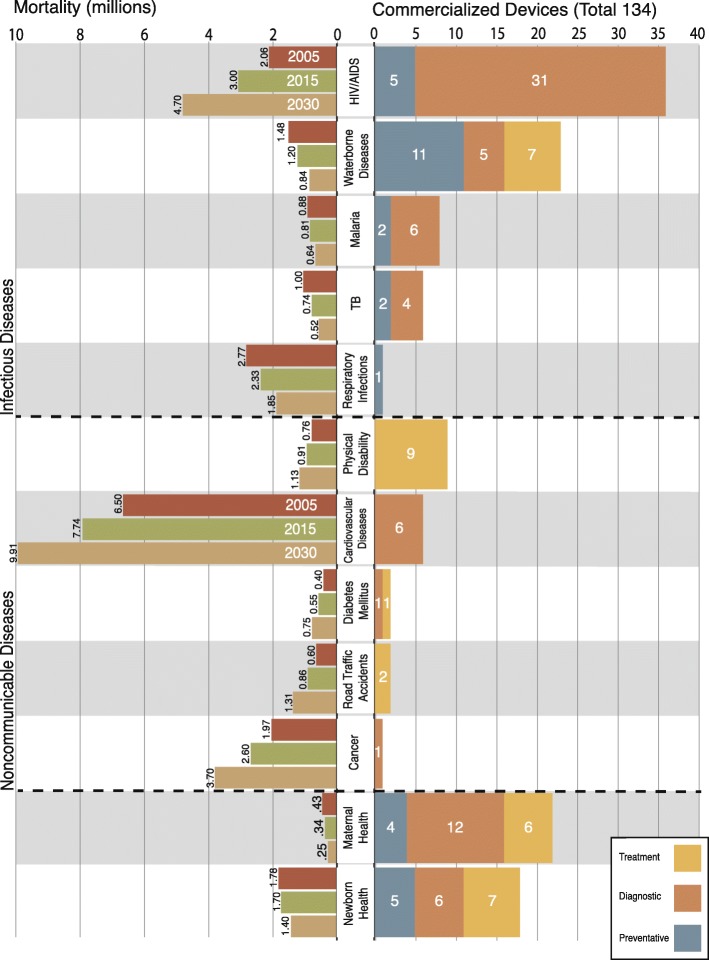
Analysis identified 134 commercialized devices exclusively designed for use in LICs. More than 85% of devices were designed to address infectious diseases or child or maternal health (MDG 4 or 5, respectively). None of the identified devices addressed prevention of noncommunicable diseases (NCDs). Only 8% of devices were designed for use in primary health facilities by non-physician health providers.
There is a significant mismatch between the projected global burden of disease due to NCDs and the relevant number of commercialized medical devices designed specifically for use in LICs. A limited number of commercialized devices were designed for use by non-physician health providers. These findings suggest the need for medical devices targeting NCDs in LICs and design processes that consider the broader context of design and engage stakeholders throughout all phases of design.
本研究描绘了专门为低收入国家(LICs)设计的市售医疗器械的全貌。
对同行评议出版物、专利、全球卫生数据库和在线资源进行了最新审查。纳入本研究的卫生技术标准为:它符合医疗器械的定义;它是为解决 LICs 十大死因之一、千年发展目标 4(MDG 4)或 MDG 5 之一而设计和开发的;并且有商业化的证据。
分析确定了 134 种专门为 LICs 设计的商业化设备。超过 85%的设备旨在解决传染病或儿童或孕产妇健康问题(分别为 MDG 4 或 MDG 5)。所确定的设备均未解决非传染性疾病(NCDs)的预防问题。只有 8%的设备设计用于非医师卫生提供者在基层医疗设施使用。
由于 NCDs 而预计的全球疾病负担与专门为 LICs 设计的商业化医疗器械数量之间存在显著不匹配。少数商业化设备被设计用于非医师卫生提供者使用。这些发现表明需要在 LICs 中针对 NCDs 开发医疗器械,并且设计过程需要考虑设计的更广泛背景,并在设计的所有阶段都让利益相关者参与进来。