Service de Médecine Hyperbare et Expertise Plongée, HIA Sainte-Anne, BP600, Toulon, Cedex 9, France.
Équipe Résidente de Recherche Subaquatique Opérationnelle, Institut de Recherche Biomédicale des Armées, BP 600, Toulon, Cedex 9, France.
Sci Rep. 2018 Jul 4;8(1):10128. doi: 10.1038/s41598-018-28510-x.
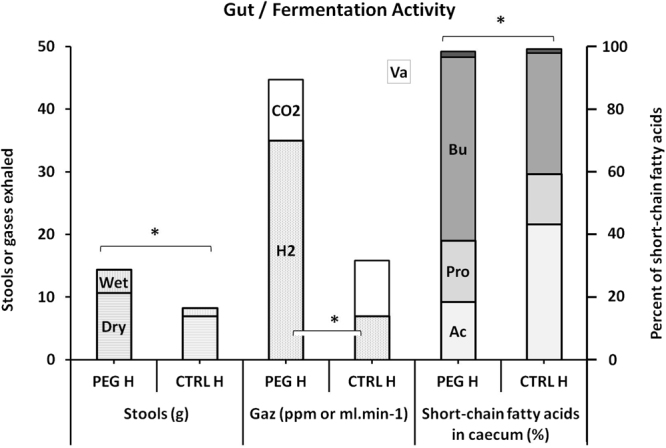
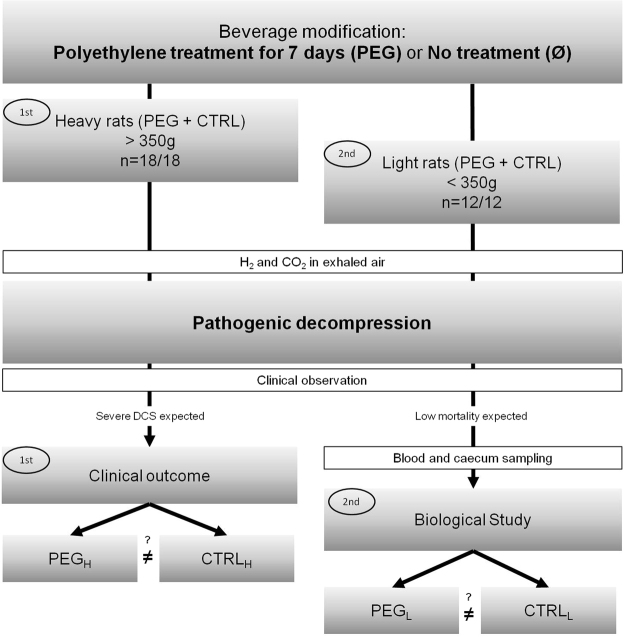
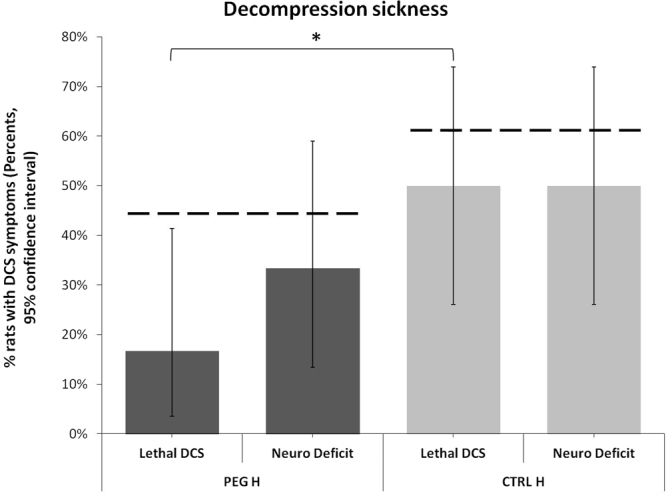
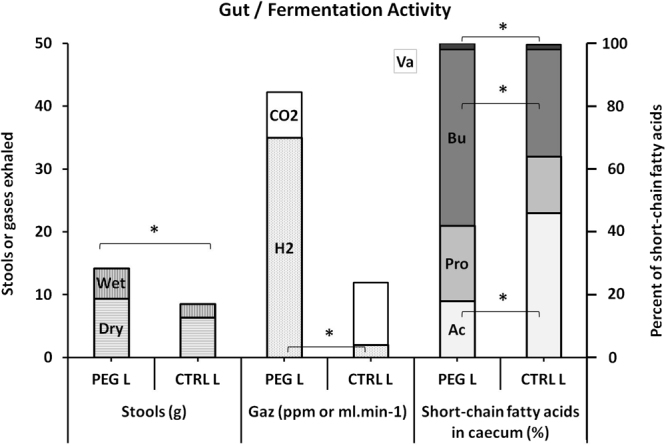
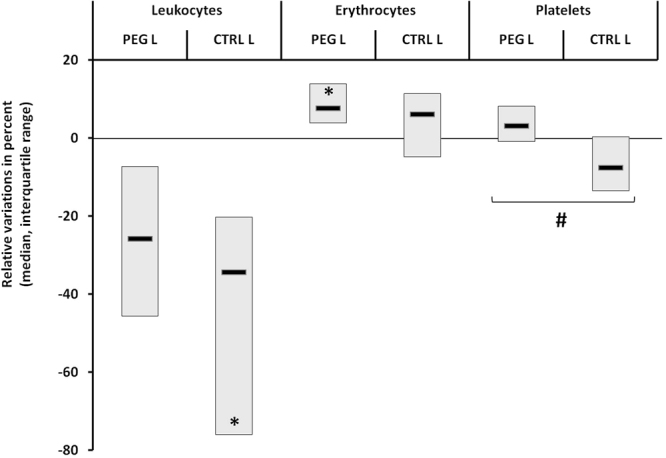
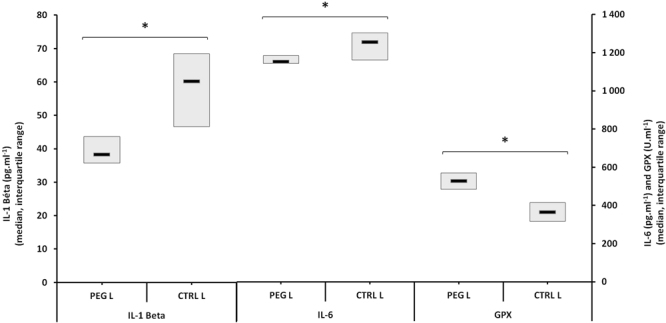
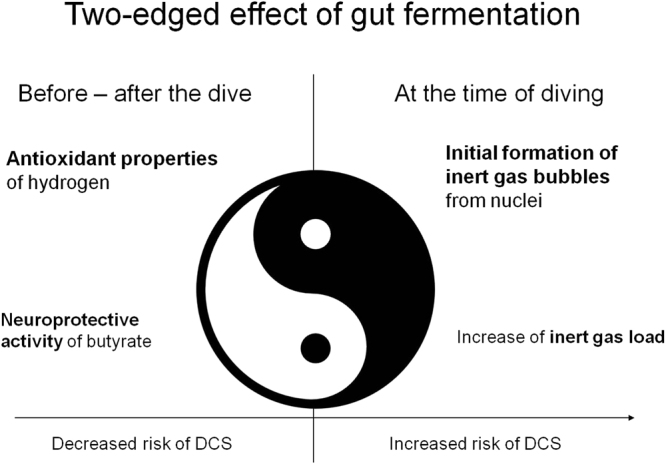
Massive bubble formation after diving can lead to decompression sickness (DCS). Gut fermentation at the time of a dive exacerbates DCS due to endogenous hydrogen production. We sought to investigate whether medium-term stimulation of fermentation as a result of polyethylene glycol (PEG)-induced acceleration of bowel transit before diving exacerbates DCS in rats. Seven days before an experimental dry dive, 60 rats were randomly divided in two groups: an experimental group treated with PEG (n = 30) and an untreated control group (n = 30). Exhaled hydrogen was measured before the dive. Following hyperbaric exposure, we assessed for signs of DCS. After anaesthetisation, arterial blood was drawn to assay inflammatory cytokines and markers of oxidative stress. PEG led to a significant increase in exhaled H (35 ppm [10-73] compared with control 7 ppm [2-15]; p = 0.001). The probability of death was reduced in PEG-treated rats (PEG: 17% [95% CI 4-41] vs control: 50% [95% CI 26-74]; p = 0.034). In addition, inflammatory markers were reduced, and the antioxidant activity of glutathione peroxidase was significantly increased (529.2 U.l [485.4-569.0] versus 366.4 U.l [317.6-414.8]; p = 0.004). Thus, gut fermentation might have a positive effect on DCS. The antioxidant and neuroprotective properties of the fermentation by-products H and butyrate may explain these results.
潜水后大量气泡形成可导致减压病(DCS)。潜水时肠道发酵会加剧 DCS,因为会产生内源性氢气。我们试图研究潜水前聚乙二醇(PEG)诱导的加速肠道转运引起的中期发酵刺激是否会加重大鼠的 DCS。在实验性干式潜水前 7 天,将 60 只大鼠随机分为两组:实验组用 PEG 处理(n=30)和未处理对照组(n=30)。潜水前测量呼出的氢气。高压暴露后,评估 DCS 迹象。麻醉后,抽取动脉血以检测炎症细胞因子和氧化应激标志物。PEG 导致呼出的 H 显著增加(35ppm[10-73]与对照组 7ppm[2-15]相比;p=0.001)。PEG 处理的大鼠死亡率降低(PEG:17%[95%CI 4-41]vs 对照组:50%[95%CI 26-74];p=0.034)。此外,炎症标志物减少,谷胱甘肽过氧化物酶的抗氧化活性显著增加(529.2 U.l[485.4-569.0]vs 366.4 U.l[317.6-414.8];p=0.004)。因此,肠道发酵可能对 DCS 有积极影响。发酵副产物 H 和丁酸盐的抗氧化和神经保护特性可能解释了这些结果。