Institute of Marine Research (IMR), Nordnes, P.O. Box 1870, 5817, Bergen, Norway.
Clinical Institute 1, University of Bergen, Bergen, Norway.
Eur J Nutr. 2019 Sep;58(6):2219-2227. doi: 10.1007/s00394-018-1768-0. Epub 2018 Jul 4.
Iodine is an essential trace element necessary for thyroid hormone synthesis. Iodine deficiency is a continuing public health problem despite international efforts to eliminate it. Studies on iodine status in preschoolers are scarce. Thus, the aims of the current study were to determine the iodine status and to investigate possible associations between urinary iodine concentration (UIC) and estimated 24 h iodine extraction (UIE) and iodine-rich foods.
Data are cross-sectional baseline data, obtained from the two-armed randomized controlled dietary trial "Fish Intervention Studies-KIDS" (FINS-KIDS) conducted in Bergen, Norway. UIC was determined by inductively coupled plasma-mass spectrometry in spot urine samples. Inadequate UIC was defined as median < 100 µg/L, and low estimated 24 h UIE as < 65 µg/day. Habitual dietary intake was assessed by a short food frequency questionnaire. Logistic regression models were used to investigate possible associations between UIC and estimated 24 h UIE and iodine-rich dietary sources including seafood, dairy products and eggs. Iodine/creatinine ratio (I/Cr) was also estimated.
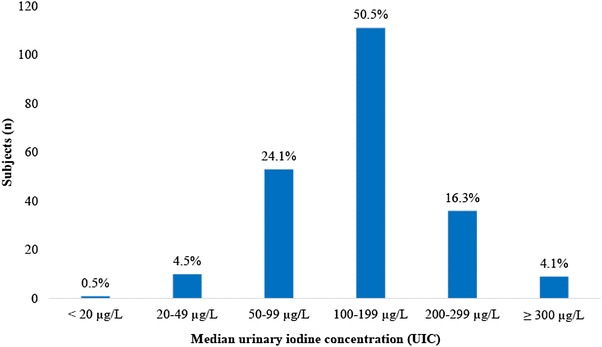
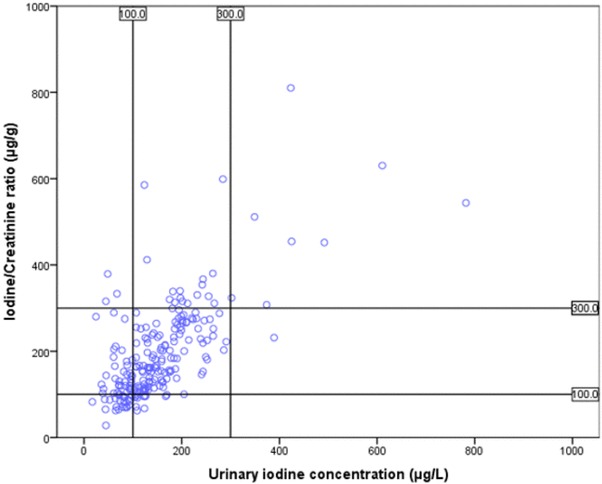
Urinary spot samples were obtained from 220 children. The median (interquartile range) UIC and estimated 24 h UIE was 132 (96) µg/L, and 65 (55) µg/day, respectively. The majority of children had an estimated I/Cr ratio within 100-199 µg/g. Intake of sweet milk < 2 times/day versus ≥ 2 times/day was associated with UIC < 100 µg/L (OR 2.17, 95% CI 1.07-4.38, p = 0.031). Intake of dairy products (OR 3.59, 95% CI 1.13-11.43, p = 0.031) and sweet milk (OR 2.77, 95% CI 1.37-5.61, p = 0.005) < 2 times/day versus ≥ 2 times day was associated with estimated 24 h UIE < 65 µg/day.
The preschoolers had adequate iodine status. Low intake of sweet milk and dairy products were associated with low iodine status.
碘是甲状腺激素合成所必需的微量元素。尽管国际社会努力消除碘缺乏症,但它仍然是一个持续存在的公共卫生问题。目前关于学龄前儿童碘状况的研究很少。因此,本研究的目的是确定碘状况,并研究尿碘浓度(UIC)与估计 24 小时碘提取量(UIE)和富含碘食物之间的可能关联。
本研究的数据是来自挪威卑尔根进行的双盲随机对照饮食试验“鱼类干预研究-儿童”(FINS-KIDS)的横断面基线数据。UIC 通过电感耦合等离子体质谱法在尿样中测定。UIC 中位数<100μg/L 定义为 UIC 不足,UIE<65μg/天定义为低估计 24 小时 UIE。习惯性膳食摄入量通过简短的食物频率问卷评估。使用逻辑回归模型调查 UIC 和估计 24 小时 UIE 与包括海鲜、奶制品和鸡蛋在内的富含碘的膳食来源之间的可能关联。还估计了碘/肌酐比(I/Cr)。
从 220 名儿童中获得了尿样。UIC 和估计的 24 小时 UIE 的中位数(四分位距)分别为 132(96)μg/L 和 65(55)μg/天。大多数儿童的估计 I/Cr 比值在 100-199μg/g 之间。与每天<2 次甜牛奶摄入相比,每天≥2 次甜牛奶摄入与 UIC<100μg/L 相关(OR 2.17,95%CI 1.07-4.38,p=0.031)。与每天<2 次摄入奶制品(OR 3.59,95%CI 1.13-11.43,p=0.031)和甜牛奶(OR 2.77,95%CI 1.37-5.61,p=0.005)相比,每天≥2 次摄入与估计的 24 小时 UIE<65μg/天相关。
学龄前儿童碘状况充足。甜牛奶和奶制品摄入量低与碘状况低有关。