Center for Perceptual Systems, University of Texas at Austin, Austin, Texas 78712, USA; email:
Department of Psychology, University of Texas at Austin, Austin, Texas 78712, USA.
Annu Rev Vis Sci. 2018 Sep 15;4:287-310. doi: 10.1146/annurev-vision-102016-061324. Epub 2018 Jul 5.
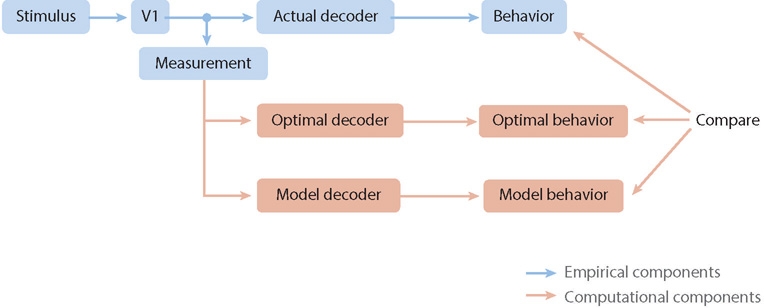
A long-term goal of visual neuroscience is to develop and test quantitative models that account for the moment-by-moment relationship between neural responses in early visual cortex and human performance in natural visual tasks. This review focuses on efforts to address this goal by measuring and perturbing the activity of primary visual cortex (V1) neurons while nonhuman primates perform demanding, well-controlled visual tasks. We start by describing a conceptual approach-the decoder linking model (DLM) framework-in which candidate decoding models take neural responses as input and generate predicted behavior as output. The ultimate goal in this framework is to find the actual decoder-the model that best predicts behavior from neural responses. We discuss key relevant properties of primate V1 and review current literature from the DLM perspective. We conclude by discussing major technological and theoretical advances that are likely to accelerate our understanding of the link between V1 activity and behavior.
视觉神经科学的一个长期目标是开发和测试定量模型,以解释初级视皮层(V1)神经活动与人类在自然视觉任务中的表现之间的实时关系。这篇综述主要关注通过在非人类灵长类动物执行要求苛刻、控制良好的视觉任务时测量和干扰 V1 神经元的活动来实现这一目标的努力。我们首先描述了一种概念方法——解码器关联模型(Decoder Linking Model,DLM)框架,其中候选解码模型将神经反应作为输入,并生成预测行为作为输出。在这个框架中,最终目标是找到实际的解码器——即从神经反应中最好地预测行为的模型。我们讨论了灵长类动物 V1 的关键相关特性,并从 DLM 的角度回顾了当前的文献。最后,我们讨论了可能加速我们理解 V1 活动与行为之间关系的主要技术和理论进展。