Department of Physiology, University of Louisville , Louisville, Kentucky.
J Appl Physiol (1985). 2018 Oct 1;125(4):999-1010. doi: 10.1152/japplphysiol.00137.2018. Epub 2018 Jul 5.
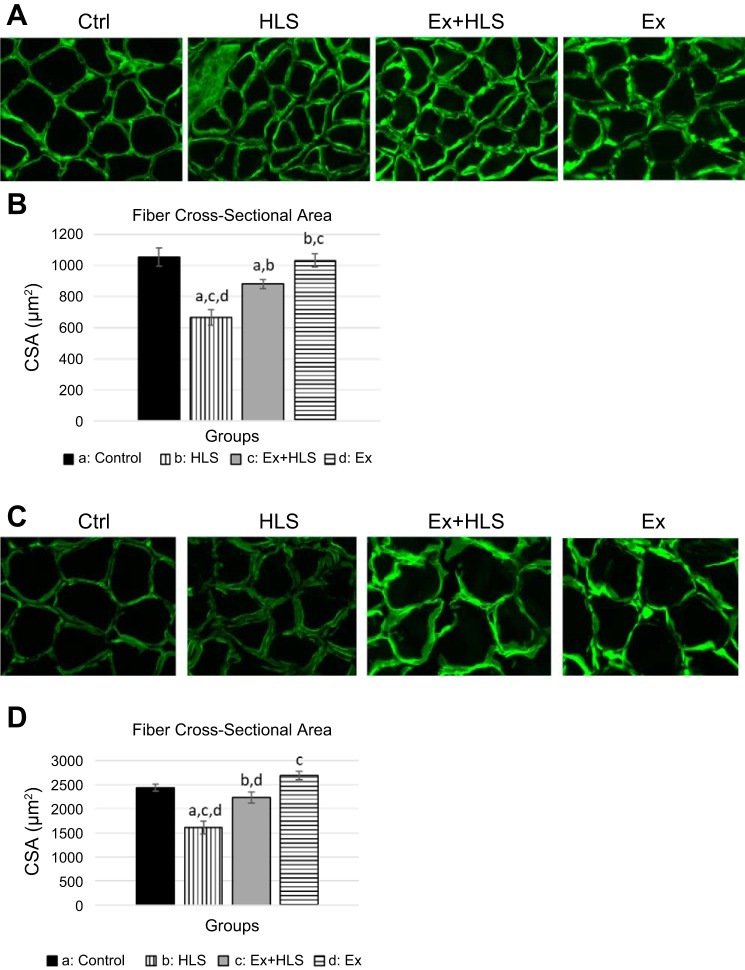
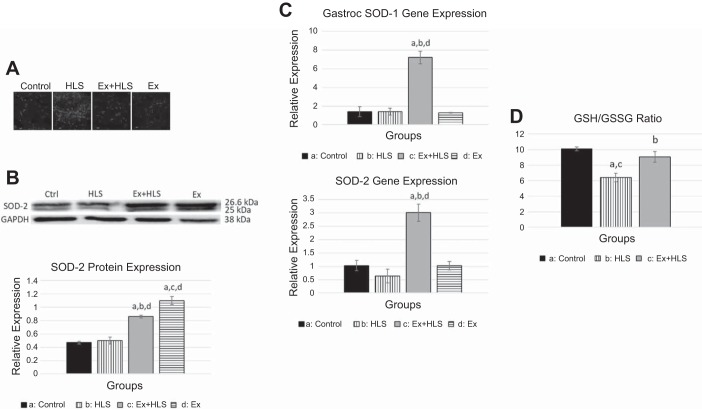
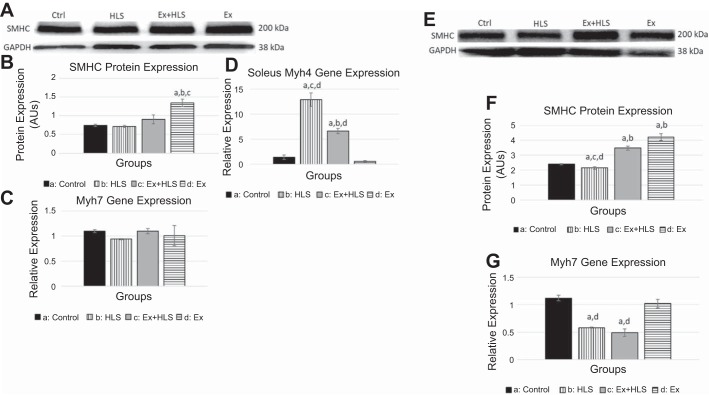
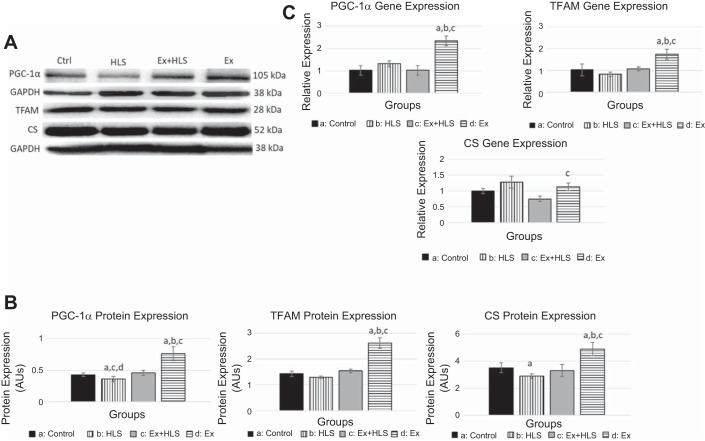
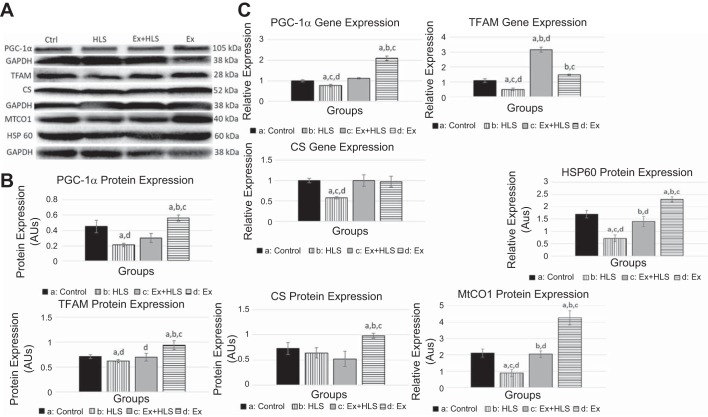
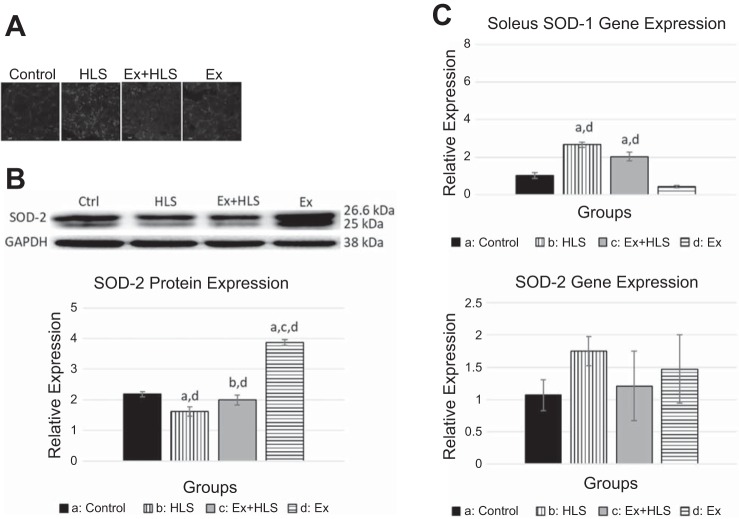
The aim of the present study was to investigate whether short-term, concurrent exercise training before hindlimb suspension (HLS) prevents or diminishes both soleus and gastrocnemius atrophy and to analyze whether changes in mitochondrial molecular markers were associated. Male C57BL/6 mice were assigned to control at 13 ± 1 wk of age, 7-day HLS at 12 ± 1 wk of age (HLS), 2 wk of exercise training before 7-day HLS at 10 ± 1 wk of age (Ex+HLS), and 2 wk of exercise training at 11 ± 1 wk of age (Ex) groups. HLS resulted in a 27.1% and 21.5% decrease in soleus and gastrocnemius muscle weight-to-body weight ratio, respectively. Exercise training before HLS resulted in a 5.6% and 8.1% decrease in soleus and gastrocnemius weight-to-body weight ratio, respectively. Exercise increased mitochondrial biogenesis- and function-associated markers and slow myosin heavy chain (SMHC) expression, and reduced fiber-type transitioning marker myosin heavy chain 4 (Myh4). Ex+HLS revealed decreased reactive oxygen species (ROS) and oxidative stress compared with HLS. Our data indicated the time before an atrophic setting, particularly caused by muscle unloading, may be a useful period to intervene short-term, progressive exercise training to prevent skeletal muscle atrophy and is associated with mitochondrial biogenesis, function, and redox balance. NEW & NOTEWORTHY Mitochondrial dysfunction is associated with disuse-induced skeletal muscle atrophy, whereas exercise is known to increase mitochondrial biogenesis and function. Here we provide evidence of short-term concurrent exercise training before an atrophic event protecting skeletal muscle from atrophy in two separate muscles with different, dominant fiber-types, and we reveal an association with the adaptive changes of mitochondrial molecular markers to exercise.
本研究旨在探讨短期、同时的下肢悬吊(HLS)前运动训练是否可以预防或减轻比目鱼肌和腓肠肌萎缩,并分析线粒体分子标志物的变化是否与之相关。雄性 C57BL/6 小鼠在 13±1 周龄时被分为对照组,在 12±1 周龄时进行 7 天的 HLS(HLS),在 10±1 周龄时进行 2 周的运动训练后进行 7 天的 HLS(Ex+HLS),并在 11±1 周龄时进行 2 周的运动训练(Ex)。HLS 导致比目鱼肌和腓肠肌肌肉重量与体重比分别下降 27.1%和 21.5%。HLS 前的运动训练导致比目鱼肌和腓肠肌肌肉重量与体重比分别下降 5.6%和 8.1%。运动增加了线粒体生物发生和功能相关标志物以及慢肌肌球蛋白重链(SMHC)的表达,并减少了纤维型转换标志物肌球蛋白重链 4(Myh4)的表达。与 HLS 相比,Ex+HLS 降低了活性氧(ROS)和氧化应激。我们的数据表明,在肌肉失用导致萎缩之前的时间,特别是肌肉失用导致萎缩之前的时间,可能是一个有用的时期,可以进行短期、渐进的运动训练来预防骨骼肌萎缩,并且与线粒体生物发生、功能和氧化还原平衡有关。
线粒体功能障碍与废用性肌肉萎缩有关,而运动已知可以增加线粒体生物发生和功能。在这里,我们提供了证据表明,在萎缩事件之前进行短期、同时的运动训练可以保护两种具有不同主导纤维类型的分离肌肉免于萎缩,并且我们揭示了与运动后线粒体分子标志物适应性变化的关联。