Department of Physiology, McGill University, Montreal, Québec, Canada.
Advanced BioImaging Facility (ABIF), McGill University, Montreal, Québec, Canada.
PLoS Comput Biol. 2018 Jul 5;14(7):e1006303. doi: 10.1371/journal.pcbi.1006303. eCollection 2018 Jul.
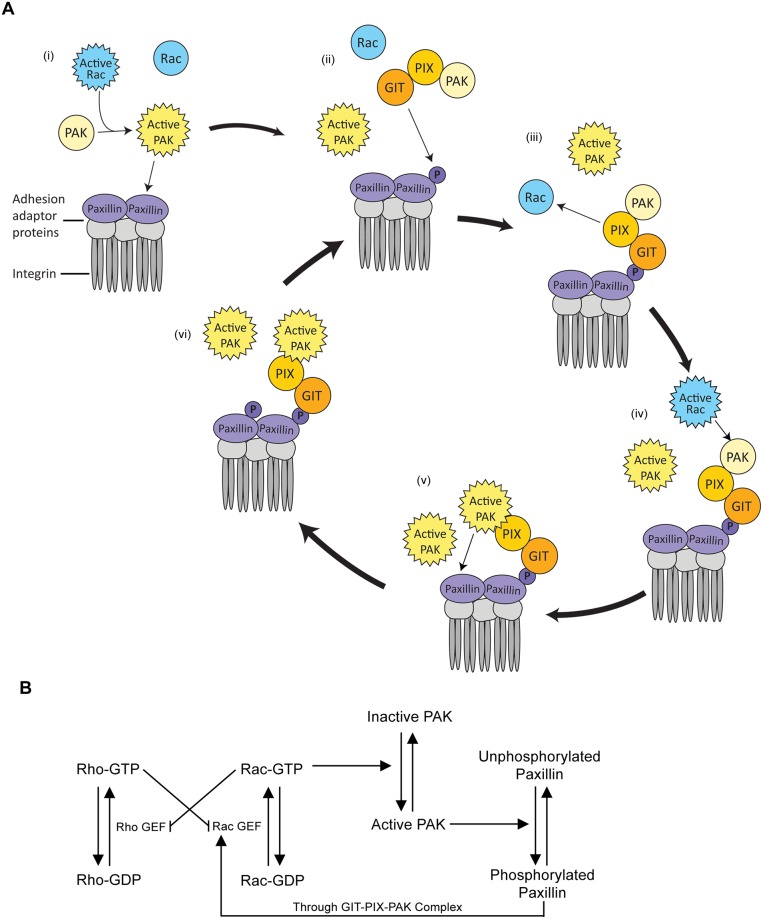
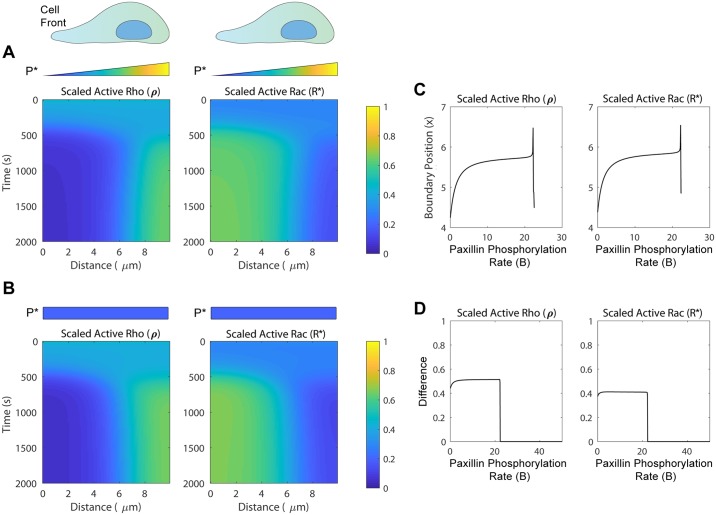
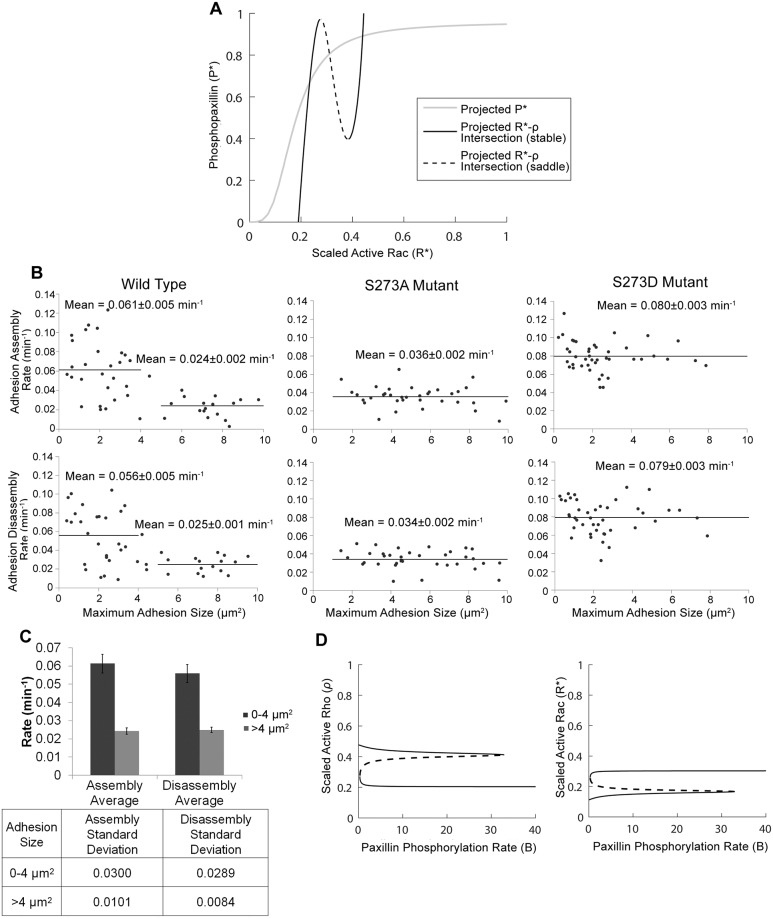
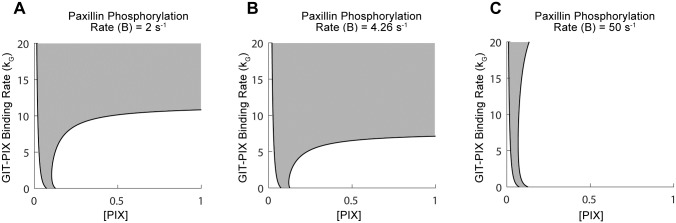
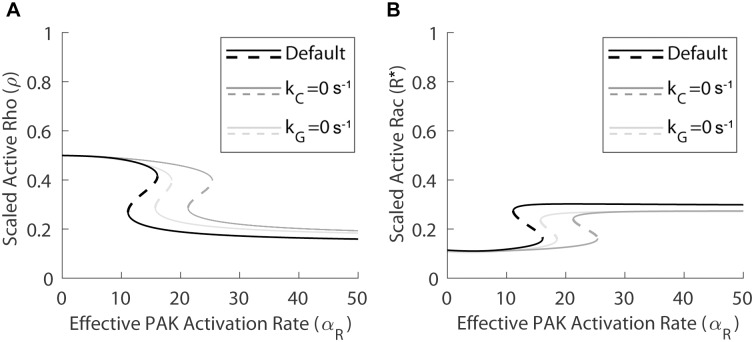
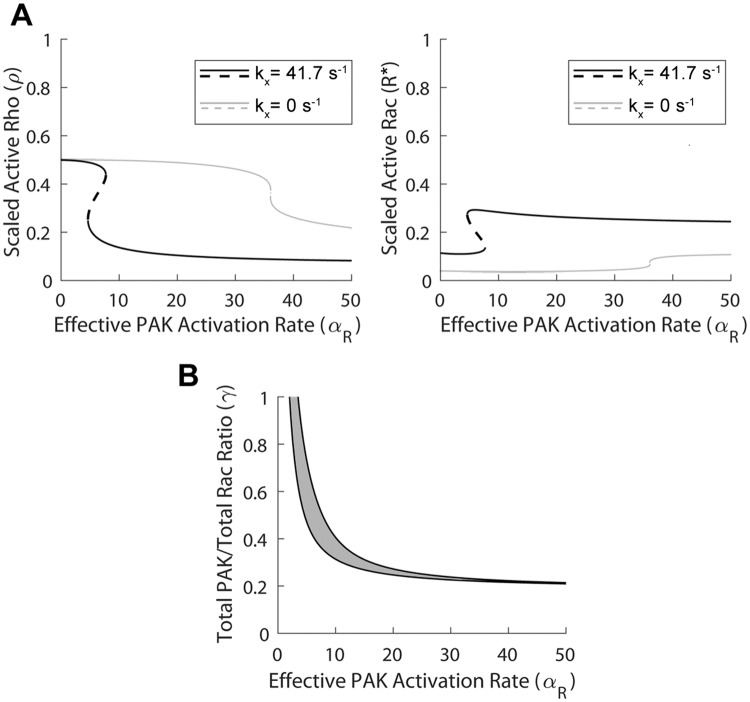
Focal adhesions are protein complexes that anchor cells to the extracellular matrix. During migration, the growth and disassembly of these structures are spatiotemporally regulated, with new adhesions forming at the leading edge of the cell and mature adhesions disassembling at the rear. Signalling proteins and structural cytoskeletal components tightly regulate adhesion dynamics. Paxillin, an adaptor protein within adhesions, is one of these proteins. Its phosphorylation at serine 273 (S273) is crucial for maintaining fast adhesion assembly and disassembly. Paxillin is known to bind to a GIT1-βPIX-PAK1 complex, which increases the local activation of the small GTPase Rac. To understand quantitatively the behaviour of this system and how it relates to adhesion assembly/disassembly, we developed a mathematical model describing the dynamics of the small GTPases Rac and Rho as determined by paxillin S273 phosphorylation. Our model revealed that the system possesses bistability, where switching between uninduced (active Rho) and induced (active Rac) states can occur through a change in rate of paxillin phosphorylation or PAK1 activation. The bistable switch is characterized by the presence of memory, minimal change in the levels of active Rac and Rho within the induced and uninduced states, respectively, and the limited regime of monostability associated with the uninduced state. These results were validated experimentally by showing the presence of bimodality in adhesion assembly and disassembly rates, and demonstrating that Rac activity increases after treating Chinese Hamster Ovary cells with okadaic acid (a paxillin phosphatase inhibitor), followed by a modest recovery after 20 min washout. Spatial gradients of phosphorylated paxillin in a reaction-diffusion model gave rise to distinct regions of Rac and Rho activities, resembling polarization of a cell into front and rear. Perturbing several parameters of the model also revealed important insights into how signalling components upstream and downstream of paxillin phosphorylation affect dynamics.
焦点黏附是将细胞锚定在细胞外基质上的蛋白复合物。在迁移过程中,这些结构的生长和解体在时空上受到调节,新的黏附在细胞前缘形成,成熟的黏附在后部解体。信号蛋白和结构细胞骨架成分紧密调节黏附动力学。黏附中的衔接蛋白 paxillin 就是其中一种蛋白质。其丝氨酸 273 位(S273)的磷酸化对于维持快速黏附组装和解体至关重要。已知 paxillin 与 GIT1-βPIX-PAK1 复合物结合,增加小 GTPase Rac 的局部激活。为了定量理解该系统的行为及其与黏附组装/解体的关系,我们开发了一个数学模型,描述了 paxillin S273 磷酸化决定的小 GTPase Rac 和 Rho 的动力学。我们的模型表明,该系统具有双稳态,通过改变 paxillin 磷酸化或 PAK1 激活的速率,可以在未诱导(活性 Rho)和诱导(活性 Rac)状态之间进行切换。双稳态开关的特征是存在记忆,在诱导和未诱导状态下,活性 Rac 和 Rho 的水平分别发生最小变化,以及与未诱导状态相关的有限单稳态范围。这些结果通过显示黏附组装和解体速率存在双峰性,并通过用 okadaic 酸(paxillin 磷酸酶抑制剂)处理中国仓鼠卵巢细胞后 Rac 活性增加,20 分钟洗脱后恢复适度,实验验证了这一结果。在反应扩散模型中,磷酸化 paxillin 的空间梯度导致 Rac 和 Rho 活性的不同区域,类似于细胞极化到前缘和后缘。扰动模型的几个参数也揭示了 paxillin 磷酸化上下游信号成分如何影响动力学的重要见解。