Department of Orthopaedic Surgery, Nihon University School of Medicine, 30-1 Oyaguchi-kamicho, Itabashi-ku, Tokyo, 173-8610, Japan.
World J Surg Oncol. 2018 Jul 5;16(1):131. doi: 10.1186/s12957-018-1439-x.
Recently, molecule-targeting and bone-modifying agents have improved the treatment outcomes of lung cancer-derived metastatic spine tumors. Therefore, the prognostic factors for such tumors were examined, and novel scoring systems for predicting the life expectancy of patients with such tumors were proposed.
In 207 patients with lung cancer-derived metastatic spine tumors (surgery 49; conservative therapy 158), we retrospectively examined the factors that influenced the post-treatment survival time (age, sex, the affected site, pathology, general condition, the number of extraspinal bone metastases, the number of spinal metastases, the presence/absence of major internal organ metastasis, paralysis state, the total Tokuhashi score, the serum alkaline phosphatase level, the serum carcinoembryonic antigen level, molecule-targeting drug treatment, and bone-modifying agent treatment). Based on the results, we devised novel scoring systems for predicting the prognosis of such patients.
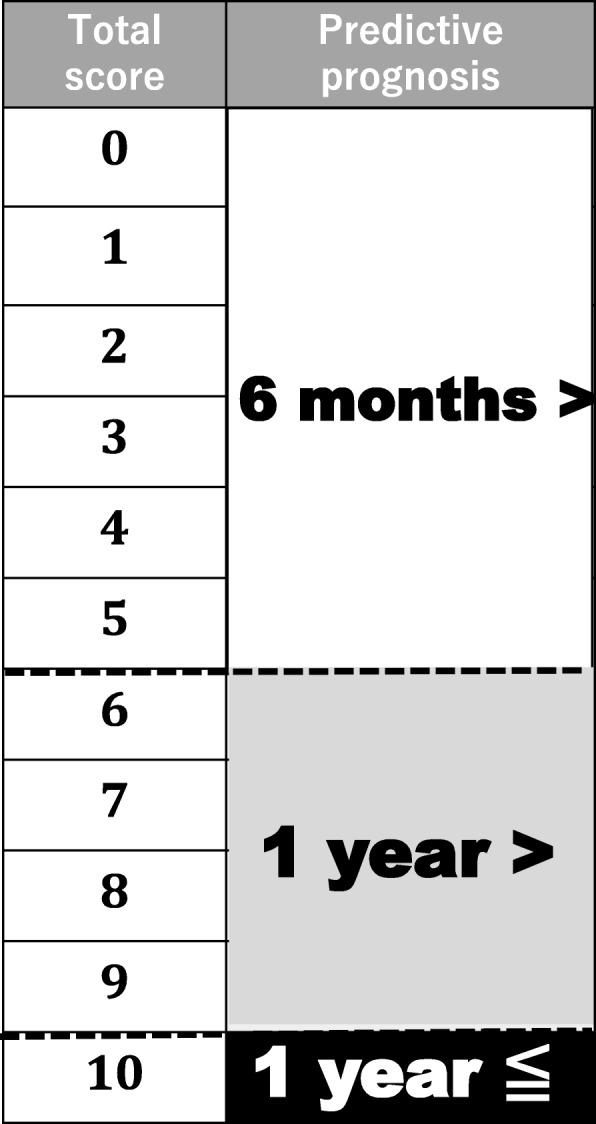
Univariate analyses showed that the pathology of the primary lung tumor, the patient's general condition and paralysis state, and the presence/absence of molecule-targeting drug treatment significantly influenced survival. We performed a Cox regression analysis of these four factors and developed criteria for a novel scoring system based on the patient's general condition and paralysis state, which exhibited significance in the regression analysis. A retrospective review indicated that the consistency rate between predicted life expectancy and actual survival was 67.3%. When criteria based on the four factors that exhibited significance in the univariate analyses were adopted, the consistency rate was 76.2%.
The patient's general condition and paralysis state, the pathology of the primary lung tumor, and molecule-targeting drug treatment influenced survival among patients with lung cancer-derived metastatic spine tumors. Novel scoring systems based on these four factors were proposed.
最近,分子靶向和骨修饰剂改善了肺癌转移性脊柱肿瘤的治疗效果。因此,研究了此类肿瘤的预后因素,并提出了预测此类肿瘤患者预期寿命的新评分系统。
在 207 例肺癌转移性脊柱肿瘤患者(手术 49 例;保守治疗 158 例)中,我们回顾性分析了影响治疗后生存时间的因素(年龄、性别、受累部位、病理、一般状况、脊柱外骨转移数量、脊柱转移数量、是否有主要内脏器官转移、瘫痪状态、总 Tokuhashi 评分、碱性磷酸酶水平、癌胚抗原水平、分子靶向药物治疗、骨修饰剂治疗)。根据结果,我们设计了预测此类患者预后的新评分系统。
单因素分析显示,原发肺癌的病理、患者的一般状况和瘫痪状态以及分子靶向药物治疗是否存在显著影响生存。我们对这四个因素进行了 Cox 回归分析,并根据患者的一般状况和瘫痪状态制定了新评分系统的标准,该标准在回归分析中具有显著性。回顾性分析表明,预测的预期寿命与实际生存的一致性率为 67.3%。当采用单因素分析中具有显著性的四个因素的标准时,一致性率为 76.2%。
肺癌转移性脊柱肿瘤患者的一般状况和瘫痪状态、原发肺癌的病理以及分子靶向药物治疗影响生存。提出了基于这四个因素的新评分系统。