European Centre for Environment and Human Health, University of Exeter Medical School, Knowledge Spa, Royal Cornwall Hospital, Truro, Cornwall TR1 3HD, UK.
Department of Mathematics and Statistics, Ain Shams University, Khalifa El-Maamon St, Abbasiya Sq., Cairo 11566, Egypt.
Int J Environ Res Public Health. 2018 Jul 5;15(7):1415. doi: 10.3390/ijerph15071415.
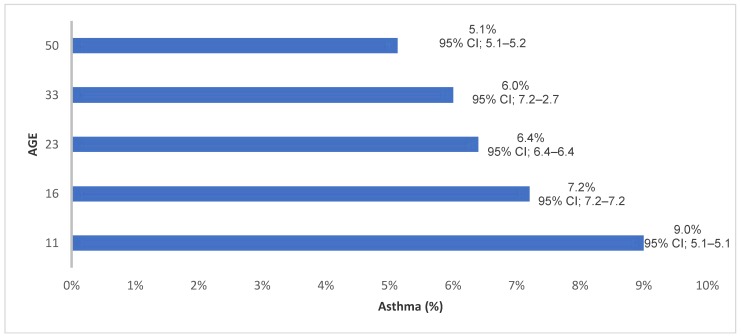
The influence of early life exposures on later life disease has for some time provided clues to modifiable risk factors of disease. The “atopic march” is thought to play a role in the progression of allergic diseases and may offer an opportunity to lower asthma’s health and socioeconomic burden, although evidence remains controversial. We aimed to examine the relationship between early life eczema and asthma later in life. Using the National Child Development Study, we examined infant eczema and childhood and adult asthma. Data related to asthma or wheezing bronchitis were available for 13,503 (73%; 95% CI 72⁻74), 11,503 (61%; 95% CI 60⁻61), 12,524 (68%; 95% CI 67⁻69), 11,194 (60%; 95% CI 60⁻60), 9377 (51%; 95% CI 51⁻51), and 9760 (53%; 95% CI 52⁻53) subjects at ages 11, 16, 23, 33, 44, and 50 years, respectively. Logistic regression models were fitted to examine each wave separately before and after adjusting for a range of potential confounders. Generalised estimating equation (GEE) methods were undertaken to examine the associations after pooling all data from questionnaires. The prevalence of self-reported asthma in those that had previously reported infant eczema ranged from 1.0%; 95% CI 0.9⁻1.4 (age 44 years) to 2.2%; 95% CI 2.1⁻2.3 (age 33 years). Participants with infant eczema had a 2⁻3-fold increased risk of reporting asthma in childhood and adulthood; this was 1.6 times at age 44 years when using spirometry measures. Similar effect sizes were observed in the GEE models when considering all participants (OR 2.9; 95% CI 2.6⁻3.2). Childhood and adult asthma were consistently associated with infant eczema both by using the self-reported data and lung measures.
早期生活暴露对晚年疾病的影响,一段时间以来为疾病的可改变风险因素提供了线索。过敏疾病的“过敏进行曲”被认为在过敏疾病的进展中起作用,尽管证据仍存在争议,但它可能提供了降低哮喘健康和社会经济负担的机会。我们旨在研究婴儿期湿疹与晚年哮喘之间的关系。我们利用国家儿童发展研究,检查了婴儿湿疹、儿童期和成年期哮喘。13503 名(73%;95%CI72-74)、11503 名(61%;95%CI60-61)、12524 名(68%;95%CI67-69)、11194 名(60%;95%CI60-60)、9377 名(51%;95%CI51-51)和 9760 名(53%;95%CI52-53)受试者分别在 11、16、23、33、44 和 50 岁时报告了哮喘或喘息性支气管炎的数据。在调整了一系列潜在混杂因素后,分别使用逻辑回归模型检查了每一波数据。使用广义估计方程(GEE)方法在合并所有问卷数据后检查关联。在报告过婴儿期湿疹的人群中,自我报告哮喘的患病率从 44 岁时的 1.0%(95%CI0.9-1.4)到 33 岁时的 2.2%(95%CI2.1-2.3)不等。有婴儿期湿疹的参与者在儿童期和成年期报告哮喘的风险增加了 2-3 倍;当使用肺活量计测量时,44 岁时的风险增加了 1.6 倍。在考虑所有参与者时,GEE 模型中观察到类似的效应大小(OR2.9;95%CI2.6-3.2)。使用自我报告数据和肺部测量,儿童期和成年期哮喘均与婴儿期湿疹密切相关。