Kane John S, Irvine Andrew J, Derwa Yannick, Rotimi Olorunda, Ford Alexander C
Leeds Gastroenterology Institute, 4th Floor, Bexley Wing, St James's University Hospital, Beckett Street, Leeds LS9 7TF, UK.
Leeds Gastroenterology Institute, St James's University Hospital, Leeds, UK.
Therap Adv Gastroenterol. 2018 Jun 21;11:1756284818783600. doi: 10.1177/1756284818783600. eCollection 2018.
Patients with microscopic colitis (MC) often present with abdominal pain and diarrhoea, and previous data suggest that there may be overlap between MC and irritable bowel syndrome (IBS). We evaluated the prevalence of IBS-type symptoms in patients with MC, and assess the impact of these symptoms on psychological health and quality of life.
We conducted a cross-sectional survey of individuals with a histological diagnosis of MC, collecting demographic data, Rome III IBS-type symptoms, and mood, somatization, and quality of life data.
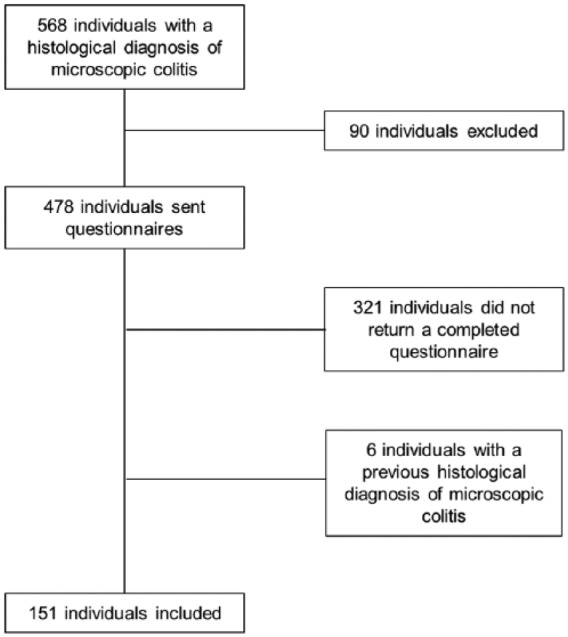
In total, 151 (31.6%) of 478 individuals with a new diagnosis of MC completed questionnaires, 52 (34.4%) of whom reported IBS-type symptoms. The commonest histological subtype was collagenous colitis (51.7%, = 78), followed by lymphocytic colitis (39.1%, = 59). Individuals with IBS-type symptoms had significantly higher levels of anxiety [Hospital Anxiety and Depression Scale (HADS) anxiety score 8.6 5.1, < 0.001], depression (HADS depression score 6.2 3.6, = 0.001), and somatoform-type behaviour (Patient Health Questionnaire 15 score 12.7 8.0, < 0.001) compared with individuals who did not. Those with IBS-type symptoms scored significantly worse across all domains of the 36-item Short Form questionnaire, except for physical functioning.
More than one third of individuals with MC reported IBS-type symptoms, although whether this is due to ongoing inflammation is unclear. These individuals had higher levels of anxiety, depression, and somatization, and impaired quality of life. Identifying concomitant IBS in individuals with MC may have important implications for management decisions.
显微镜下结肠炎(MC)患者常出现腹痛和腹泻,既往数据表明MC与肠易激综合征(IBS)之间可能存在重叠。我们评估了MC患者中IBS型症状的患病率,并评估这些症状对心理健康和生活质量的影响。
我们对经组织学诊断为MC的个体进行了横断面调查,收集人口统计学数据、罗马III型IBS型症状以及情绪、躯体化和生活质量数据。
在478例新诊断为MC的个体中,共有151例(31.6%)完成了问卷调查,其中52例(34.4%)报告有IBS型症状。最常见的组织学亚型是胶原性结肠炎(51.7%,n = 78),其次是淋巴细胞性结肠炎(39.1%,n = 59)。与没有IBS型症状的个体相比,有IBS型症状的个体焦虑水平[医院焦虑抑郁量表(HADS)焦虑评分8.6±5.1,P<0.001]、抑郁水平(HADS抑郁评分6.2±3.6,P = 0.001)和躯体形式行为水平[患者健康问卷15项评分12.7±8.0,P<0.001]显著更高。有IBS型症状的个体在36项简明健康调查问卷的所有领域得分均显著更差,但身体功能领域除外。
超过三分之一的MC患者报告有IBS型症状,尽管这是否归因于持续炎症尚不清楚。这些个体焦虑、抑郁和躯体化水平更高,生活质量受损。在MC患者中识别合并的IBS可能对管理决策具有重要意义。