Harris Salim, Kurniawan Mohammad, Rasyid Al, Mesiano Taufik, Hidayat Rakhmad
Department of Neurology, Faculty of Medicine, Universitas Indonesia and Cipto Mangunkusumo General Hospital, Jakarta, Indonesia.
SAGE Open Med. 2018 Jun 20;6:2050312118784312. doi: 10.1177/2050312118784312. eCollection 2018.
Stroke is the number one cause of morbidity and mortality in Indonesia. Lacunar infarction is one of cerebral small vessel disease spectrum. This study aimed to present stroke epidemiology in Indonesia and risk factors associated with cerebral small vessel disease.
A multicenter prospective cross-sectional study of 18 hospitals in Indonesia was conducted using Stroke Case Report Form from 2012 to 2014. Stroke was diagnosed based on clinical findings confirmed with non-contrast computed tomography of the brain. Subjects were classified into two large groups: ischemic (lacunar and non-lacunar) and hemorrhagic (intracranial and subarachnoid hemorrhage). Other risk factors were assessed on admission.
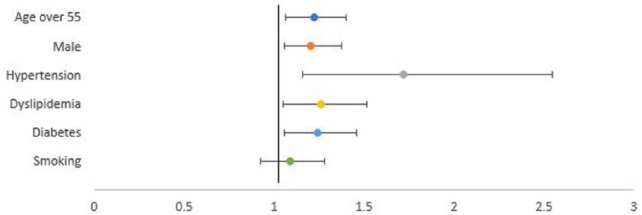
We enrolled 5411 patients, of whom 3627 (67.03%) had ischemic stroke and 1784 (32.97%) had hemorrhagic stroke. Male patients were prevalent in both large groups, although found less in subarachnoid hemorrhage group. Among patients with hemorrhagic stroke, 1603 (89.54%) of them had intracerebral hemorrhage and 181 (10.46%) had subarachnoid hemorrhage. From 3627 ischemic stroke patients, 1635 (45.07%) of them had lacunar infarction. We found that age above 55 years old, male gender, hypertension, dyslipidemia, and diabetes were important risk factors associated with lacunar stroke (p < 0.05).
Ischemic stroke was the leading cause of stroke in Indonesia. In total, 45% of the total ischemic stroke patients had lacunar infarction. Important risk factors associated with lacunar infarction were hypertension, dyslipidemia, diabetes, age over 55, and male population.
中风是印度尼西亚发病和死亡的首要原因。腔隙性脑梗死是脑小血管疾病谱之一。本研究旨在介绍印度尼西亚的中风流行病学以及与脑小血管疾病相关的危险因素。
2012年至2014年,在印度尼西亚的18家医院开展了一项多中心前瞻性横断面研究,使用中风病例报告表。中风根据脑部非增强计算机断层扫描确诊的临床发现进行诊断。受试者分为两大组:缺血性(腔隙性和非腔隙性)和出血性(颅内出血和蛛网膜下腔出血)。入院时评估其他危险因素。
我们纳入了5411例患者,其中3627例(67.03%)患有缺血性中风,1784例(32.97%)患有出血性中风。两大组中男性患者均占多数,不过在蛛网膜下腔出血组中较少。在出血性中风患者中,1603例(89.54%)为脑出血,181例(10.46%)为蛛网膜下腔出血。在3627例缺血性中风患者中,1635例(45.07%)为腔隙性脑梗死。我们发现,55岁以上年龄、男性、高血压、血脂异常和糖尿病是与腔隙性中风相关的重要危险因素(p < 0.05)。
缺血性中风是印度尼西亚中风的主要原因。总体而言,缺血性中风患者中有45%患有腔隙性脑梗死。与腔隙性脑梗死相关的重要危险因素为高血压、血脂异常、糖尿病、55岁以上年龄和男性人群。