Diamond Sarah E, Chick Lacy D, Perez Abe, Strickler Stephanie A, Zhao Crystal
Department of Biology, Case Western Reserve University, 2080 Adelbert Rd., Cleveland, OH, USA.
Hathaway Brown School, 19600 North Park Boulevard, Shaker Heights, OH, USA.
Conserv Physiol. 2018 Jun 14;6(1):coy030. doi: 10.1093/conphys/coy030. eCollection 2018.
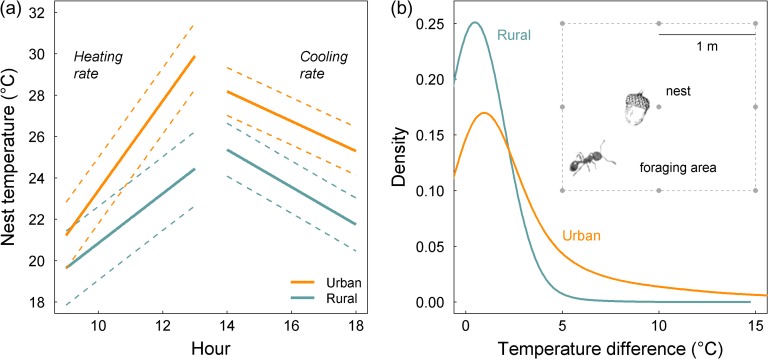
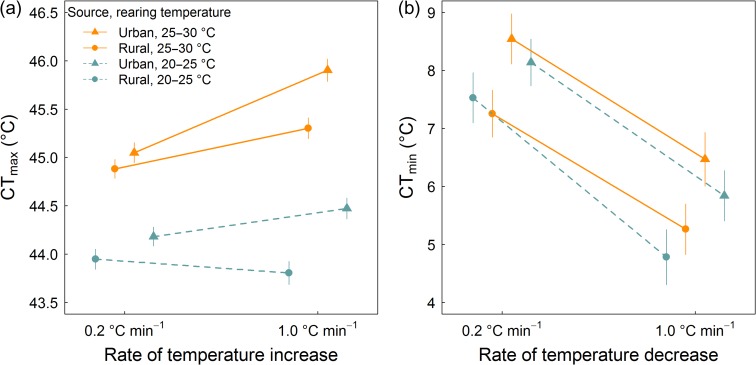
Because cities contain high levels of impervious surfaces and diminished buffering effects of vegetation cover, urbanized environments can warm faster over the day and exhibit more rapid warming over space due to greater thermal heterogeneity in these environments. Whether organismal physiologies can adapt to these more rapid spatio-temporal changes in temperature rise within cities is unknown, and exploring these responses can inform not only how plastic and evolutionary mechanisms shape organismal physiologies, but also the potential for organisms to cope with urban development. Here, we examined how plasticity in thermal tolerance under faster and slower rates of temperature change might evolve in response to the more rapid spatio-temporal temperature rise in cities. We focused on acorn ants, a temperature-sensitive, ground-dwelling ant species that makes its home inside hollowed out acorns. We reared acorn ant colonies from urban and rural populations under a common garden design in the laboratory and assessed the thermal tolerances of F1 offspring workers using both fast (1°C min) and slow (0.2°C min) rates of temperature change. Relative to the rural population, the urban population exhibited higher heat tolerance when the temperature was increased quickly, providing evidence that temperature ramp-rate plasticity evolved in the urban population. This result was correlated with both faster rates of diurnal warming in urban acorn ant nest sites and greater spatial heterogeneity in environmental temperature across urban foraging areas. By contrast, rates of diurnal cooling in acorn ant nest sites were similar across urban and rural habitats, and correspondingly, we found that urban and rural populations responded similarly to variation in the rate of temperature decrease when we assessed cold tolerance. Our study highlights the importance of considering not only evolutionary differentiation in trait means across urbanization gradients, but also how trait plasticity might or might not evolve.
由于城市中不透水表面的比例较高,植被覆盖的缓冲作用减弱,城市化环境在白天升温更快,且由于这些环境中更大的热不均匀性,在空间上升温也更快。生物体的生理机能能否适应城市中温度上升这种更快的时空变化尚不清楚,探索这些反应不仅可以了解可塑性和进化机制如何塑造生物体的生理机能,还能了解生物体应对城市发展的潜力。在这里,我们研究了在温度变化速度较快和较慢的情况下,热耐受性的可塑性如何随着城市中更快的时空温度上升而进化。我们聚焦于橡子蚁,这是一种对温度敏感的地栖蚂蚁物种,它们在中空的橡子内筑巢。我们在实验室的共同花园设计下饲养来自城市和农村种群的橡子蚁群落,并使用快速(每分钟1°C)和缓慢(每分钟0.2°C)的温度变化速率评估F1代工蚁的热耐受性。相对于农村种群,城市种群在温度快速升高时表现出更高的耐热性,这为城市种群中温度变化速率可塑性的进化提供了证据。这一结果与城市橡子蚁巢穴白天升温速度更快以及城市觅食区域环境温度的更大空间不均匀性相关。相比之下,城市和农村栖息地的橡子蚁巢穴夜间降温速率相似,相应地,我们发现当评估耐寒性时,城市和农村种群对温度下降速率变化的反应相似。我们的研究强调了不仅要考虑城市化梯度上性状均值的进化分化,还要考虑性状可塑性可能如何或是否会进化的重要性。