Chen Tianyan, Wang Jing, Qiu Hongtao, Yu Qiang, Yan Taotao, Qi Caijing, Cao Furong, Tian Zhen, Guo Dandan, Yao Naijuan, Yang Yuan, He Yingli, Zhao Yingren, Liu Jinfeng
Department of Infectious Diseases Department of Rheumatology and Immunology, the First Affiliated Hospital, Xi'an Jiaotong University Obstetric Department, Northwest Women's and Children's Hospital Department of Pediatric Surgery, the Second Affiliated Hospital Department of Gynaecology and Obstetrics Department of Neonatology, the First Affiliated Hospital, Xi'an Jiaotong University, Xi'an, Shaanxi Province, China.
Medicine (Baltimore). 2018 Jul;97(27):e11406. doi: 10.1097/MD.0000000000011406.
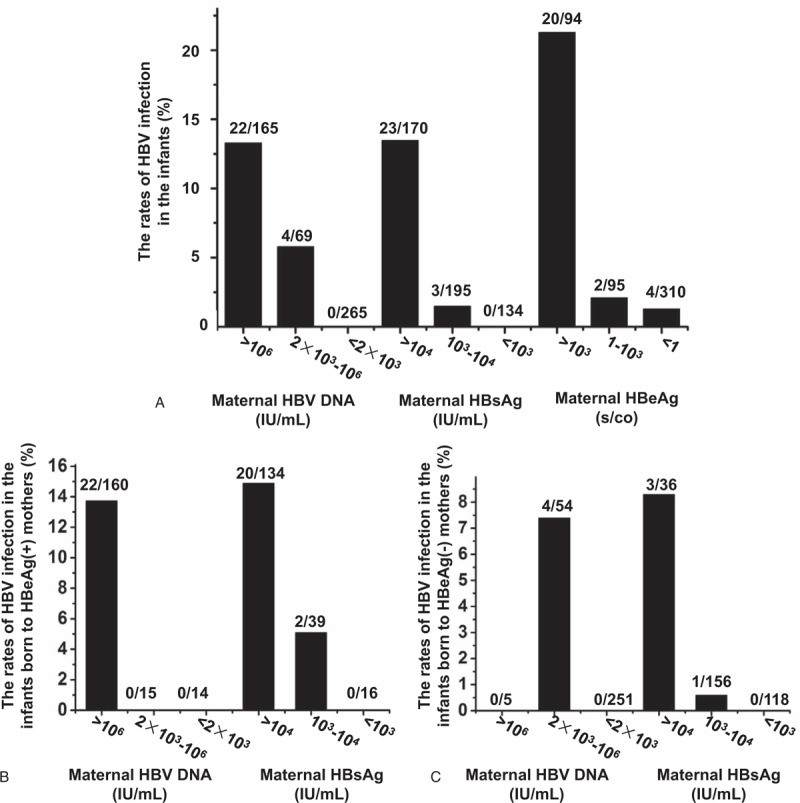
The seroprevalence of hepatitis B virus (HBV) and its impact on pregnancy outcomes of women from Shaanxi Province (China) was assessed. Risk factors for mother-to-child transmission (MTCT) were evaluated based on HBV-related seroprevalence data.Viral markers and biochemical parameters were assessed in HBsAg-positive mothers and their infants out of 13,451 cases recruited. A pretested and structured questionnaire was used to test the general HBV knowledge. Descriptive statistics and logistic regression analysis were done to reveal possible risk factors for MTCT.The overall prevalence of HBsAg in pregnant women was 7.07% (951/13,451), and a rate as high as 9.40% was observed. Among the HBsAg-positive pregnant women, 30.49% (290/951) were HBeAg-positive, 22.08% (210/951) had HBV DNA levels >10 IU/mL and only 16.19% with a high risk of MTCT (34/210) had received antiviral treatment. The overall MTCT rate was 5.21%. Noteworthy, the risk ratio and 95% confidence interval (95% CI) of MTCT in HBeAg-negative mothers with HBV DNA levels >2 × 10 IU/mL and HBsAg >10 IU/mL was 26.062 (2.633-258.024), which was significantly higher than that of HBeAg-positive mothers with HBV DNA level >10 IU/mL. Moreover, the awareness and knowledge about HBV transmission, risk factors, and intervention for MTCT were generally lacking among HBsAg-positive mothers.As a higher HBsAg seroprevalence and a higher MTCT rate among HBeAg-negative mothers with lower HBV DNA level was observed, our study emphasizes different interventional criteria for HBeAg-positive and HBeAg-negative mothers. Extensive health education, routine screening, and immunization against HBV during pregnancy are highly warranted to minimize the possibility of perinatal transmission.
评估了中国陕西省乙型肝炎病毒(HBV)的血清流行率及其对女性妊娠结局的影响。基于HBV相关血清流行率数据评估母婴传播(MTCT)的危险因素。在招募的13451例病例中,对HBsAg阳性母亲及其婴儿的病毒标志物和生化参数进行了评估。使用经过预测试的结构化问卷来测试一般的HBV知识。进行描述性统计和逻辑回归分析以揭示MTCT的可能危险因素。孕妇中HBsAg的总体流行率为7.07%(951/13451),观察到高达9.40%的比率。在HBsAg阳性孕妇中,30.49%(290/951)为HBeAg阳性,22.08%(210/951)的HBV DNA水平>10 IU/mL,而仅有16.19%有MTCT高风险(34/210)的孕妇接受了抗病毒治疗。总体MTCT率为5.21%。值得注意的是,HBV DNA水平>2×10 IU/mL且HBsAg>10 IU/mL的HBeAg阴性母亲的MTCT风险比及95%置信区间(95%CI)为26.062(2.633 - 258.024),显著高于HBV DNA水平>10 IU/mL的HBeAg阳性母亲。此外,HBsAg阳性母亲对HBV传播、危险因素及MTCT干预的认识和知识普遍缺乏。由于观察到较低HBV DNA水平的HBeAg阴性母亲中有较高的HBsAg血清流行率和较高的MTCT率,我们的研究强调了针对HBeAg阳性和HBeAg阴性母亲的不同干预标准。孕期广泛的健康教育、常规筛查和HBV免疫接种对于将围产期传播的可能性降至最低非常必要。