Division of Pulmonology, University Children's Hospital Basel, University of Basel, Basel, Switzerland.
Swiss Tropical and Public Health Institute, University of Basel, Basel, Switzerland.
PLoS One. 2018 Jul 6;13(7):e0200236. doi: 10.1371/journal.pone.0200236. eCollection 2018.
Many studies investigating the impact of individual risk factors on cord blood immune cell counts may be biased given that cord blood composition is influenced by a multitude of factors. The aim of this study was to comprehensively investigate the relative impact of environmental, hereditary and perinatal factors on cord blood cells.
In 295 neonates from the prospective Basel-Bern Infant Lung Development Cohort, we performed complete blood counts and fluorescence-activated cell sorting scans of umbilical cord blood. The associations between risk factors and cord blood cells were assessed using multivariable linear regressions.
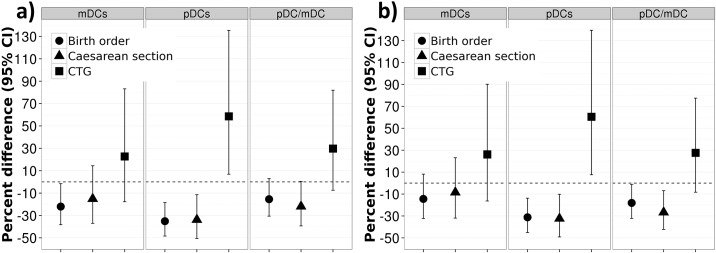
The multivariable regression analysis showed that an increase per 10μg/m3 of the average nitrogen dioxide 14 days before birth was associated with a decrease in leukocyte (6.7%, 95% CI:-12.1,-1.0) and monocyte counts (11.6%, 95% CI:-19.6,-2.8). Maternal smoking during pregnancy was associated with significantly lower cord blood cell counts in multiple cell populations. Moreover, we observed sex differences regarding eosinophilic granulocytes and plasmacytoid dendritic cells. Finally, significantly increased numbers of cord blood cells were observed in infants exposed to perinatal stress. Cesarean section seems to play a significant role in Th1/Th2 balance.
Our results suggest that all three: environmental, hereditary and perinatal factors play a significant role in the composition of cord blood cells at birth, and it is important to adjust for all of these factors in cord blood studies. In particular, perinatal circumstances seem to influence immune balance, which could have far reaching consequences in the development of immune mediated diseases.
许多研究调查了个体风险因素对脐血免疫细胞计数的影响,但由于脐血成分受多种因素影响,这些研究可能存在偏倚。本研究旨在全面研究环境、遗传和围产期因素对脐血细胞的相对影响。
在前瞻性的巴塞尔-伯尔尼婴儿肺发育队列的 295 名新生儿中,我们对脐带血进行了全血细胞计数和荧光激活细胞分选扫描。使用多变量线性回归评估危险因素与脐血细胞之间的关联。
多变量回归分析表明,出生前 14 天平均二氧化氮每增加 10μg/m3,白细胞(6.7%,95%CI:-12.1,-1.0)和单核细胞计数(11.6%,95%CI:-19.6,-2.8)降低。母亲在怀孕期间吸烟与多种细胞群的脐血细胞计数显著降低有关。此外,我们观察到嗜酸性粒细胞和浆细胞样树突状细胞存在性别差异。最后,在围产期应激暴露的婴儿中,观察到脐血细胞数量显著增加。剖宫产似乎在 Th1/Th2 平衡中发挥重要作用。
我们的结果表明,环境、遗传和围产期因素都对出生时脐血细胞的组成起着重要作用,在脐血研究中需要调整所有这些因素。特别是,围产期情况似乎会影响免疫平衡,这可能对免疫介导疾病的发展产生深远影响。