School of Psychology, Victoria University of Wellington, Wellington, New Zealand.
PLoS One. 2018 Jul 6;13(7):e0200295. doi: 10.1371/journal.pone.0200295. eCollection 2018.
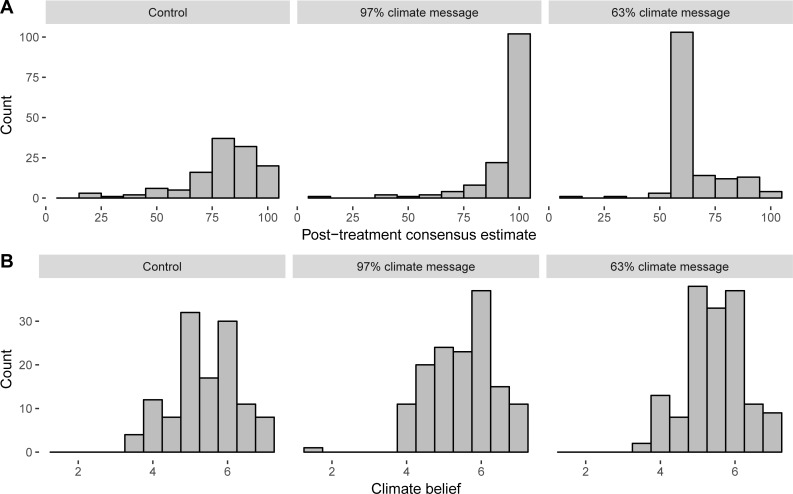
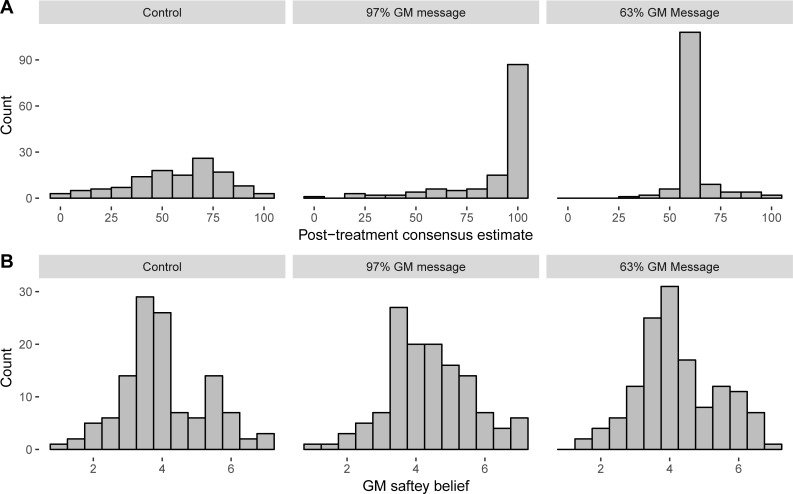
Despite an overwhelming scientific consensus, a sizable minority of people doubt that human activity is causing climate change. Communicating the existence of a scientific consensus has been suggested as a way to correct individuals' misperceptions about human-caused climate change and other scientific issues, though empirical support is mixed. We report an experiment in which psychology students were presented with consensus information about two issues, and subsequently reported their perception of the level of consensus and extent of their endorsement of those issues. We find that messages about scientific consensus on the reality of anthropogenic climate change and the safety of genetically modified food shift perceptions of scientific consensus. Using mediation models we also show that, for both these issues, high consensus messages also increase reported personal agreement with the scientific consensus, mediated by changes in perceptions of a scientific consensus. This confirms the role of perceived consensus in informing personal beliefs about climate change, though results indicate the impact of single, one-off messages may be limited.
尽管存在压倒性的科学共识,但仍有相当一部分人怀疑人类活动是否正在导致气候变化。人们提出,传达科学共识的存在是纠正个人对人为气候变化和其他科学问题的误解的一种方法,尽管实证支持存在分歧。我们报告了一项实验,在该实验中,心理学专业的学生接触了有关两个问题的共识信息,然后报告了他们对共识水平的看法以及对这些问题的认可程度。我们发现,有关人为气候变化现实和转基因食品安全性的科学共识信息改变了人们对科学共识的看法。通过中介模型,我们还表明,对于这两个问题,关于人为气候变化和转基因食品安全性的科学共识的高共识信息也会增加个人对科学共识的报告认同,这是由对科学共识看法的变化引起的。这证实了感知共识在告知个人对气候变化的看法方面的作用,尽管结果表明单次、一次性信息的影响可能有限。