Hales Susie A, Di Simplicio Martina, Iyadurai Lalitha, Blackwell Simon E, Young Kerry, Fairburn Christopher G, Geddes John R, Goodwin Guy M, Holmes Emily A
Oxford Institute of Clinical Psychology Training,Oxford,UK.
Centre for Psychiatry,Brain Sciences Division,Imperial College London,London,UK.
Behav Cogn Psychother. 2018 Nov;46(6):706-725. doi: 10.1017/S1352465818000334. Epub 2018 Jul 9.
Despite the global impact of bipolar disorder (BD), treatment success is limited. Challenges include syndromal and subsyndromal mood instability, comorbid anxiety, and uncertainty around mechanisms to target. The Oxford Mood Action Psychology Programme (OxMAPP) offered a novel approach within a cognitive behavioural framework, via mental imagery-focused cognitive therapy (ImCT).
This clinical audit evaluated referral rates, clinical outcomes and patient satisfaction with the OxMAPP service.
Eleven outpatients with BD received ImCT in addition to standard psychiatric care. Mood data were collected weekly from 6 months pre-treatment to 6 months post-treatment via routine mood monitoring. Anxiety was measured weekly from start of treatment until 1 month post-treatment. Patient feedback was provided via questionnaire.
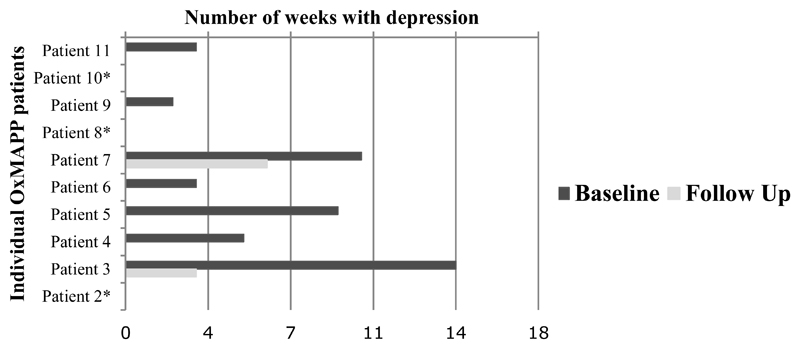
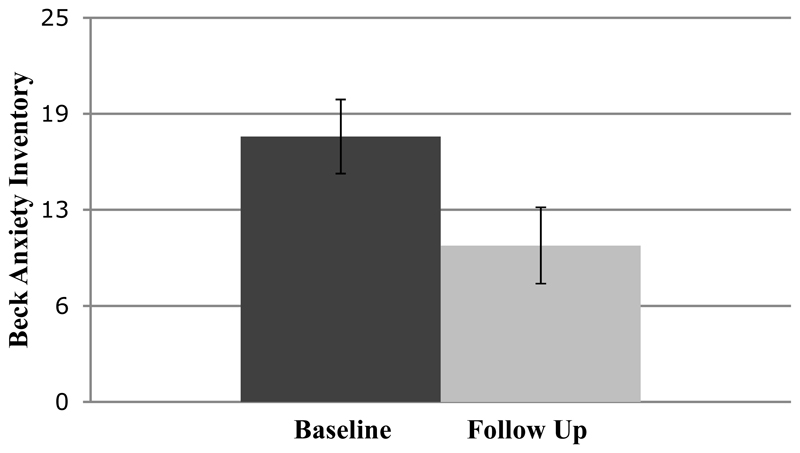
Referral and treatment uptake rates indicated acceptability to referrers and patients. From pre- to post-treatment, there was (i) a significant reduction in the duration of depressive episode relapses, and (ii) a non-significant trend towards a reduction in the number of episodes, with small to medium effect size. There was a large effect size for the reduction in weekly anxiety symptoms from assessment to 1 month follow-up. Patient feedback indicated high levels of satisfaction with ImCT, and underscored the importance of the mental imagery focus.
This clinical audit provides preliminary evidence that ImCT can help improve depressive and anxiety symptoms in BD as part of integrated clinical care, with high patient satisfaction and acceptability. Formal assessment designs are needed to further test the feasibility and efficacy of the new ImCT treatment on anxiety and mood instability.
尽管双相情感障碍(BD)具有全球影响,但治疗成功有限。挑战包括综合征性和亚综合征性情绪不稳定、共病焦虑以及针对治疗机制的不确定性。牛津情绪行动心理学项目(OxMAPP)在认知行为框架内提供了一种新方法,即通过以心理意象为重点的认知疗法(ImCT)。
本临床审计评估了OxMAPP服务的转诊率、临床结果和患者满意度。
11名BD门诊患者除接受标准精神科护理外,还接受了ImCT。通过常规情绪监测,从治疗前6个月到治疗后6个月每周收集情绪数据。从治疗开始到治疗后1个月每周测量焦虑情况。通过问卷调查收集患者反馈。
转诊率和治疗接受率表明转诊者和患者对该服务可接受。从治疗前到治疗后,(i)抑郁发作复发的持续时间显著缩短,(ii)发作次数有减少的非显著趋势,效应量小到中等。从评估到1个月随访,每周焦虑症状减少的效应量较大。患者反馈表明对ImCT的满意度很高,并强调了以心理意象为重点的重要性。
本临床审计提供了初步证据,表明作为综合临床护理的一部分,ImCT有助于改善BD患者的抑郁和焦虑症状,患者满意度和接受度较高。需要正式的评估设计来进一步测试新的ImCT治疗对焦虑和情绪不稳定的可行性和疗效。