Piaggio Niccolò, Pardini Matteo, Roccatagliata Luca, Scialò Carlo, Cabona Corrado, Bonzano Laura, Inglese Matilde, Mancardi Giovanni L, Caponnetto Claudia
1Department of Neuroscience, Rehabilitation, Ophthalmology, Genetics, Maternal and Child Health, University of Genova and IRCCS Azienda Ospedale Università San Martino-IST, Largo Rosanna Benzi 10, 16132 Genoa, Italy.
2Department of Health Sciences (DISSAL), University of Genova, Via Pastore 1, 16132 Genoa, Italy.
Eur Radiol Exp. 2018 Jun 22;2:13. doi: 10.1186/s41747-018-0045-6. eCollection 2018 Dec.
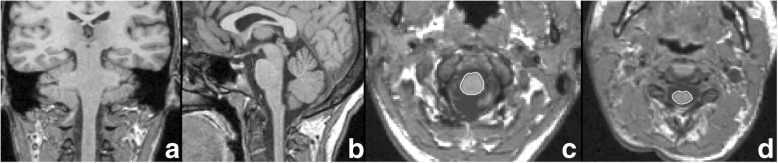
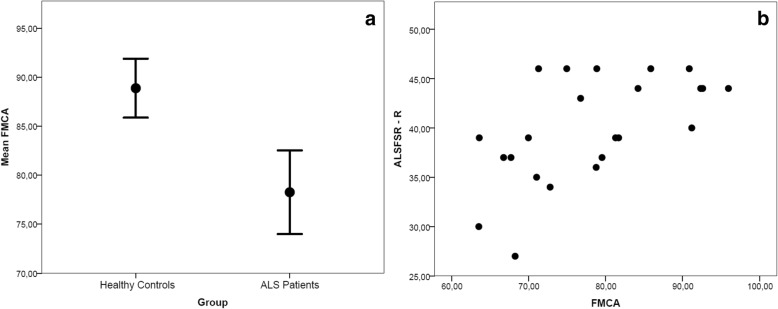
Spinal cord atrophy is one of the hallmarks of amyotrophic lateral sclerosis (ALS); however, it is not routinely assessed in routine clinical practice. In the present study, we evaluated whether spinal cord cross-sectional area measured at the foramen magnum level using a magnetic resonance imaging head scan represents a clinically meaningful measure to be added to the whole-brain volume assessment. Using an active surface approach, we measured the cord area at the foramen magnum and brain parenchymal fraction on T1-weighted three-dimensional spoiled gradient recalled head scans in two groups of subjects: 23 patients with ALS (males/females, 13/10; mean ± standard deviation [SD] age 61.7 ± 10.3 years; median ALS Functional Rating Scale-Revised score 39, range 27-46) and 18 age- and sex-matched healthy volunteers (mean ± SD age 55.7 ± 10.2 years). Spinal cord area at the foramen magnum was significantly less in patients than in control subjects and was significantly correlated with disability as measured with the ALS Functional Rating Scale-Revised (ρ = 0.593, < 0.005). This correlation remained significant after taking into account inter-individual differences in brain parenchymal fraction (ρ = 0.684, < 0.001). Our data show that spinal cord area at the foramen magnum correlates with disability in ALS independently of whole-brain atrophy, thus indicating its potential as a disease biomarker.
脊髓萎缩是肌萎缩侧索硬化症(ALS)的标志性特征之一;然而,在常规临床实践中并未对其进行常规评估。在本研究中,我们评估了使用磁共振成像头部扫描在枕骨大孔水平测量的脊髓横截面积是否代表一种有临床意义的测量方法,可添加到全脑体积评估中。我们采用主动表面法,在两组受试者的T1加权三维扰相梯度回波头部扫描上测量了枕骨大孔处的脊髓面积和脑实质分数:23例ALS患者(男/女,13/10;平均±标准差[SD]年龄61.7±10.3岁;ALS功能评定量表修订版评分中位数39,范围27 - 46)和18名年龄及性别匹配的健康志愿者(平均±SD年龄55.7±10.2岁)。患者枕骨大孔处的脊髓面积显著小于对照组,且与ALS功能评定量表修订版所测量的残疾程度显著相关(ρ = 0.593,< 0.005)。在考虑个体间脑实质分数差异后,这种相关性仍然显著(ρ = 0.684,< 0.001)。我们的数据表明,枕骨大孔处的脊髓面积与ALS患者的残疾程度相关,且独立于全脑萎缩,因此表明其作为疾病生物标志物的潜力。