Department of Physics, University of Chicago, Chicago, United States.
The James Franck Institute, University of Chicago, Chicago, United States.
Elife. 2018 Jul 10;7:e37624. doi: 10.7554/eLife.37624.
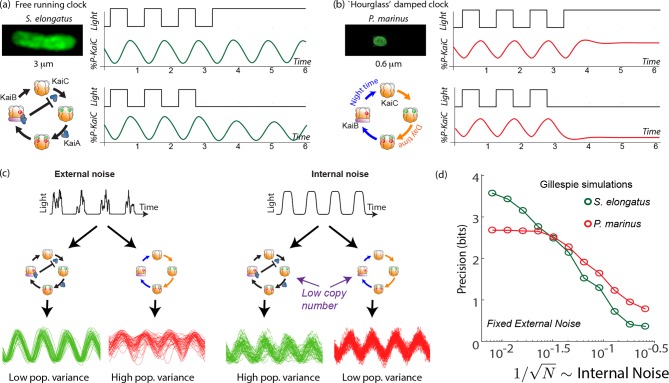
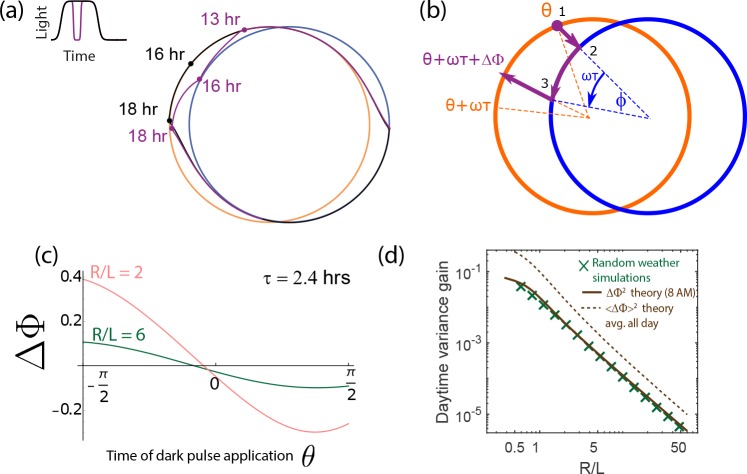
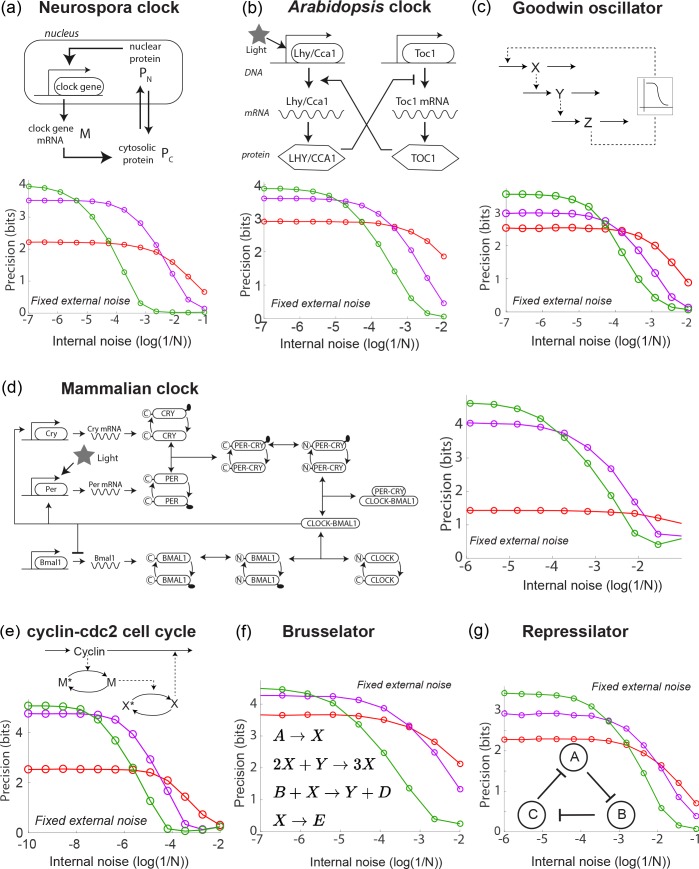
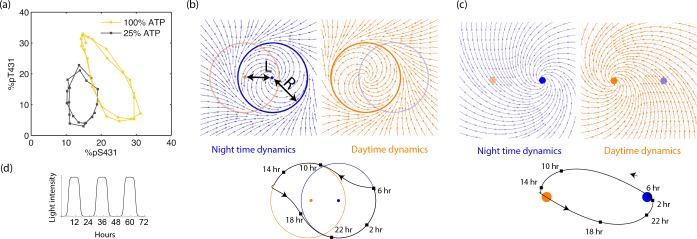
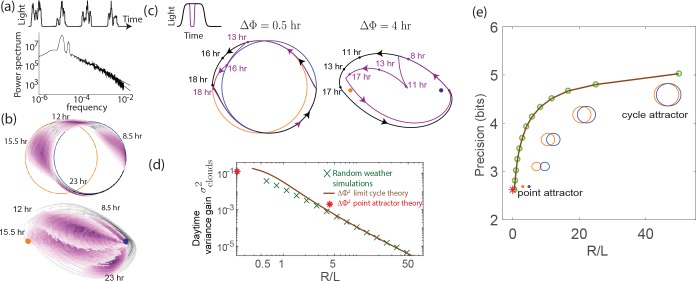
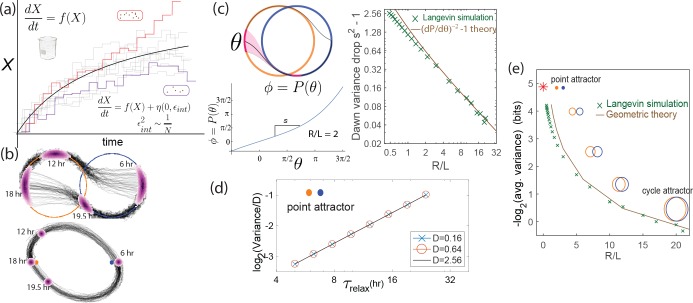
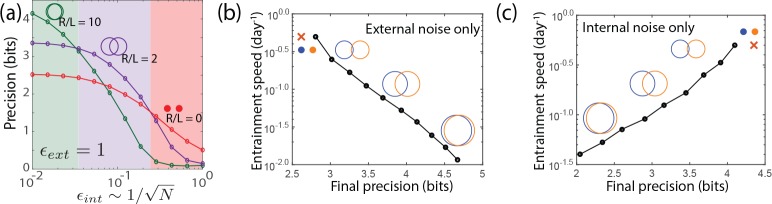
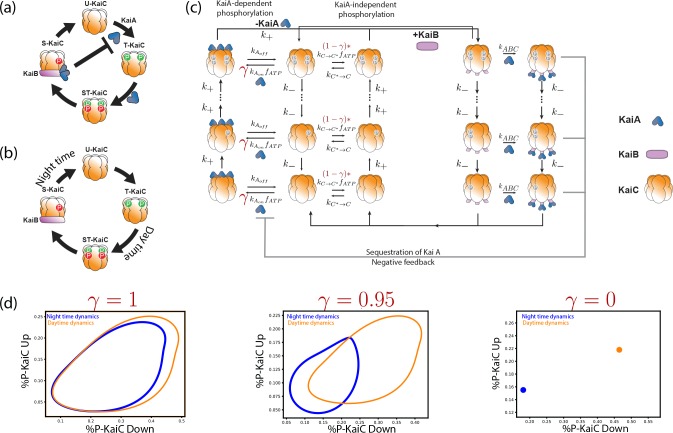
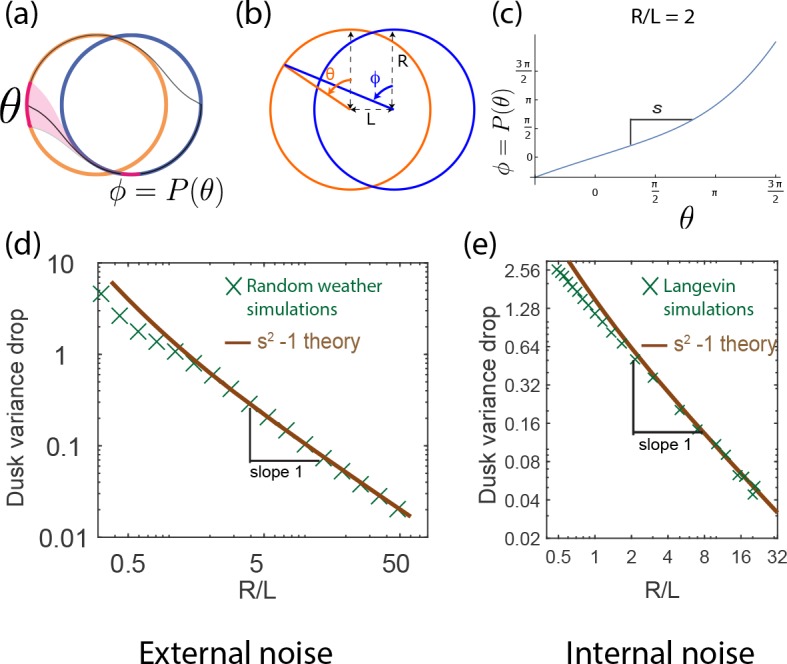
Many organisms use free running circadian clocks to anticipate the day night cycle. However, others organisms use simple stimulus-response strategies ('hourglass clocks') and it is not clear when such strategies are sufficient or even preferable to free running clocks. Here, we find that free running clocks, such as those found in the cyanobacterium and humans, can efficiently project out light intensity fluctuations due to weather patterns ('external noise') by exploiting their limit cycle attractor. However, such limit cycles are necessarily vulnerable to 'internal noise'. Hence, at sufficiently high internal noise, point attractor-based 'hourglass' clocks, such as those found in a smaller cyanobacterium with low protein copy number, , can outperform free running clocks. By interpolating between these two regimes in a diverse range of oscillators drawn from across biology, we demonstrate biochemical clock architectures that are best suited to different relative strengths of external and internal noise.
许多生物利用自由运行的生物钟来预测昼夜周期。然而,其他生物则采用简单的刺激-反应策略(“沙漏时钟”),目前尚不清楚这些策略何时足以满足需求,甚至何时比自由运行的时钟更可取。在这里,我们发现,自由运行的生物钟,如蓝藻和人类中的生物钟,可以通过利用其极限环吸引子有效地预测由于天气模式(“外部噪声”)引起的光强度波动。然而,这种极限环必然容易受到“内部噪声”的影响。因此,在足够高的内部噪声下,基于点吸引子的“沙漏”时钟,如在低蛋白拷贝数的较小蓝藻中发现的那种,能够胜过自由运行的时钟。通过在来自生物学各个领域的各种振荡器之间进行这两种模式的插值,我们展示了最适合不同外部和内部噪声相对强度的生化时钟结构。