Institute of Chinese Medical Sciences, State Key Laboratory of Quality Research in Chinese Medicine, University of Macau, Macao SAR, China,
Department of Pharmaceutics, China Pharmaceutical University, Nanjing, Jiangsu, China.
Int J Nanomedicine. 2018 Jun 28;13:3781-3793. doi: 10.2147/IJN.S163763. eCollection 2018.
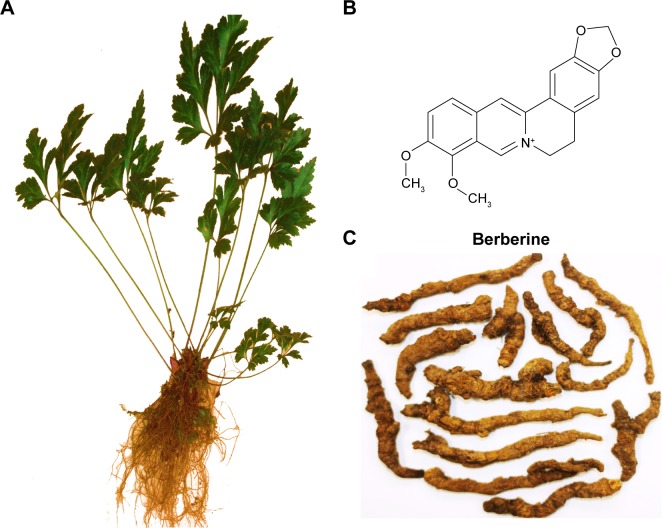
Berberine (BBR) is a plant-derived benzylisoquinoline alkaloid and has been demonstrated to be a potential treatment for various chronic diseases. The poor water solubility and P-glycoprotein (Pgp)-mediated drug efflux are the main challenges for its further application in a clinical setting.
In this study, a Brij-S20 (BS20)-modified nanocrystal formulation (BBR-BS20-NCs) has been developed and investigated with the purpose of improving the intestinal absorption of BBR. The physicochemical properties of the developed BBR-BS20-NCs were characterized and the enhancement of the BBR-BS20-NCs on BBR absorption were investigated both in vitro and in vivo.
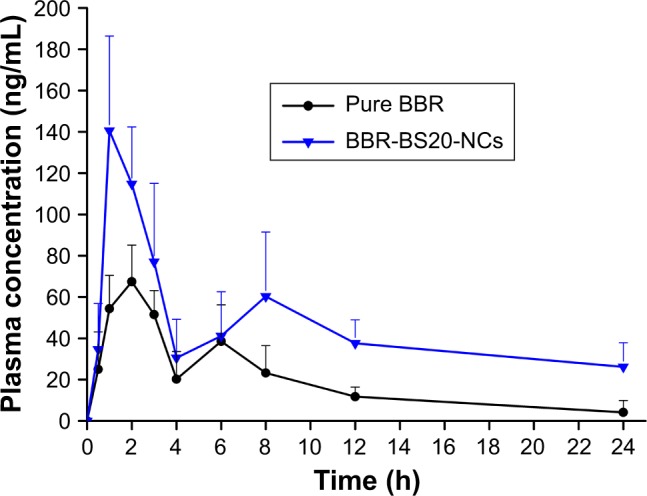
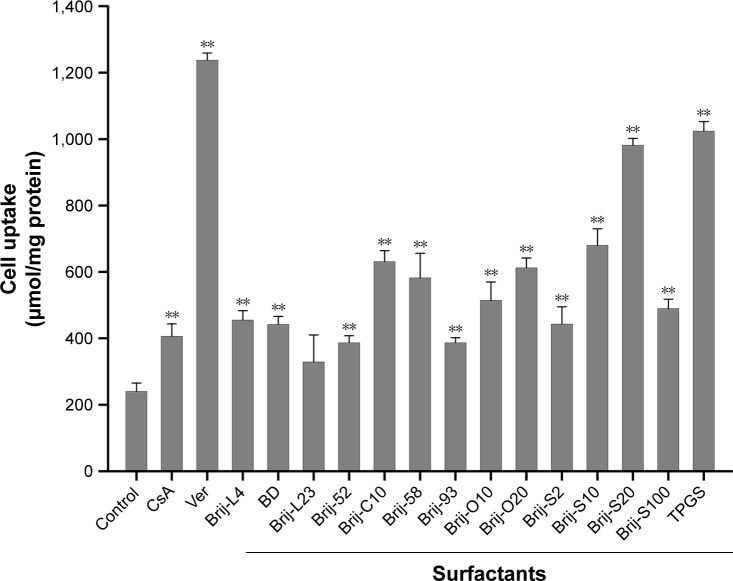
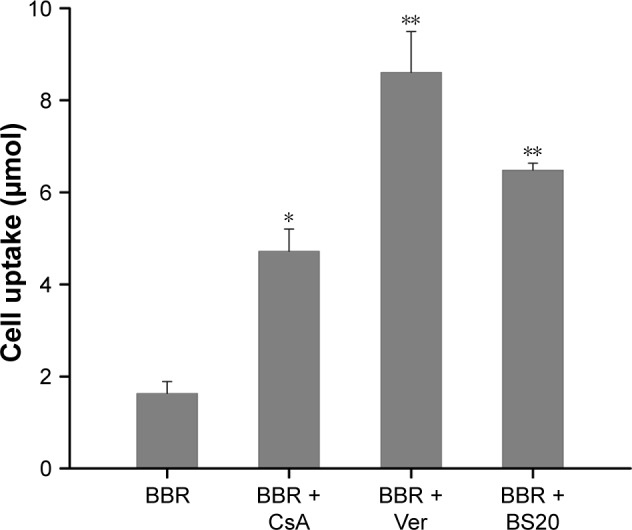
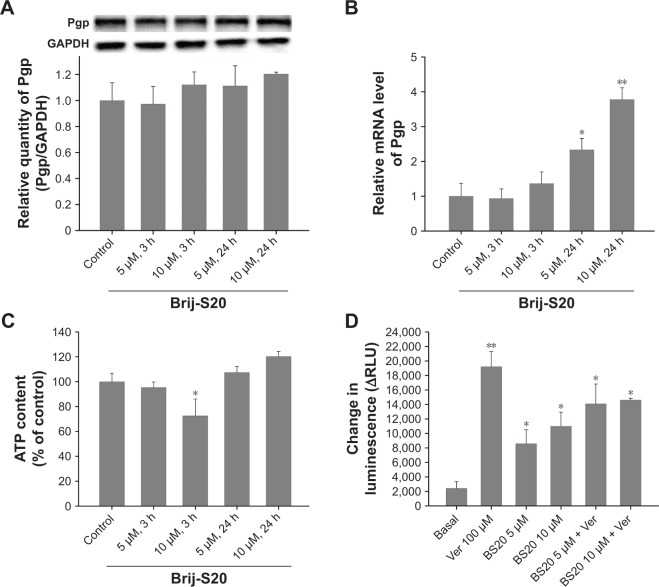
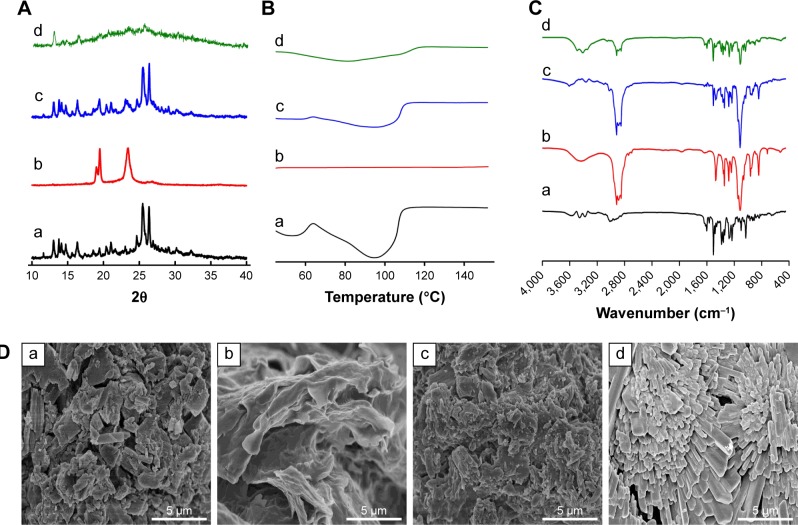
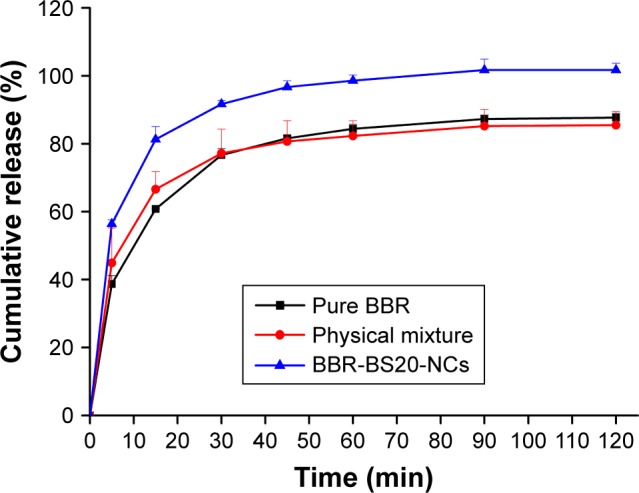
The results indicated that BS20 could significantly enhance the intracellular uptake of BBR in MDCK-MDR1 cells via a short-term and reversible modulation on the Pgp function, accompanied by a marked increase in Pgp mRNA expression but without significant influence on the Pgp protein expression. Moreover, the morphology of the prepared BBR-BS20-NCs was observed to be prism-like, with a smooth surface and an average diameter of 148.0 ± 3.2 nm. Compared to raw BBR and physical mixture, BBR-BS20-NCs facilitated the dissolution rate and extent of release of BBR in aqueous solution, and further increased the absorption of BBR in MDCK-MDR1 monolayer by overcoming the Pgp-mediated secretory transport ([BL-AP] values of 2.85 ± 0.04 × 10 cm/s, 2.21 ± 0.14 × 10 cm/s, and 2.00 ± 0.07 × 10 cm/s for pure BBR, physical mixture, and BBR-BS20-NCs, respectively). Significant improvements in the maximum concentration observed (C) and area under drug concentration-time curve (AUC) of BBR-BS20-NCs were obtained in pharmacokinetic studies compared to pure BBR, and the relative bioavailability of BBR-BS20-NCs to pure BBR was 404.1%.
The developed BBR-BS20-NCs combine the advantages of nanocrystal formulation and functional excipient. The novel pharmaceutical design provides a new strategy to improve the oral bioavailability of those drugs with both poor water solubility and Pgp-mediated efflux.
小檗碱(BBR)是一种植物衍生的苯并异喹啉生物碱,已被证明是治疗各种慢性疾病的潜在药物。其较差的水溶性和 P 糖蛋白(Pgp)介导的药物外排是其在临床应用中进一步应用的主要挑战。
在本研究中,开发了一种 Brij-S20(BS20)修饰的纳米晶体制剂(BBR-BS20-NCs),旨在提高 BBR 的肠道吸收。对所开发的 BBR-BS20-NCs 的理化性质进行了表征,并在体外和体内研究了 BBR-BS20-NCs 对 BBR 吸收的增强作用。
结果表明,BS20 可通过短期和可逆调节 Pgp 功能显著增加 MDCK-MDR1 细胞中 BBR 的细胞内摄取,同时显著增加 Pgp mRNA 表达,但对 Pgp 蛋白表达无显著影响。此外,所制备的 BBR-BS20-NCs 的形态观察为棱柱形,表面光滑,平均直径为 148.0 ± 3.2nm。与原料药和物理混合物相比,BBR-BS20-NCs 促进了 BBR 在水溶液中的溶解速率和释放程度,并通过克服 Pgp 介导的分泌转运进一步增加了 MDCK-MDR1 单层中 BBR 的吸收([BL-AP] 值分别为 2.85 ± 0.04×10cm/s、2.21 ± 0.14×10cm/s 和 2.00 ± 0.07×10cm/s 用于纯 BBR、物理混合物和 BBR-BS20-NCs)。与纯 BBR 相比,药代动力学研究中 BBR-BS20-NCs 的最大浓度(C)和药物浓度-时间曲线下面积(AUC)均得到显著改善,BBR-BS20-NCs 相对于纯 BBR 的相对生物利用度为 404.1%。
所开发的 BBR-BS20-NCs 结合了纳米晶体制剂和功能性赋形剂的优势。这种新的药物设计为提高那些具有较差水溶性和 Pgp 介导外排的药物的口服生物利用度提供了一种新策略。