Kolkhir Pavel, Pogorelov Dmitry, Darlenski Razvigor, Caminati Marco, Tanno Luciana Kase, Le Pham Duy, Gonzalez-Estrada Alexei, Antolín-Amérigo Darío, Dimov Ves, Weller Karsten, Sánchez-Borges Mario, Ansotegui Ignacio, Maurer Marcus
1Division of Immune-mediated skin diseases, I.M. Sechenov First Moscow State Medical University, 119991, Trubeckaya str., 8/2, Moscow, Russian Federation.
2Department of Infection and Immunity, Luxembourg Institute of Health, Esch-sur-Alzette, Luxembourg.
World Allergy Organ J. 2018 Jul 4;11(1):14. doi: 10.1186/s40413-018-0193-4. eCollection 2018.
The approaches to the diagnosis and treatment of chronic spontaneous urticaria (CSU) differ in various parts of the world. We sought to determine the adherence to international and national urticaria guidelines as well as the motives to deviate from the guidelines among physicians worldwide.
A web-based questionnaire was created and launched via e-mail by the World Allergy Organization (WAO) to representatives of all WAO Member Societies, the members of the American Academy of Allergy, Asthma & Immunology (AAAAI) and the members of the WAO Junior Members Group (JMG), regardless of the specialty, affiliation, or nationality in March 2017.
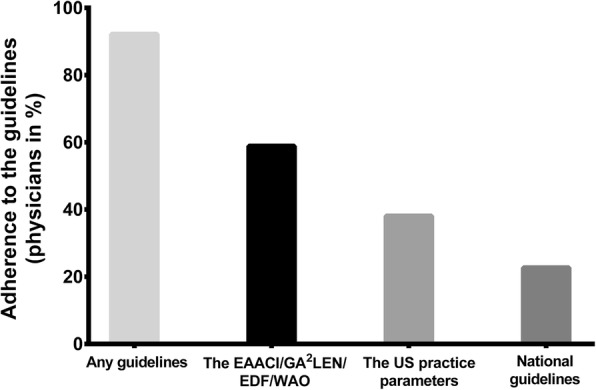
We received 1140 completed surveys from participating physicians from 99 countries. Virtually all participants (96%) were aware of at least one urticaria guideline and reported that they follow a guideline. However, one in five physicians who follow a guideline (22%) reported to deviate from it. Reliance on own clinical experience is the most frequent reason for deviation from guidelines or not following them (44%). Young (< 40 years) and less experienced physicians more often follow a guideline and less often deviate than older and experienced ones. Physicians who follow a urticaria guideline showed higher rates of routinely ordering a complete blood count, the erythrocyte sedimentation rate, C-reactive protein, anti-thyroid antibodies, and thyroid-stimulating hormone and of performing the autologous serum skin test as compared to those who do not. Physicians who follow a urticaria guideline showed higher rates of using second generation antihistamines as their first-line treatment of CSU ( = 0.001) and more frequently observed higher efficacy of these drugs (or had more confidence that it would work, < 0.019) as compared to those who do not follow the guidelines.
Physicians' characteristics (e.g. age, clinical experience, and specialty) and country specifics and regional features (e.g. availability of drugs for CSU treatment) importantly influence adherence to urticaria guidelines and CSU patient care and should be addressed in more detail in future research.
慢性自发性荨麻疹(CSU)的诊断和治疗方法在世界不同地区存在差异。我们试图确定全球医生对国际和国家荨麻疹指南的遵循情况以及偏离指南的动机。
世界过敏组织(WAO)于2017年3月通过电子邮件向所有WAO成员协会的代表、美国过敏、哮喘与免疫学会(AAAAI)的成员以及WAO青年成员组(JMG)的成员创建并发放了一份基于网络的问卷,无论其专业、所属机构或国籍如何。
我们收到了来自99个国家参与调查的医生的1140份完整调查问卷。几乎所有参与者(96%)都知晓至少一项荨麻疹指南,并报告他们遵循指南。然而,在遵循指南的医生中,五分之一(22%)报告称会偏离指南。依赖自身临床经验是偏离指南或不遵循指南的最常见原因(44%)。年轻(<40岁)且经验较少的医生比年长且经验丰富的医生更常遵循指南,偏离的情况更少。与不遵循荨麻疹指南的医生相比,遵循该指南的医生在常规进行全血细胞计数、红细胞沉降率、C反应蛋白、抗甲状腺抗体和促甲状腺激素检测以及进行自体血清皮肤试验方面的比例更高。与不遵循指南的医生相比,遵循荨麻疹指南的医生在将第二代抗组胺药作为CSU一线治疗药物的使用率更高(P = 0.001),并且更频繁地观察到这些药物具有更高的疗效(或对其疗效更有信心,P < 0.019)。
医生的特征(如年龄、临床经验和专业)以及国家具体情况和地区特点(如CSU治疗药物的可获得性)对遵循荨麻疹指南和CSU患者护理有重要影响,未来研究应更详细地探讨这些问题。