Faculty of Veterinary Medicine, University of Helsinki, Helsinki, Finland.
Sydspetsens miljöhälsa, Hangö, Finland.
Euro Surveill. 2018 Jul;23(27). doi: 10.2807/1560-7917.ES.2018.23.27.1700497.
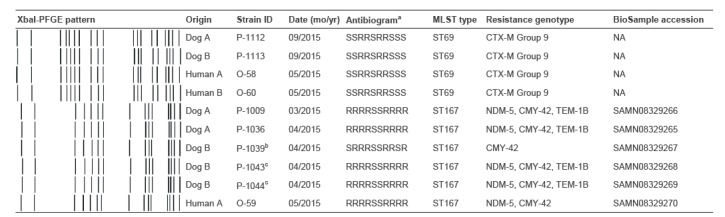
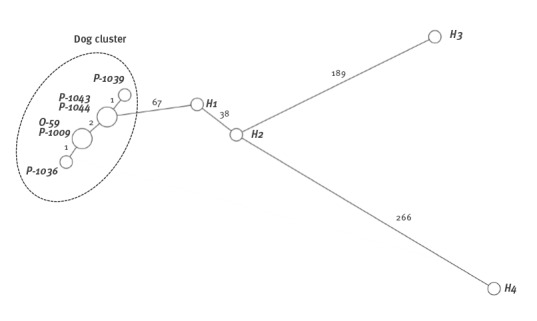
IntroductionCarbapenemase-producing (CPE) have rarely been reported in dogs, and never in animals in Finland. However, in April 2015, two meropenem-resistant were identified from two dogs in one family. Both dogs suffered from chronic . Epidemiological and molecular investigations (pulsed-field gel electrophoresis (PFGE), multilocus sequence typing) were conducted to investigate the source of infection and transmission routes. In both dogs and one family member New Delhi metallo-beta-lactamase (NDM-5)-producing multidrug-resistant ST167 was found. Whole genome sequencing confirmed that the isolates were identical or only had one or two allelic differences. Additionally, the dogs and humans of the family carried an identical extended-spectrum beta-lactamase (ESBL) CTX-M-group 9 ST69 strain, indicating interspecies transmission. While the original source remains unclear, human-to-canine transmission is possible. No carbapenems had been administered to the dogs, but exposure to numerous other antimicrobials likely sustained the bacteria and supported its propagation in the canine host. To our knowledge, canine clinical NDM-5 in Europe, and confirmed CPE transmission between dogs and humans have not been previously reported. The screening of veterinary isolates for carbapenem resistance is highly recommended.
介绍
产碳青霉烯酶 (CPE)在狗中很少见,在芬兰的动物中从未见过。然而,2015 年 4 月,在一个家庭的两只狗中发现了两株美罗培南耐药菌。这两只狗都患有慢性疾病。进行了流行病学和分子调查(脉冲场凝胶电泳(PFGE)、多位点序列分型),以调查感染源和传播途径。在两只狗和一名家庭成员中发现了携带新德里金属β-内酰胺酶(NDM-5)的多药耐药 ST167。全基因组测序证实分离株完全相同或仅有一个或两个等位基因差异。此外,该家庭的狗和人携带相同的扩展谱β-内酰胺酶(ESBL)CTX-M 组 9 ST69 菌株,表明存在种间传播。虽然原始来源尚不清楚,但人类向犬类的传播是可能的。这些狗没有使用碳青霉烯类药物,但接触到许多其他抗生素可能维持了细菌的存活,并支持其在犬宿主中的繁殖。据我们所知,这是在欧洲首次报道犬科动物临床 NDM-5,以及确认的 CPE 在狗和人类之间传播。强烈建议对兽医分离株进行碳青霉烯类耐药性筛查。