Department of Medicine, Thoracic Oncology Service, Division of Solid Tumor Oncology, Memorial Sloan Kettering Cancer Center, New York, New York.
Oncology Center, Hospital Sirio-Libanês, Sao Paulo, Brazil.
Cancer Immunol Res. 2018 Sep;6(9):1093-1099. doi: 10.1158/2326-6066.CIR-17-0755. Epub 2018 Jul 10.
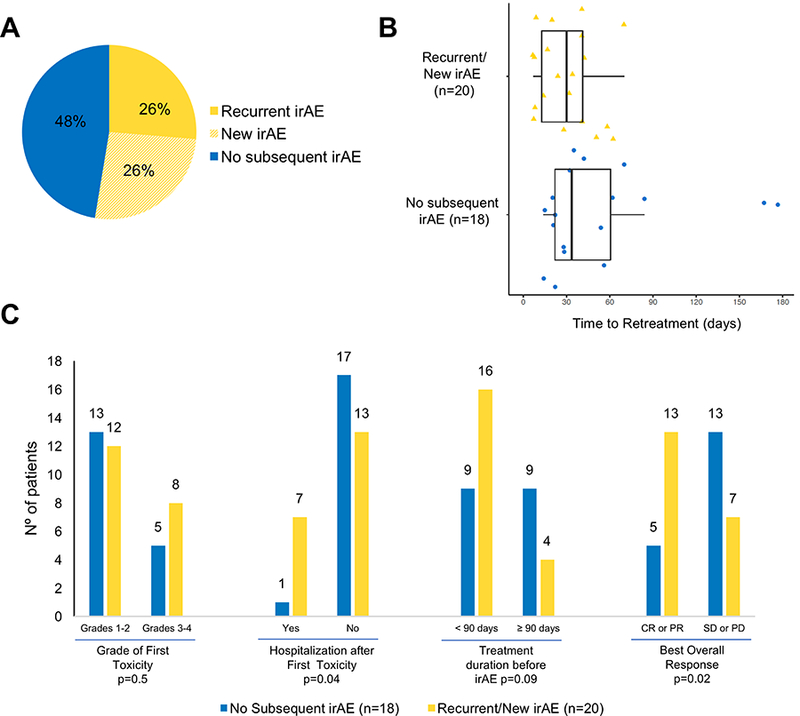
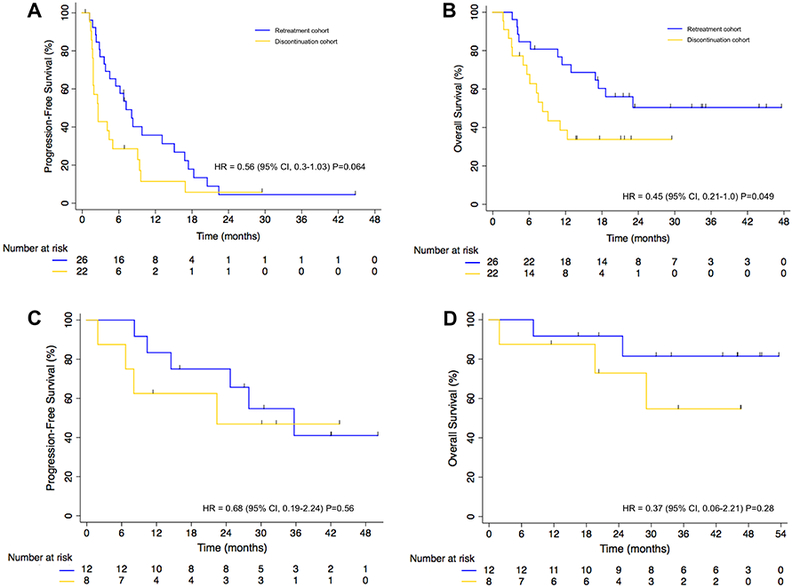
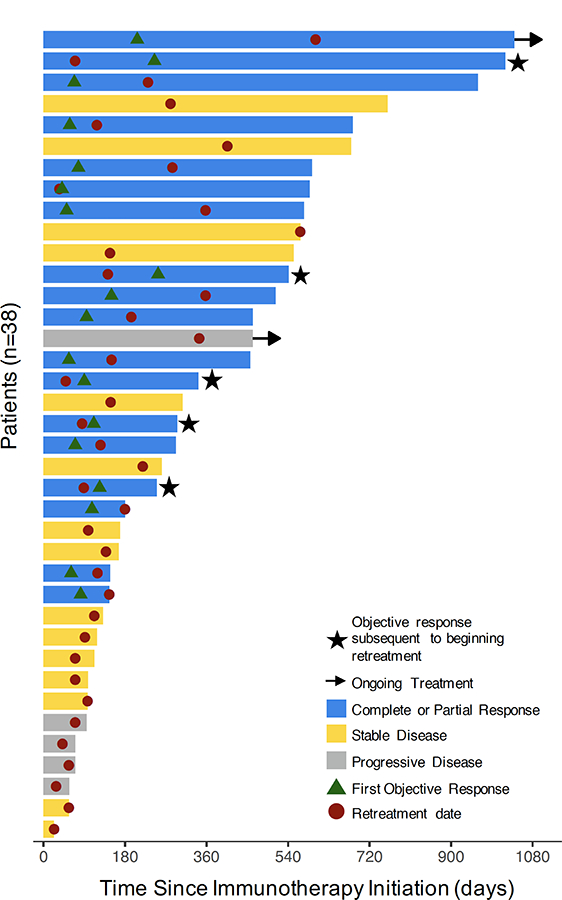
Considering retreatment following recovery from an immune-related adverse event (irAE) is a common clinical scenario, but the safety and benefit of retreatment is unknown. We identified patients with advanced non-small cell lung cancer (NSCLC) treated with anti-PD-(L)1 who had treatment held due to irAEs and divided them into two groups: those retreated with anti-PD-(L)1 (retreatment cohort) or those who had treatment stopped (discontinuation cohort). Out of 482 NSCLC patients treated with anti-PD-(L)1, 68 (14%) developed a serious irAE requiring treatment interruption. Of these, 38 (56%) were retreated and 30 (44%) had treatment discontinued. In the retreatment cohort, 18 (48%) patients had no subsequent irAEs, 10 (26%) had recurrence of the initial irAE, and 10 (26%) had a new irAE. Most recurrent/new irAEs were mild (58% grade 1-2) and manageable (84% resolved or improved to grade 1). Two treatment-related deaths occurred. Recurrent/new irAEs were more likely if the initial irAE required hospitalization, but the initial grade and time to retreatment did not influence risk. Among those with no observed partial responses prior to the irAE, progression-free survival (PFS) and overall survival (OS) were longer in the retreatment cohort. Conversely, for those with objective responses prior to the irAE, PFS and OS were similar in the retreatment and discontinuation cohorts. Among patients with early objective responses prior to a serious irAE, outcomes were similar, whether or not they were retreated. Together, data suggest that benefit may occur with retreatment in patients with irAEs who had no treatment response prior to irAE onset. .
考虑到在免疫相关不良事件 (irAE) 缓解后进行补救治疗是一种常见的临床情况,但补救治疗的安全性和获益尚不清楚。我们确定了接受抗 PD-(L)1 治疗的晚期非小细胞肺癌 (NSCLC) 患者,这些患者因 irAE 而暂停治疗,并将他们分为两组:接受抗 PD-(L)1 补救治疗的患者(补救治疗组)或停止治疗的患者(停药组)。在接受抗 PD-(L)1 治疗的 482 例 NSCLC 患者中,有 68 例(14%)发生需要中断治疗的严重 irAE。其中,38 例(56%)接受补救治疗,30 例(44%)停止治疗。在补救治疗组中,18 例(48%)患者无后续 irAE,10 例(26%)患者最初的 irAE 复发,10 例(26%)患者出现新的 irAE。大多数复发性/新的 irAE 为轻度(58% 为 1-2 级),且可控制(84% 缓解或降至 1 级)。发生了 2 例与治疗相关的死亡。如果初始 irAE 需要住院治疗,则更有可能发生复发性/新的 irAE,但初始 irAE 等级和补救治疗时间并不影响风险。在 irAE 发生前无观察到部分缓解的患者中,补救治疗组的无进展生存期 (PFS) 和总生存期 (OS) 更长。相反,在 irAE 发生前有客观缓解的患者中,补救治疗组和停药组的 PFS 和 OS 相似。在发生严重 irAE 前有早期客观缓解的患者中,无论是否接受补救治疗,结局相似。总的来说,数据表明,对于在 irAE 发生前无治疗反应的 irAE 患者,补救治疗可能会带来获益。