Cancer Research UK, London, EC1V 4AD, UK.
Cancer Research UK/MRC Oxford Institute for Radiation Oncology, University of Oxford, Oxford, OX3 7DQ, UK.
Br J Cancer. 2018 Jul;119(2):220-229. doi: 10.1038/s41416-018-0156-0. Epub 2018 Jul 11.
Immunohistochemistry (IHC) is often used in personalisation of cancer treatments. Analysis of large data sets to uncover predictive biomarkers by specialists can be enormously time-consuming. Here we investigated crowdsourcing as a means of reliably analysing immunostained cancer samples to discover biomarkers predictive of cancer survival.
We crowdsourced the analysis of bladder cancer TMA core samples through the smartphone app 'Reverse the Odds'. Scores from members of the public were pooled and compared to a gold standard set scored by appropriate specialists. We also used crowdsourced scores to assess associations with disease-specific survival.
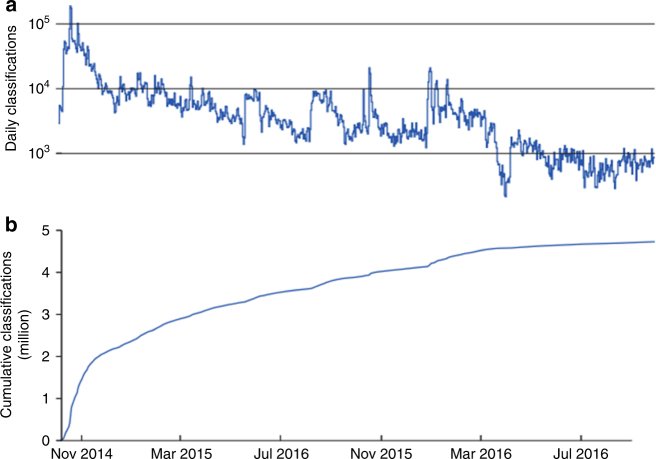
Data were collected over 721 days, with 4,744,339 classifications performed. The average time per classification was approximately 15 s, with approximately 20,000 h total non-gaming time contributed. The correlation between crowdsourced and expert H-scores (staining intensity × proportion) varied from 0.65 to 0.92 across the markers tested, with six of 10 correlation coefficients at least 0.80. At least two markers (MRE11 and CK20) were significantly associated with survival in patients with bladder cancer, and a further three markers showed results warranting expert follow-up.
Crowdsourcing through a smartphone app has the potential to accurately screen IHC data and greatly increase the speed of biomarker discovery.
免疫组织化学(IHC)常用于癌症治疗的个体化。专家分析大型数据集以发现预测性生物标志物可能非常耗时。在这里,我们研究了众包作为一种可靠的方法,用于分析免疫染色的癌症样本,以发现预测癌症生存的生物标志物。
我们通过智能手机应用程序“逆转 Odds”对膀胱癌 TMA 核心样本进行了众包分析。公众成员的评分被汇集并与由适当专家评分的黄金标准进行比较。我们还使用众包评分来评估与疾病特异性生存的关联。
在 721 天内收集了数据,共进行了 4744339 次分类。每次分类的平均时间约为 15 秒,总共贡献了大约 20000 小时的非游戏时间。在测试的标记物中,众包和专家 H 评分(染色强度×比例)之间的相关性从 0.65 到 0.92 不等,其中至少有 0.80 的 10 个相关系数中有 6 个。至少有两个标记物(MRE11 和 CK20)与膀胱癌患者的生存显著相关,另外三个标记物的结果值得专家进一步跟进。
通过智能手机应用程序进行众包具有准确筛选 IHC 数据并大大加快生物标志物发现速度的潜力。