Division of Chemistry and Chemical Engineering, California Institute of Technology, 1200 E California Blvd., Pasadena, CA, 91125, USA.
Advanced Concepts Team, European Space Agency, ESTEC, Keplerlaan 1, Noordwijk, 2200, AG, The Netherlands.
Nat Commun. 2018 Jul 10;9(1):2527. doi: 10.1038/s41467-018-04844-y.
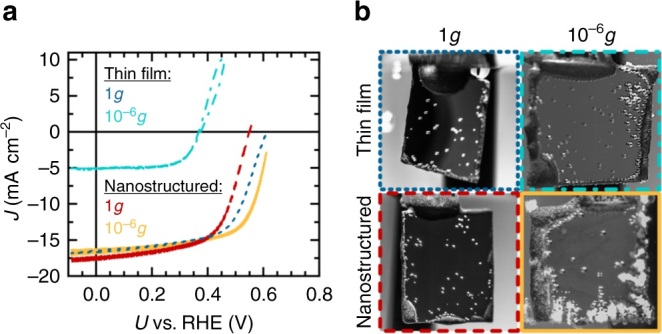
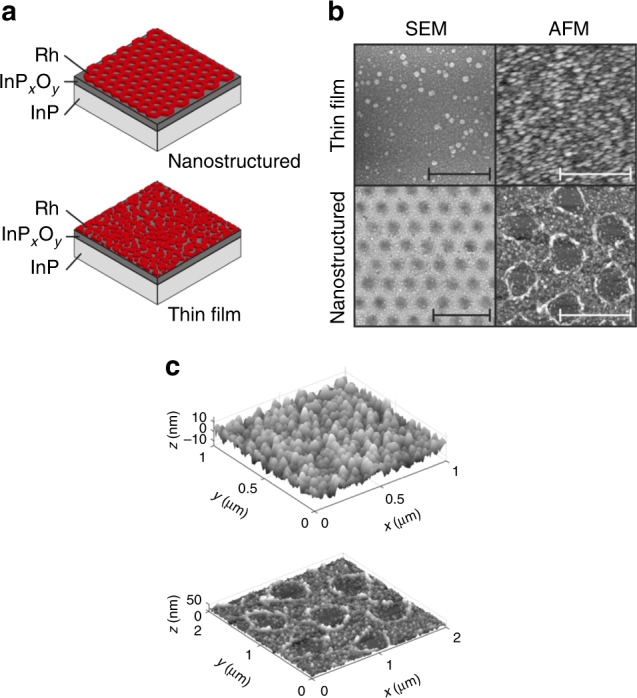
Long-term space missions require extra-terrestrial production of storable, renewable energy. Hydrogen is ascribed a crucial role for transportation, electrical power and oxygen generation. We demonstrate in a series of drop tower experiments that efficient direct hydrogen production can be realized photoelectrochemically in microgravity environment, providing an alternative route to existing life support technologies for space travel. The photoelectrochemical cell consists of an integrated catalyst-functionalized semiconductor system that generates hydrogen with current densities >15 mA/cm in the absence of buoyancy. Conditions are described adverting the resulting formation of ion transport blocking froth layers on the photoelectrodes. The current limiting factors were overcome by controlling the micro- and nanotopography of the Rh electrocatalyst using shadow nanosphere lithography. The behaviour of the applied system in terrestrial and microgravity environment is simulated using a kinetic transport model. Differences observed for varied catalyst topography are elucidated, enabling future photoelectrode designs for use in reduced gravity environments.
长期的太空任务需要在地球以外生产可储存的可再生能源。氢气在交通运输、电力和氧气生成方面被认为具有关键作用。我们通过一系列的落塔实验证明,在微重力环境下可以通过光电化学方法高效地直接生产氢气,为现有的航天生命支持技术提供了一种替代途径。光电化学电池由集成的催化剂功能化半导体系统组成,在没有浮力的情况下,电流密度>15 mA/cm2 时可产生氢气。文中描述了如何避免在光电电极上形成阻碍离子传输的泡沫层。通过使用阴影纳米球光刻技术控制 Rh 电催化剂的微观和纳观形貌,克服了电流限制因素。使用动力学输运模型模拟了应用系统在地面和微重力环境中的行为。阐明了不同催化剂形貌的差异,为在微重力环境下使用的光电电极设计提供了参考。