• 文献检索
  • 文档翻译
  • 深度研究
  • 学术资讯
  • Suppr Zotero 插件Zotero 插件
  • 邀请有礼
  • 套餐&价格
  • 历史记录
应用&插件
Suppr Zotero 插件Zotero 插件浏览器插件Mac 客户端Windows 客户端微信小程序
定价
高级版会员购买积分包购买API积分包
服务
文献检索文档翻译深度研究API 文档MCP 服务
关于我们
关于 Suppr公司介绍联系我们用户协议隐私条款
关注我们

Suppr 超能文献

核心技术专利:CN118964589B侵权必究
粤ICP备2023148730 号-1Suppr @ 2026

文献检索

告别复杂PubMed语法,用中文像聊天一样搜索,搜遍4000万医学文献。AI智能推荐,让科研检索更轻松。

立即免费搜索

文件翻译

保留排版,准确专业,支持PDF/Word/PPT等文件格式,支持 12+语言互译。

免费翻译文档

深度研究

AI帮你快速写综述,25分钟生成高质量综述,智能提取关键信息,辅助科研写作。

立即免费体验

红细胞“搭便车”可将纳米载体递送至目标器官,效率提高数个数量级。

Red blood cell-hitchhiking boosts delivery of nanocarriers to chosen organs by orders of magnitude.

机构信息

Pulmonary, Allergy, & Critical Care Division, Department of Medicine, University of Pennsylvania, Philadelphia, PA, 19104, USA.

Department of Systems Pharmacology and Translational Therapeutics and Center for Translational Targeted Therapeutics and Nanomedicine, Perelman School of Medicine, University of Pennsylvania, Philadelphia, PA, 19104, USA.

出版信息

Nat Commun. 2018 Jul 11;9(1):2684. doi: 10.1038/s41467-018-05079-7.

DOI:10.1038/s41467-018-05079-7
PMID:29992966
原文链接:https://pmc.ncbi.nlm.nih.gov/articles/PMC6041332/
Abstract

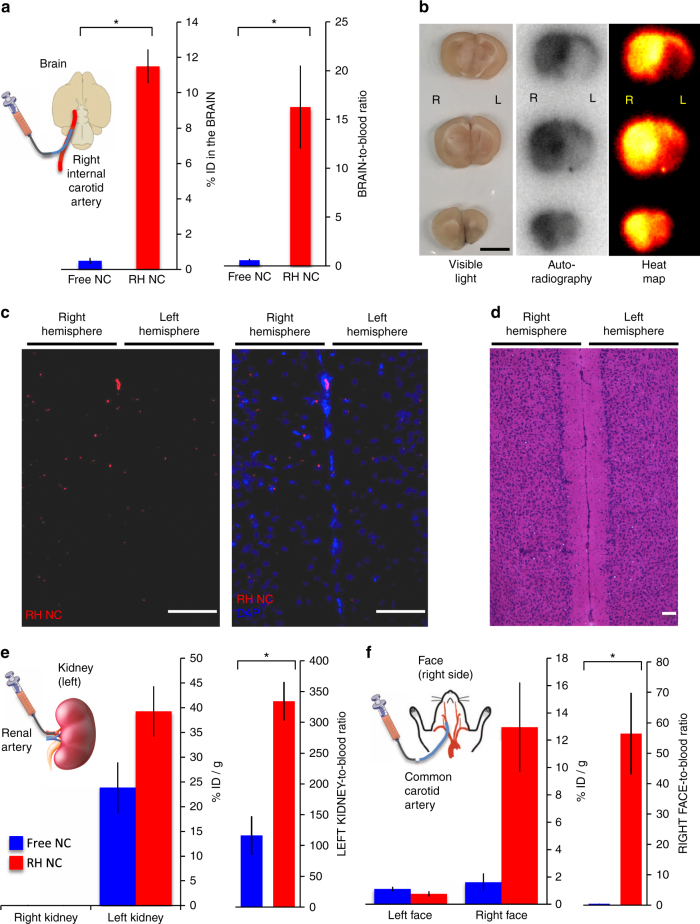
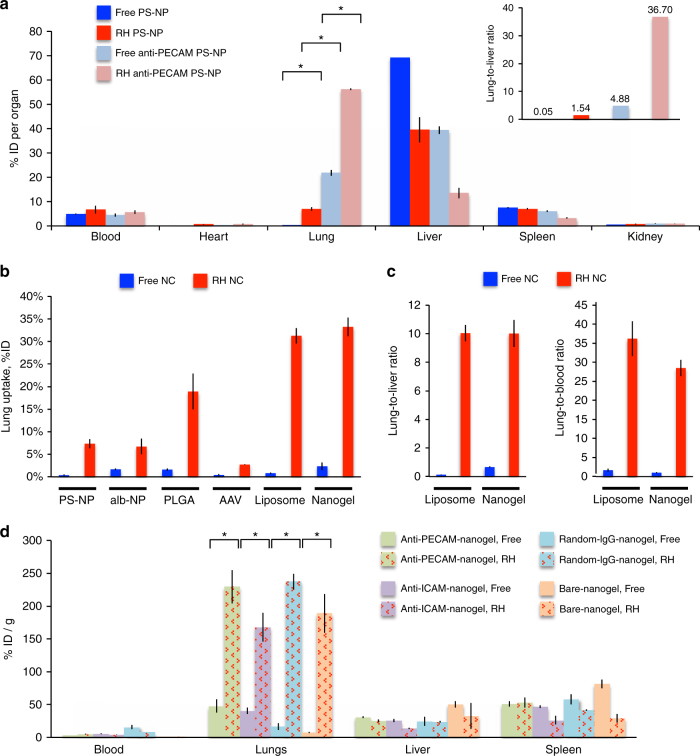
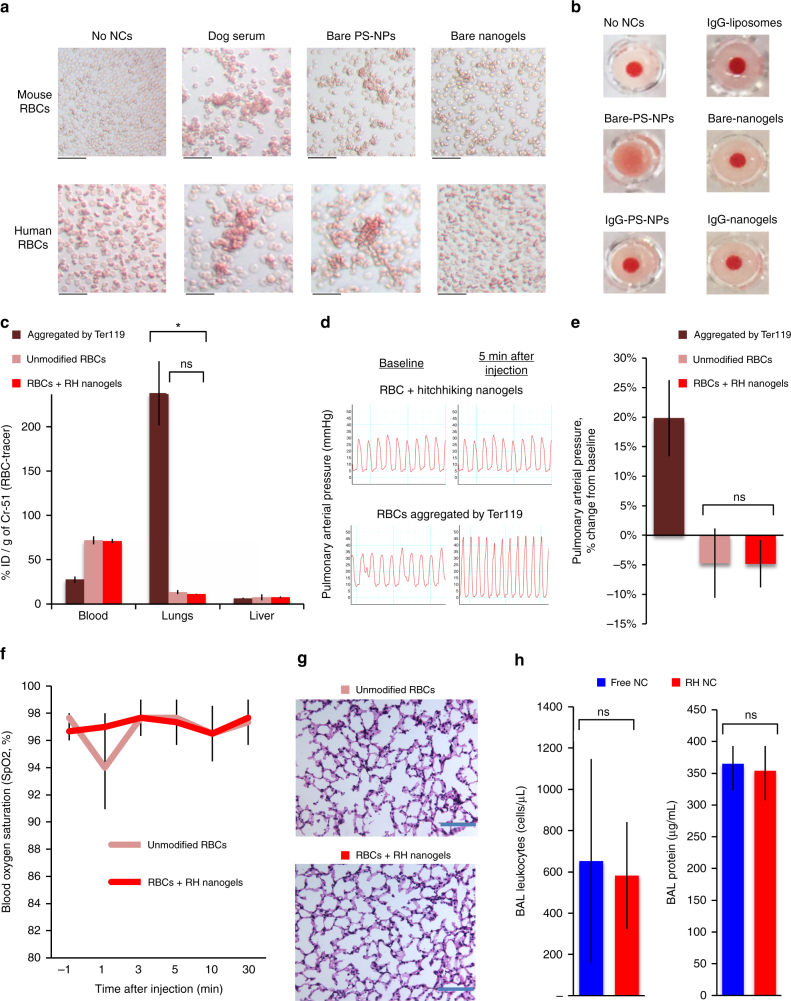
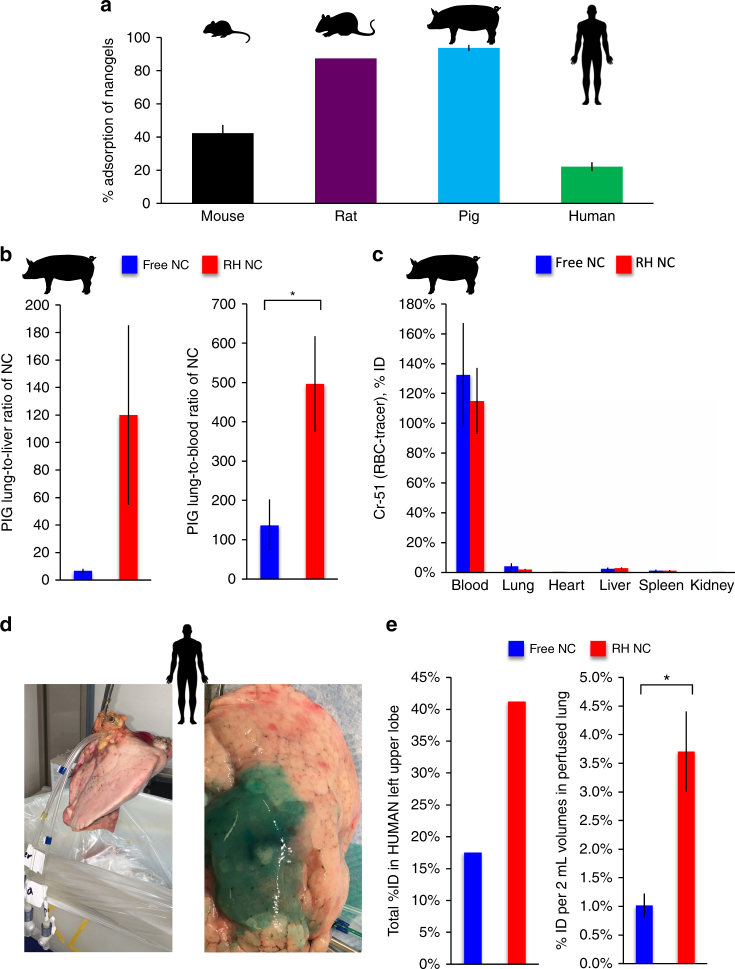
Drug delivery by nanocarriers (NCs) has long been stymied by dominant liver uptake and limited target organ deposition, even when NCs are targeted using affinity moieties. Here we report a universal solution: red blood cell (RBC)-hitchhiking (RH), in which NCs adsorbed onto the RBCs transfer from RBCs to the first organ downstream of the intravascular injection. RH improves delivery for a wide range of NCs and even viral vectors. For example, RH injected intravenously increases liposome uptake in the first downstream organ, lungs, by ~40-fold compared with free NCs. Intra-carotid artery injection of RH NCs delivers >10% of the injected NC dose to the brain, ~10× higher than that achieved with affinity moieties. Further, RH works in mice, pigs, and ex vivo human lungs without causing RBC or end-organ toxicities. Thus, RH is a clinically translatable platform technology poised to augment drug delivery in acute lung disease, stroke, and several other diseases.

摘要

纳米载体(NCs)的药物递送长期以来一直受到肝脏摄取和有限的靶器官沉积的阻碍,即使使用亲和部分对 NCs 进行靶向。在这里,我们报告了一个通用的解决方案:红细胞(RBC)搭便车(RH),其中吸附在 RBC 上的 NC 从 RBC 转移到血管内注射后的第一个下游器官。RH 提高了广泛的 NC 甚至病毒载体的递送效率。例如,与游离 NC 相比,静脉内注射 RH 脂质体可使肺部等第一个下游器官的脂质体摄取增加约 40 倍。颈动脉内注射 RH-NC 可将超过 10%的注射 NC 剂量递送到大脑,比使用亲和部分实现的水平高约 10 倍。此外,RH 在小鼠、猪和离体人肺中均有效,而不会引起 RBC 或终末器官毒性。因此,RH 是一种具有临床转化潜力的平台技术,有望增强急性肺疾病、中风和其他几种疾病的药物递送。
https://cdn.ncbi.nlm.nih.gov/pmc/blobs/86bf/6041332/8786484250d0/41467_2018_5079_Fig7_HTML.jpg
https://cdn.ncbi.nlm.nih.gov/pmc/blobs/86bf/6041332/4479dd2eb9d6/41467_2018_5079_Fig1_HTML.jpg
https://cdn.ncbi.nlm.nih.gov/pmc/blobs/86bf/6041332/37e02a622184/41467_2018_5079_Fig2_HTML.jpg
https://cdn.ncbi.nlm.nih.gov/pmc/blobs/86bf/6041332/fd19bdddb617/41467_2018_5079_Fig3_HTML.jpg
https://cdn.ncbi.nlm.nih.gov/pmc/blobs/86bf/6041332/159d3de630f6/41467_2018_5079_Fig4_HTML.jpg
https://cdn.ncbi.nlm.nih.gov/pmc/blobs/86bf/6041332/8881909d57a0/41467_2018_5079_Fig5_HTML.jpg
https://cdn.ncbi.nlm.nih.gov/pmc/blobs/86bf/6041332/ca03ddb1c2d8/41467_2018_5079_Fig6_HTML.jpg
https://cdn.ncbi.nlm.nih.gov/pmc/blobs/86bf/6041332/8786484250d0/41467_2018_5079_Fig7_HTML.jpg
https://cdn.ncbi.nlm.nih.gov/pmc/blobs/86bf/6041332/4479dd2eb9d6/41467_2018_5079_Fig1_HTML.jpg
https://cdn.ncbi.nlm.nih.gov/pmc/blobs/86bf/6041332/37e02a622184/41467_2018_5079_Fig2_HTML.jpg
https://cdn.ncbi.nlm.nih.gov/pmc/blobs/86bf/6041332/fd19bdddb617/41467_2018_5079_Fig3_HTML.jpg
https://cdn.ncbi.nlm.nih.gov/pmc/blobs/86bf/6041332/159d3de630f6/41467_2018_5079_Fig4_HTML.jpg
https://cdn.ncbi.nlm.nih.gov/pmc/blobs/86bf/6041332/8881909d57a0/41467_2018_5079_Fig5_HTML.jpg
https://cdn.ncbi.nlm.nih.gov/pmc/blobs/86bf/6041332/ca03ddb1c2d8/41467_2018_5079_Fig6_HTML.jpg
https://cdn.ncbi.nlm.nih.gov/pmc/blobs/86bf/6041332/8786484250d0/41467_2018_5079_Fig7_HTML.jpg

相似文献

1
Red blood cell-hitchhiking boosts delivery of nanocarriers to chosen organs by orders of magnitude.红细胞“搭便车”可将纳米载体递送至目标器官,效率提高数个数量级。
Nat Commun. 2018 Jul 11;9(1):2684. doi: 10.1038/s41467-018-05079-7.
2
Red Blood Cell Hitchhiking: A Novel Approach for Vascular Delivery of Nanocarriers.红细胞搭乘:一种新型纳米载体血管递药方法。
Annu Rev Biomed Eng. 2021 Jul 13;23:225-248. doi: 10.1146/annurev-bioeng-121219-024239. Epub 2021 Mar 31.
3
Dual Affinity to RBCs and Target Cells (DART) Enhances Both Organ- and Cell Type-Targeting of Intravascular Nanocarriers.双重亲和性红细胞和靶细胞(DART)增强了血管内纳米载体对器官和细胞类型的靶向性。
ACS Nano. 2022 Mar 22;16(3):4666-4683. doi: 10.1021/acsnano.1c11374. Epub 2022 Mar 10.
4
Delivering nanoparticles to lungs while avoiding liver and spleen through adsorption on red blood cells.通过吸附在红细胞上,将纳米颗粒输送到肺部,同时避免肝脏和脾脏摄取。
ACS Nano. 2013 Dec 23;7(12):11129-37. doi: 10.1021/nn404853z. Epub 2013 Nov 12.
5
A numerical study on drug delivery multiscale synergy of cellular hitchhiking onto red blood cells.药物输送的数值研究——细胞搭便车进入红细胞的多尺度协同作用。
Nanoscale. 2021 Oct 28;13(41):17359-17372. doi: 10.1039/d1nr04057j.
6
Nanoparticle-based drug delivery via RBC-hitchhiking for the inhibition of lung metastases growth.基于纳米颗粒的药物输送通过 RBC 搭便车抑制肺转移生长。
Nanoscale. 2019 Jan 23;11(4):1636-1646. doi: 10.1039/c8nr07730d.
7
Red Blood Cell-Hitchhiking Delivery of Simvastatin to Relieve Acute Respiratory Distress Syndrome.红细胞搭便车递送辛伐他汀缓解急性呼吸窘迫综合征。
Int J Nanomedicine. 2024 Jun 6;19:5317-5333. doi: 10.2147/IJN.S460890. eCollection 2024.
8
Mechanisms that determine nanocarrier targeting to healthy versus inflamed lung regions.决定纳米载体靶向健康肺区与炎症肺区的机制。
Nanomedicine. 2017 May;13(4):1495-1506. doi: 10.1016/j.nano.2016.12.019. Epub 2017 Jan 5.
9
Red blood cells: The metamorphosis of a neglected carrier into the natural mothership for artificial nanocarriers.红细胞:一个被忽视的载体向人工纳米载体天然母舰的蜕变。
Adv Drug Deliv Rev. 2021 Nov;178:113992. doi: 10.1016/j.addr.2021.113992. Epub 2021 Sep 29.
10
Red Blood Cells-Derived Vesicles for Delivery of Lipophilic Drug Camptothecin.红细胞衍生囊泡递送脂溶性药物喜树碱。
ACS Appl Mater Interfaces. 2019 Jun 26;11(25):22141-22151. doi: 10.1021/acsami.9b04827. Epub 2019 Jun 12.

引用本文的文献

1
Innovative nanocarriers: Synthetic and biomimetic strategies for enhanced drug delivery.创新纳米载体:用于增强药物递送的合成与仿生策略
Mater Today Bio. 2025 Aug 8;34:102180. doi: 10.1016/j.mtbio.2025.102180. eCollection 2025 Oct.
2
Recent Progress in Nano-TCM Active Ingredient Co-Delivery Systems for Inflammation-Mediated Diseases.用于炎症介导疾病的纳米中药活性成分共递送系统的最新进展
Int J Nanomedicine. 2025 Aug 2;20:9573-9596. doi: 10.2147/IJN.S526731. eCollection 2025.
3
Glyco Ionic Liquids as Novel Nanoparticle Coatings to Enhance Triple-Negative Breast Cancer Drug Delivery.

本文引用的文献

1
Nanoparticle Properties Modulate Their Attachment and Effect on Carrier Red Blood Cells.纳米颗粒性质调节其对载体红细胞的附着和作用。
Sci Rep. 2018 Jan 25;8(1):1615. doi: 10.1038/s41598-018-19897-8.
2
Regulation and function of endothelial glycocalyx layer in vascular diseases.血管疾病中内皮糖萼层的调节和功能。
Vascul Pharmacol. 2018 Jan;100:26-33. doi: 10.1016/j.vph.2017.09.002. Epub 2017 Sep 12.
3
Comparative efficacy and safety of reperfusion therapy with fibrinolytic agents in patients with ST-segment elevation myocardial infarction: a systematic review and network meta-analysis.
糖离子液体作为新型纳米颗粒涂层用于增强三阴性乳腺癌药物递送
Adv Healthc Mater. 2025 Jul 9:e2500592. doi: 10.1002/adhm.202500592.
4
Bottom-up Biomaterial strategies for creating tailored stem cells in regenerative medicine.用于在再生医学中创建定制干细胞的自下而上生物材料策略。
Front Bioeng Biotechnol. 2025 May 20;13:1581292. doi: 10.3389/fbioe.2025.1581292. eCollection 2025.
5
Erythrocytes enhance oxygen-carrying capacity through self-regulation.红细胞通过自我调节增强携氧能力。
Front Physiol. 2025 May 16;16:1592176. doi: 10.3389/fphys.2025.1592176. eCollection 2025.
6
Targeted Drug Delivery to the Spleen and Its Implications for the Prevention and Treatment of Cancer.靶向药物输送至脾脏及其对癌症预防和治疗的意义。
Pharmaceutics. 2025 May 15;17(5):651. doi: 10.3390/pharmaceutics17050651.
7
Cellular determinants influence the red blood cell adsorption efficiency of poly(amine--ester) nanoparticles.细胞决定因素影响聚(胺 - 酯)纳米颗粒对红细胞的吸附效率。
Sci Adv. 2025 May 2;11(18):eadt8637. doi: 10.1126/sciadv.adt8637.
8
Targeted delivery of IL-21 neutralizing nanotherapeutics to lymph nodes and kidney allografts attenuates B cell alloimmunity.将白细胞介素-21中和纳米疗法靶向递送至淋巴结和肾脏同种异体移植物可减弱B细胞同种免疫。
Kidney Int. 2025 Jul;108(1):48-56. doi: 10.1016/j.kint.2025.03.017. Epub 2025 Apr 21.
9
State of the Art in Actuation of Micro/Nanorobots for Biomedical Applications.用于生物医学应用的微纳机器人驱动技术的现状
Small Sci. 2024 Feb 2;4(3):2300211. doi: 10.1002/smsc.202300211. eCollection 2024 Mar.
10
Tumor Microenvironment Triggered In Situ Coagulation of Supramolecularly Engineered Platelets for Precise Tumor Embolization.肿瘤微环境触发超分子工程血小板原位凝血以实现精确肿瘤栓塞
Adv Sci (Weinh). 2025 Jul;12(26):e2414879. doi: 10.1002/advs.202414879. Epub 2025 Apr 7.
溶栓药物再灌注治疗 ST 段抬高型心肌梗死患者的疗效和安全性比较:系统评价和网络荟萃分析。
Lancet. 2017 Aug 19;390(10096):747-759. doi: 10.1016/S0140-6736(17)31441-1.
4
Protein nanocages that penetrate airway mucus and tumor tissue.能够穿透气道黏液和肿瘤组织的蛋白质纳米笼。
Proc Natl Acad Sci U S A. 2017 Aug 8;114(32):E6595-E6602. doi: 10.1073/pnas.1705407114. Epub 2017 Jul 24.
5
Strategies to enhance the distribution of nanotherapeutics in the brain.增强纳米药物在脑部分布的策略。
J Control Release. 2017 Dec 10;267:232-239. doi: 10.1016/j.jconrel.2017.07.028. Epub 2017 Jul 21.
6
Surface chemistry governs cellular tropism of nanoparticles in the brain.表面化学决定了纳米颗粒在大脑中的细胞趋向性。
Nat Commun. 2017 May 19;8:15322. doi: 10.1038/ncomms15322.
7
Mechanisms that determine nanocarrier targeting to healthy versus inflamed lung regions.决定纳米载体靶向健康肺区与炎症肺区的机制。
Nanomedicine. 2017 May;13(4):1495-1506. doi: 10.1016/j.nano.2016.12.019. Epub 2017 Jan 5.
8
Improved i.p. drug delivery with bioadhesive nanoparticles.利用生物粘附性纳米颗粒改进腹腔内给药
Proc Natl Acad Sci U S A. 2016 Oct 11;113(41):11453-11458. doi: 10.1073/pnas.1523141113. Epub 2016 Sep 23.
9
Myocardial ischaemia reperfusion injury: the challenge of translating ischaemic and anaesthetic protection from animal models to humans.心肌缺血再灌注损伤:将缺血和麻醉保护从动物模型转化到人类的挑战。
Br J Anaesth. 2016 Sep;117 Suppl 2:ii44-ii62. doi: 10.1093/bja/aew267.
10
Neuroprotection in acute stroke: targeting excitotoxicity, oxidative and nitrosative stress, and inflammation.急性脑卒中的神经保护:靶向兴奋性毒性、氧化应激和硝化应激以及炎症。
Lancet Neurol. 2016 Jul;15(8):869-881. doi: 10.1016/S1474-4422(16)00114-9. Epub 2016 May 11.