Zhou Hai-Hong, Shu Bo, Liu Tong-Zu, Wang Xing-Huan, Yang Zhong-Hua, Guo Yong-Lian
Department of Urology, Wuhan Central Hospital, Tongji Medical University, Huazhong University of Science and Technology Department of Urology, Zhongnan Hospital of Wuhan University, Wuhan University, Wuhan, China.
Medicine (Baltimore). 2018 Jul;97(28):e11443. doi: 10.1097/MD.0000000000011443.
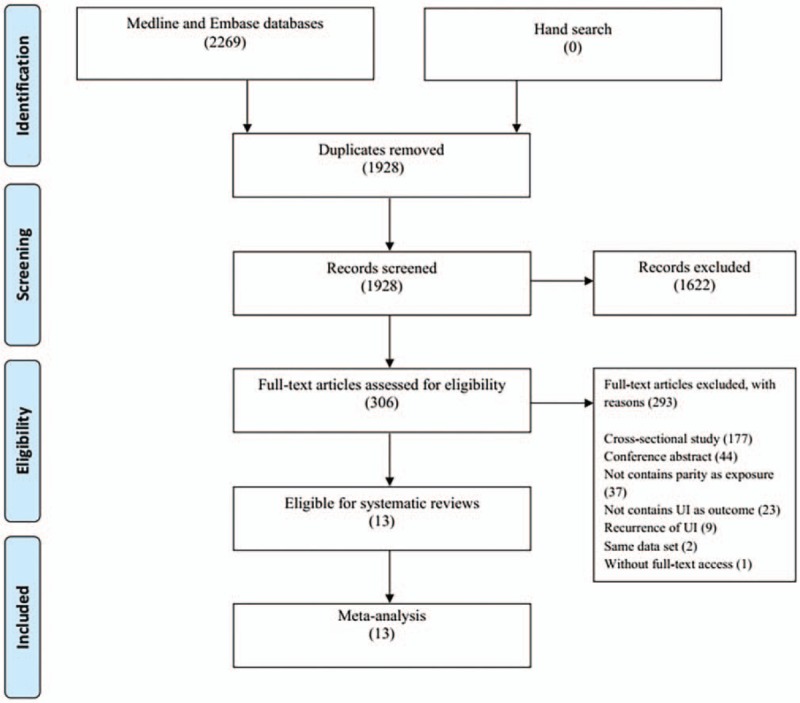
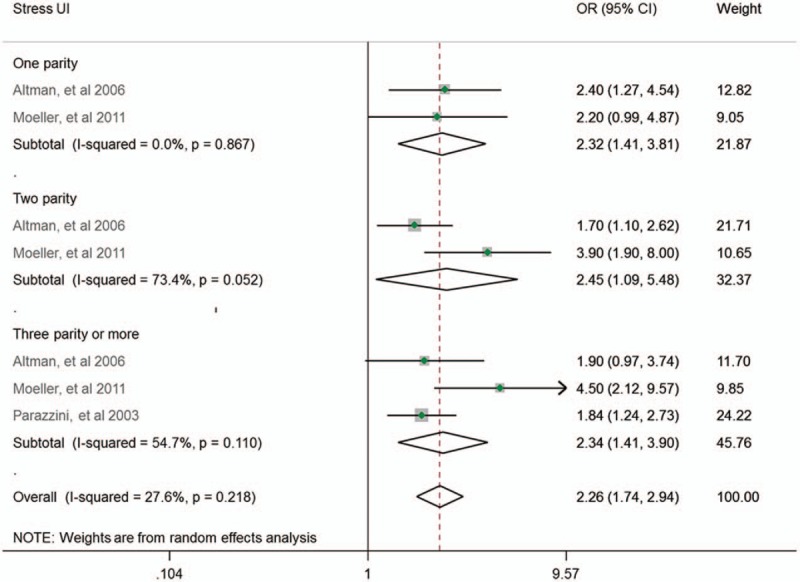
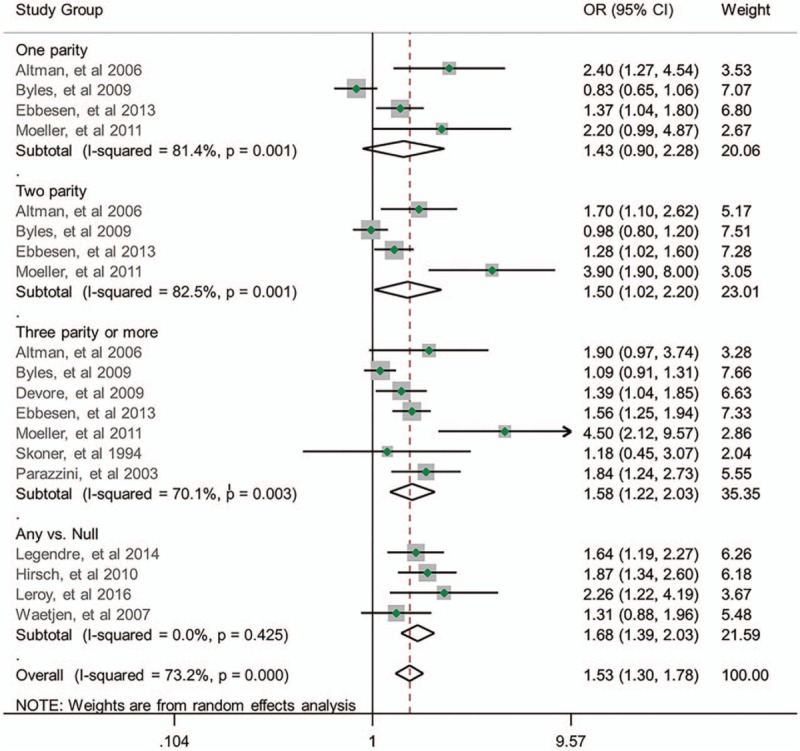
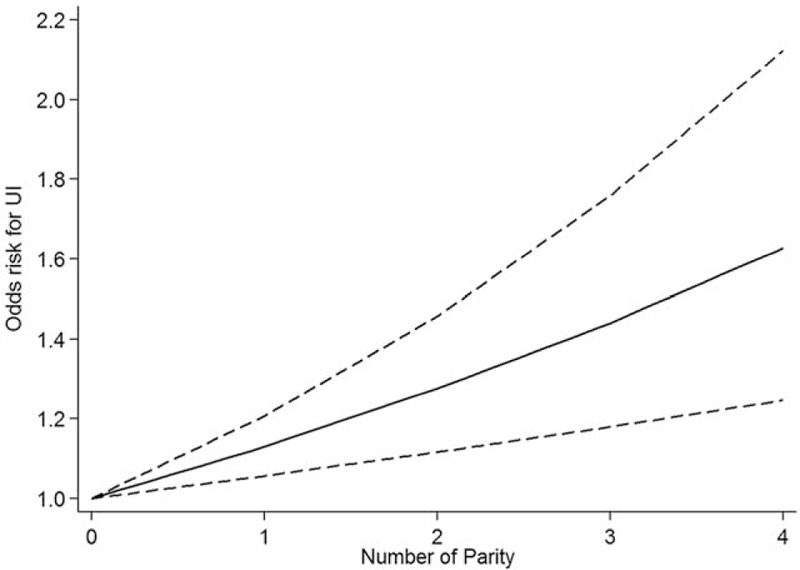
Urinary incontinence (UI) is a common complaint for adult female. Cross-sectional studies suggested parity may link with UI, but the association between them was not well-established. We conducted a meta-analysis to investigate the association between parity and UI.Medline and Embase were searched for eligible case-control and cohort studies about parity and UI. Two authors screened the literature and extracted the data independently. Odds ratio (OR) was used as the measure of the effect of parity on UI. We pooled the ORs of different number of parity by a random-effect model. Subgroup analysis was conducted by a subtype of UI. Sensitivity analysis was conducted to see whether the results were stable.Thirteen studies (8 cohorts and 5 case-controls) were included in our meta-analysis, with a total of 74,883 adult females. Our meta-analysis showed that compared with nulliparity, ORs of women with 1, 2, and ≥3 parity were 1.43 [95% confidence interval (95% CI): 0.90-2.28; I = 81.4%; n = 4], 1.50 (95% CI: 1.02-2.20; I = 82.5%; n = 4), and 1.58 (95% CI: 1.22-2.03; I = 70.1%; n = 7) compared with nulliparity. The OR for any multiparity to nulliparity was 1.68 (95% CI: 1.39-2.03; I = 0%; n = 4). Subgroup analysis showed that parity was associated with an increased risk of stress UI (OR = 2.32, 95% CI: 1.41-3.81; I = 0%; n = 2; 1 compared with null parity) but not urgent UI; However, the definition of parity varies across studies and studies defined parity as delivery times showed higher pooled OR than those not. Sensitivity analysis showed our results were stable.Current evidence suggested that parity was associated with an increased risk of overall and stress UI but not urgency UI, though the definition of parity may differ. Higher parity may have a more significant effect on overall UI. Standardized definition of parity is needed.
尿失禁(UI)是成年女性的常见问题。横断面研究表明生育情况可能与尿失禁有关,但二者之间的关联尚未完全明确。我们进行了一项荟萃分析,以研究生育情况与尿失禁之间的关联。
我们在Medline和Embase数据库中检索了关于生育情况和尿失禁的合格病例对照研究及队列研究。两位作者独立筛选文献并提取数据。采用比值比(OR)作为衡量生育情况对尿失禁影响的指标。我们通过随机效应模型汇总不同生育次数的OR值。按尿失禁亚型进行亚组分析。进行敏感性分析以查看结果是否稳定。
我们的荟萃分析纳入了13项研究(8项队列研究和5项病例对照研究),共74,883名成年女性。我们的荟萃分析表明,与未生育相比,生育1次、2次和≥3次的女性的OR值分别为1.43 [95%置信区间(95%CI):0.90 - 2.28;I = 81.4%;n = 4]、1.50(95%CI:1.02 - 2.20;I = 82.5%;n = 4)和1.58(95%CI:1.22 - 2.03;I = 70.1%;n = 7)。任何多胎生育与未生育相比的OR值为1.68(95%CI:1.39 - 2.03;I = 0%;n = 4)。亚组分析表明,生育情况与压力性尿失禁风险增加相关(OR = 2.32,95%CI:1.41 - 3.81;I = 0%;n = 2;与未生育相比为1次生育),但与急迫性尿失禁无关;然而,不同研究中生育情况的定义各不相同,将生育情况定义为分娩次数的研究显示汇总的OR值高于未如此定义的研究。敏感性分析表明我们的结果是稳定的。
目前的证据表明,尽管生育情况的定义可能不同,但生育情况与总体及压力性尿失禁风险增加相关,与急迫性尿失禁无关。较高的生育次数可能对总体尿失禁有更显著的影响。需要对生育情况进行标准化定义。