Cariou Marie, Ribière Céline, Morlière Stéphanie, Gauthier Jean-Pierre, Simon Jean-Christophe, Peyret Pierre, Charlat Sylvain
Laboratoire de Biométrie et Biologie Evolutive, CNRS, UMR 5558, Université de Lyon, Université Lyon 1, 43 Boulevard du 11 novembre 1918, 69622, Villeurbanne, France.
Department of Biology, University of Namur, Rue de Bruxelles 61, 5000, Namur, Belgium.
BMC Res Notes. 2018 Jul 11;11(1):461. doi: 10.1186/s13104-018-3559-3.
Targeted sequencing of 16S rDNA amplicons is routinely used for microbial community profiling but this method suffers several limitations such as bias affinity of universal primers and short read size. Gene capture by hybridization represents a promising alternative. Here we used a metagenomic extract from the pea aphid Acyrthosiphon pisum to compare the performances of two widely used PCR primer pairs with DNA capture, based on solution hybrid selection.
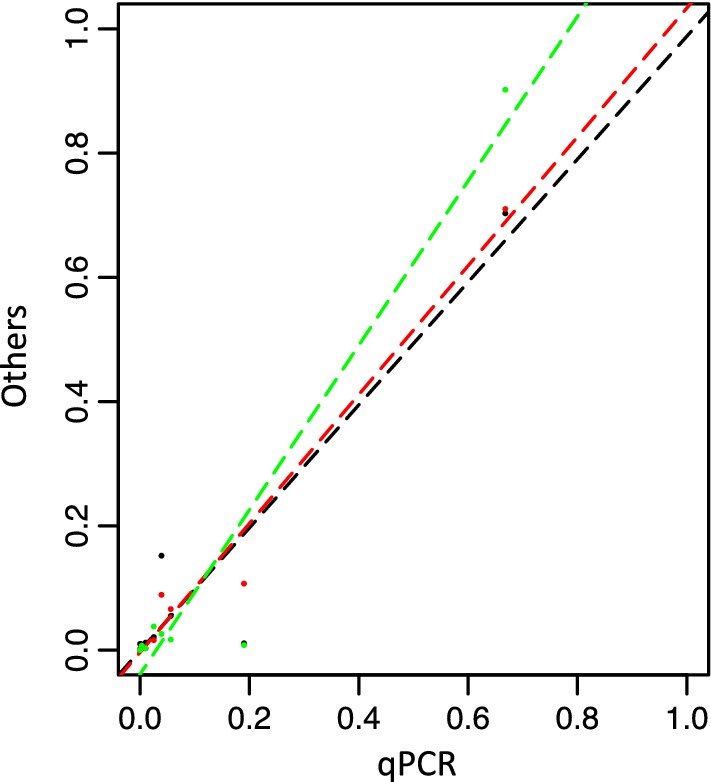
All methods produced an exhaustive description of the 8 bacterial taxa known to be present in this sample. In addition, the methods yielded similar quantitative results, with the number of reads strongly correlating with quantitative PCR controls. Both methods can thus be considered as qualitatively and quantitatively robust on such a sample with low microbial complexity.
16S rDNA扩增子的靶向测序常用于微生物群落分析,但该方法存在一些局限性,如通用引物的偏倚亲和力和短读长。杂交基因捕获是一种很有前景的替代方法。在这里,我们使用豌豆蚜(Acyrthosiphon pisum)的宏基因组提取物,基于溶液杂交选择,比较两种广泛使用的PCR引物对与DNA捕获的性能。
所有方法都对该样本中已知存在的8个细菌类群进行了详尽的描述。此外,这些方法产生了相似的定量结果,读数数量与定量PCR对照密切相关。因此,在这种微生物复杂性较低的样本上,这两种方法在定性和定量方面都可被认为是可靠的。