State Key Laboratory of Veterinary Etiological Biology, OIE/National Foot and Mouth Disease Reference Laboratory, Key Laboratory of Animal Virology of Ministry of Agriculture, Lanzhou Veterinary Research Institute, Chinese Academy of Agricultural Sciences, Lanzhou 730046, China.
College of Veterinary Medicine, Gansu Agricultural University, Lanzhou 730070, China.
Viruses. 2018 Jul 11;10(7):364. doi: 10.3390/v10070364.
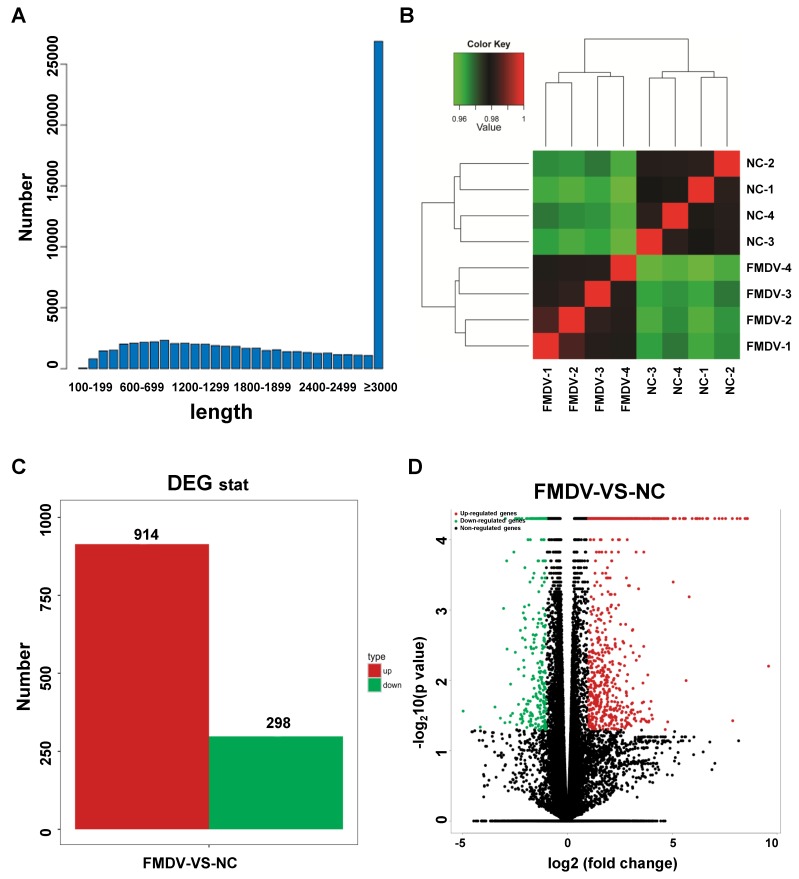
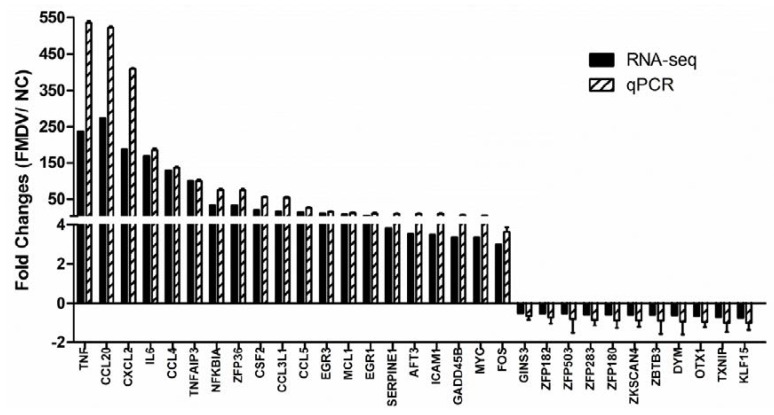
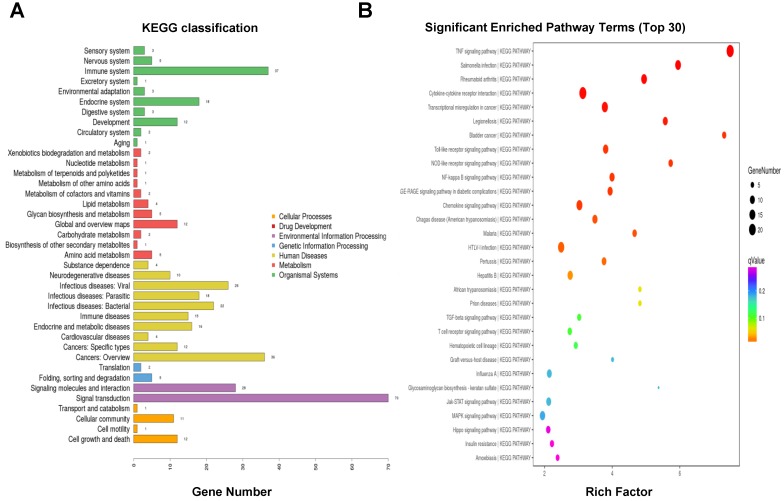
Foot-and-mouth disease (FMD) is a highly contagious disease that results in enormous economic loses worldwide. Although the protection provided by vaccination is limited during early infection, it is recognized as the best method to prevent FMD outbreaks. Furthermore, the mechanism of host early responses against foot-and-mouth disease virus (FMDV) infection remains unclear. In our study, a pig kidney cell line (PK-15) was used as a cell model to reveal the mechanism of early pig responses to FMDV infection. Four non-treated control and four FMDV-treated PK-15 cells were sequenced with RNA-seq technology, and the differentially expressed genes (DEGs) were analyzed. The results showed that 1212 DEGs were in the FMDV-infected PK-15 cells, including 914 up-regulated and 298 down-regulated genes. Kyoto Encyclopedia of Genes and Genomes (KEGG) pathways were significantly enriched in the tumor necrosis factor (TNF), cytokine-cytokine receptor interaction, NOD-like receptor, toll-like receptor, NF-κB, and the chemokine signaling pathways. To verify the results of the DEGs, 30 immune-related DEGs (19 up-regulated and 11 down-regulated) were selected for Quantitative Reverse Transcriptase polymerase chain reaction (RT-qPCR) verification. The results showed that RT-qPCR-measured genes exhibited a similar pattern as the RNA-seq analyses. Based on bioinformatics analysis, during FMDV early infection, we found that a series of cytokines, such as interleukins (IL6), chemokines (CXCL2, CCL20 and CCL4), and transcription factors (ZFP36, FOS, NFKBIA, ZBTB3, ZNF503, ZNF283, dymeclin (DYM), and orthodenticle homeobox 1 (OTX1)) were involved in the battle between FMDV and the host. Combined with their features and functions, we propose inflammation as the main early mechanism by which the host responds to FMDV infection. These data provide an additional panel of candidate genes for deciphering the mechanisms of a host's early response against FMDV infection.
口蹄疫(FMD)是一种高度传染性疾病,在全球范围内造成了巨大的经济损失。虽然疫苗接种提供的保护在早期感染时有限,但它被认为是预防 FMD 爆发的最佳方法。此外,宿主对口蹄疫病毒(FMDV)感染的早期反应机制尚不清楚。在我们的研究中,使用猪肾细胞系(PK-15)作为细胞模型来揭示宿主对 FMDV 感染的早期反应机制。用 RNA-seq 技术对 4 个未经处理的对照和 4 个 FMDV 处理的 PK-15 细胞进行测序,并分析差异表达基因(DEGs)。结果表明,在 FMDV 感染的 PK-15 细胞中,有 1212 个 DEGs,其中 914 个上调,298 个下调。肿瘤坏死因子(TNF)、细胞因子-细胞因子受体相互作用、NOD 样受体、Toll 样受体、NF-κB 和趋化因子信号通路在京都基因与基因组百科全书(KEGG)途径中显著富集。为了验证 DEGs 的结果,选择了 30 个免疫相关的 DEGs(19 个上调和 11 个下调)进行定量逆转录聚合酶链反应(RT-qPCR)验证。结果表明,RT-qPCR 测量的基因与 RNA-seq 分析表现出相似的模式。基于生物信息学分析,在 FMDV 早期感染过程中,我们发现一系列细胞因子,如白细胞介素(IL6)、趋化因子(CXCL2、CCL20 和 CCL4)和转录因子(ZFP36、FOS、NFKBIA、ZBTB3、ZNF503、ZNF283、dymeclin(DYM)和同源盒基因 1(OTX1))参与了 FMDV 与宿主之间的斗争。结合它们的特征和功能,我们提出炎症是宿主对 FMDV 感染早期反应的主要机制。这些数据为破译宿主对 FMDV 感染的早期反应机制提供了一个额外的候选基因面板。