Cléry Justine, Hamed Suliann Ben
UMR5229, Institut des Sciences Cognitives Marc Jeannerod, CNRS-Université Claude Bernard Lyon I, Bron, France.
Front Psychol. 2018 Jun 27;9:1073. doi: 10.3389/fpsyg.2018.01073. eCollection 2018.
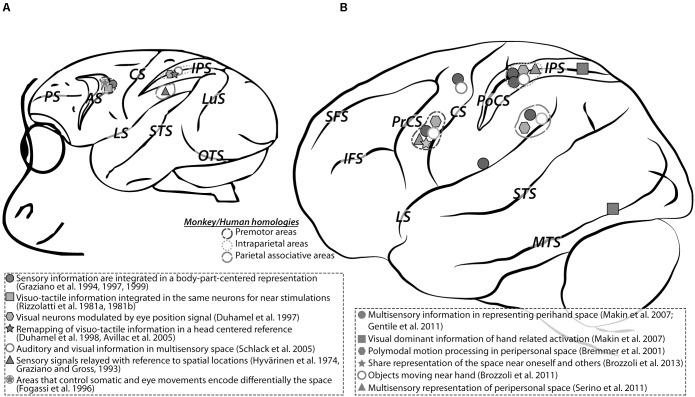
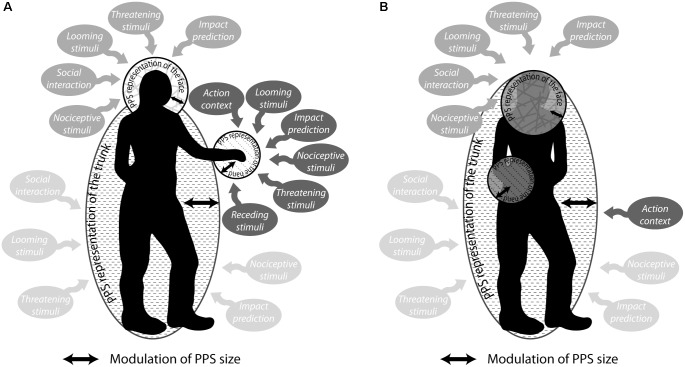
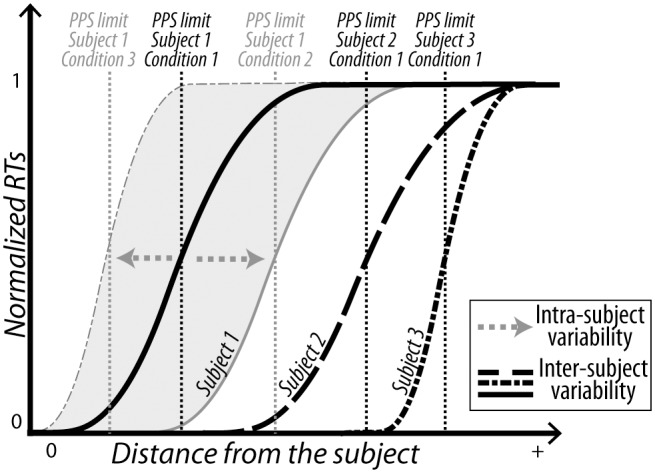
The construction of a coherent representation of our body and the mapping of the space immediately surrounding it are of the highest ecological importance. This space has at least three specificities: it is a space where actions are planned in order to interact with our environment; it is a space that contributes to the experience of self and self-boundaries, through tactile processing and multisensory interactions; last, it is a space that contributes to the experience of body integrity against external events. In the last decades, numerous studies have been interested in peripersonal space (PPS), defined as the space directly surrounding us and which we can interact with (for reviews, see Cléry et al., 2015b; de Vignemont and Iannetti, 2015; di Pellegrino and Làdavas, 2015). These studies have contributed to the understanding of how this space is constructed, encoded and modulated. The majority of these studies focused on subparts of PPS (the hand, the face or the trunk) and very few of them investigated the interaction between PPS subparts. In the present review, we summarize the latest advances in this research and we discuss the new perspectives that are set forth for futures investigations on this topic. We describe the most recent methods used to estimate PPS boundaries by the means of dynamic stimuli. We then highlight how impact prediction and approaching stimuli modulate this space by social, emotional and action-related components involving principally a parieto-frontal network. In a next step, we review evidence that there is not a unique representation of PPS but at least three sub-sections (hand, face and trunk PPS). Last, we discuss how these subspaces interact, and we question whether and how bodily self-consciousness (BSC) is functionally and behaviorally linked to PPS.
构建关于我们身体的连贯表征以及描绘紧邻身体的空间,具有极高的生态重要性。这个空间至少有三个特性:它是一个用于规划行动以便与我们的环境进行交互的空间;它是一个通过触觉处理和多感官交互来促成自我及自我边界体验的空间;最后,它是一个有助于抵御外部事件维持身体完整性体验的空间。在过去几十年里,众多研究关注了个人周边空间(PPS),即直接环绕我们且我们能够与之交互的空间(综述见Cléry等人,2015b;de Vignemont和Iannetti,2015;di Pellegrino和Làdavas,2015)。这些研究有助于理解这个空间是如何构建、编码和调制的。这些研究大多聚焦于PPS的子部分(手、脸或躯干),很少有研究探究PPS各子部分之间的相互作用。在本综述中,我们总结了该研究的最新进展,并讨论了针对此主题未来研究提出的新观点。我们描述了通过动态刺激手段估计PPS边界所使用的最新方法。然后我们强调了影响预测和接近刺激如何通过主要涉及顶叶 - 额叶网络的社会、情感和与行动相关的成分来调制这个空间。接下来,我们回顾证据表明不存在PPS的单一表征,而是至少有三个子部分(手部、面部和躯干PPS)。最后,我们讨论这些子空间如何相互作用,并质疑身体自我意识(BSC)是否以及如何在功能和行为上与PPS相关联。