Dicus Jeremy R, Holmstrup Michael E, Shuler Kyle T, Rice Tyler T, Raybuck Shawn D, Siddons Chelsea A
Department of Exercise and Rehabilitative Sciences, Slippery Rock University, Slippery Rock, PA, USA.
Int J Exerc Sci. 2018 Jun 1;11(1):708-716. doi: 10.70252/CUDK5288. eCollection 2018.
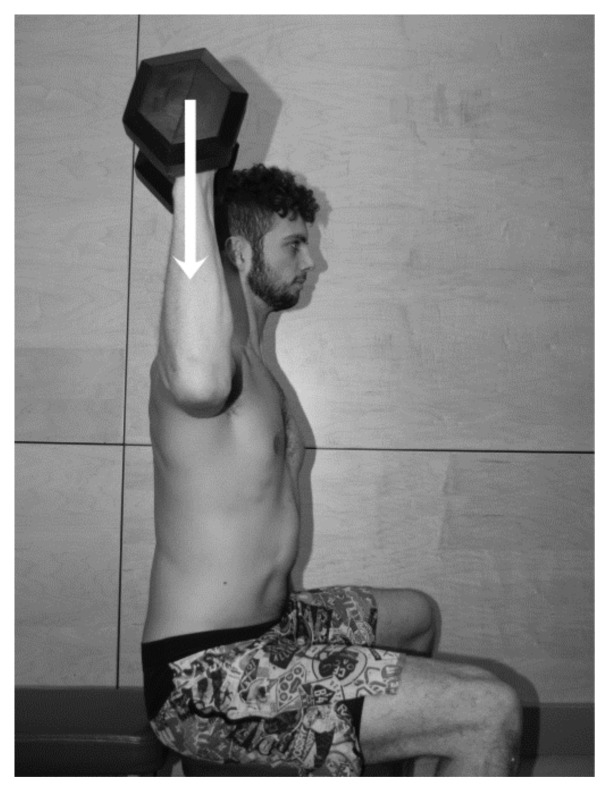
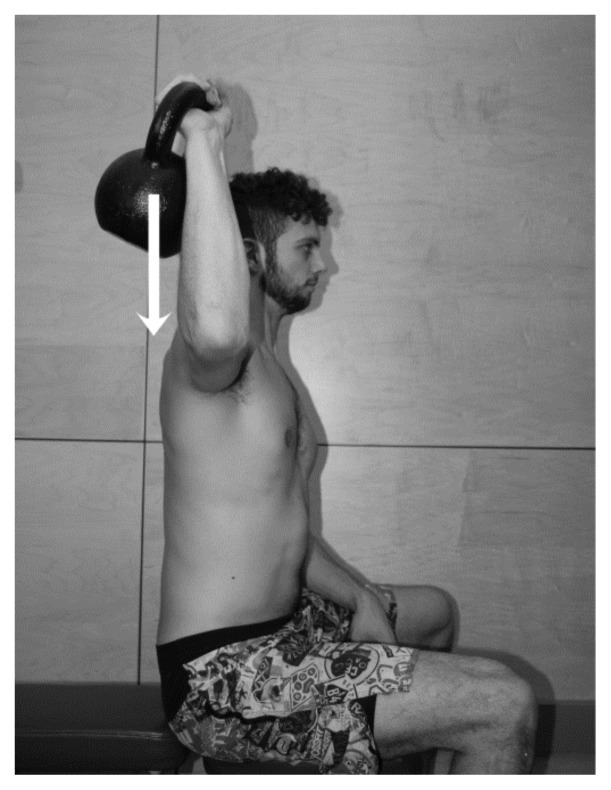
Kettlebells often replace dumbbells during common resistance training exercises such as the overhead press. When performing an overhead press, the center of mass of a dumbbell is in line with the glenohumeral joint. In comparison, the center of mass of the kettlebell is posterior to the glenohumeral joint. Posterior displacement of the kettlebell center of mass may result in less stability during the pressing motion. The purpose of this study was to examine muscle activity during an overhead press with resistance training implements of differing stability. Surface electromyography (EMG) for the anterior deltoid and pectoralis major was analyzed for 21 subjects. Technique and pace of the overhead press were standardized and monitored. Filtered EMG data were collected, normalized, and average peak amplitude as a percentage of MVIC was calculated for each repetition. A repeated-measures analysis of variance was used to compare EMG values for the anterior deltoid and pectoralis major across implements. A statistically significant increase in normalized EMG activity ( < .05) was identified in the anterior deltoid when using the dumbbell (63.3±13.3%) compared to the kettlebell (57.9±15.0%). In this study, EMG activity was augmented in the anterior deltoid when using the more stable implement, the dumbbell.
在诸如推举等常见的阻力训练练习中,壶铃常常会取代哑铃。进行推举时,哑铃的质心与盂肱关节在一条直线上。相比之下,壶铃的质心在盂肱关节后方。壶铃质心的后移可能会导致推举动作时稳定性降低。本研究的目的是检查使用稳定性不同的阻力训练器械进行推举时的肌肉活动情况。对21名受试者的三角肌前束和胸大肌进行了表面肌电图(EMG)分析。推举的技术和节奏进行了标准化并加以监测。收集滤波后的肌电图数据,进行归一化处理,并计算每次重复动作时平均峰值幅度占最大随意等长收缩(MVIC)的百分比。采用重复测量方差分析来比较不同器械上三角肌前束和胸大肌的肌电图值。与使用壶铃(57.9±15.0%)相比,使用哑铃时三角肌前束的归一化肌电图活动有统计学意义的增加(<.05)(63.3±13.3%)。在本研究中,使用更稳定的器械哑铃时,三角肌前束的肌电图活动增强。